

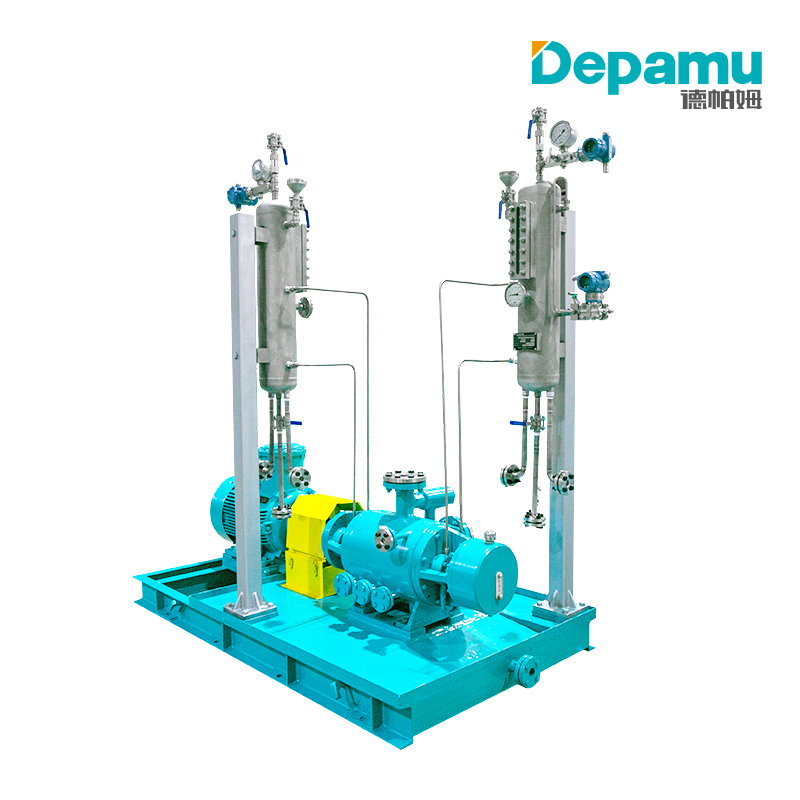
Depamu Positive Displacement Twin Screw Pump: The Engineered Solution for Heavy Oil and High-Viscosity Liquid Transfer
The efficient and reliable movement of heavy oil and high-viscosity liquids is one of the most persistent challenges in the petroleum, petrochemical, and heavy process industries. Unlike water-like fluids, heavy crude oils, residual fuel oils, bitumen, and industrial syrups exhibit viscosities that can exceed 100,000 centipoise (cP), often carry abrasive solids, and may require elevated temperatures to become pumpable at all. In these unforgiving conditions, conventional centrifugal pumps frequently fall short, suffering from cavitation, severe wear, and a dramatic loss of volumetric efficiency as viscosity rises. It is within this demanding operational envelope that the positive displacement twin screw pump has established itself as the technology of choice. Among the manufacturers advancing this field, Depamu (Hangzhou) Pumps Technology Co., Ltd. has emerged as a significant global player, combining advanced German engineering principles with two decades of application expertise to deliver twin screw pump solutions specifically optimized for the most challenging heavy and viscous media.
The Fundamental Advantage of Positive Displacement Twin Screw Technology
At its core, the Depamu twin screw pump operates on a principle fundamentally different from that of a centrifugal pump. Centrifugal pumps rely on a high-speed impeller to impart kinetic energy to the fluid, and their flow rate is intrinsically sensitive to changes in system pressure and fluid viscosity. In heavy oil service, this sensitivity becomes a critical liability, as even modest fluctuations in back pressure can cause significant deviations from the required flow rate. The twin screw pump, by contrast, is a true positive displacement machine. It delivers a virtually constant volume of fluid for each revolution of its shafts, regardless of the back pressure the system exerts, within its designed operating range.
Inside the pump casing, two precision-machined, counter-rotating screw rotors—one right-handed and one left-handed—are housed within a close-clearance liner. As these rotors turn, the helical grooves on the screws and the inner wall of the casing form a series of interconnected, sealed cavities. These cavities fill with fluid at the suction port and then move steadily and axially along the length of the rotors toward the discharge port. The fluid is transported gently, without the turbulence, agitation, or pulsation characteristic of many other pump types. This axial, low-velocity conveying action is a defining feature of the twin screw design and is central to its suitability for shear-sensitive and high-viscosity products.
Depamu’s Engineering Distinctions: Design Features for Demanding Service
While the twin screw principle provides the foundation, Depamu’s pumps incorporate a series of specific design features that elevate their performance and reliability in heavy oil and high-viscosity applications. A critical differentiator is the use of synchronized timing gears. These external gears ensure that the two screw rotors rotate in precise synchronization without ever coming into direct metal-to-metal contact with each other. This eliminates a primary source of wear and seizure risk, particularly important when handling fluids with poor lubricity or when the pump is subjected to transient dry-running conditions. Furthermore, the bearings that support the rotor shafts are mounted externally and are isolated from the process fluid. They are lubricated independently, which allows the pump to handle non-lubricating media—such as many heavy oils and aqueous slurries—without compromising bearing life. This external arrangement also simplifies maintenance, as critical bearing and gear components can be inspected and serviced without dismantling the entire pump wet-end.
For heavy oil service, the availability of a heating jacket on the pump casing is often essential. Heavy fuel oils, such as marine heavy fuel oil (HFO) or No. 6 fuel oil, and many crude oils exhibit viscosities so high at ambient temperatures that they are effectively unpumpable. A heating jacket allows a thermal transfer fluid to circulate around the pump casing, maintaining the metal at an elevated temperature and preventing the process fluid from solidifying, gelling, or depositing on internal surfaces. This ensures reliable transfer from storage tanks to day tanks or process units, even in cold climates or marine environments.
Another hallmark of the Depamu design is its exceptional self-priming capability. Because the pumped fluid itself acts as a sealing liquid within the working components of the pump, the unit can draw liquid from depths of up to 8 meters of water column without the need for auxiliary priming systems or foot valves. This high suction capability, coupled with a low Net Positive Suction Head (NPSH) requirement of just 1.5 meters, allows the pump to operate reliably in suction conditions that would cause a centrifugal pump to cavitate and lose performance. The pump’s ability to handle multiphase mixtures is equally noteworthy; Depamu twin screw pumps can tolerate gas content of up to 98%, making them suitable for crude oil gathering, wellhead operations, and situations where dissolved gases may evolve during pumping—a scenario that can vapor-lock a centrifugal pump.
Technical Specifications and Performance Envelope
Depamu’s twin screw pumps are engineered to comply with API 676, the internationally recognized standard for positive displacement rotary pumps in the petroleum, petrochemical, and natural gas industries. This compliance ensures that the pumps meet stringent requirements for dimensions, materials, performance, and testing expected by global oil and gas operators.
The performance envelope of the Depamu twin screw pump line is broad and covers the full spectrum of heavy and viscous liquid duties. Flow rates range from 0.1 to 3,000 cubic meters per hour (m³/h), accommodating duties from small-scale additive injection to high-volume pipeline and tanker transfer. Discharge pressures can reach up to 4.8 MPa (approximately 48 bar) or higher depending on the specific configuration, providing ample head for long-distance transfer, loading operations, and process feed requirements. The pumps are designed to handle fluid viscosities up to 100,000 cP as a standard capability, with certain configurations and models extending this limit even further to handle materials with viscosities approaching semi-solid consistency. Solid content in the pumped fluid can be as high as 60%, enabling the pump to manage heavy oils containing sand, formation fines, or other particulate matter that would rapidly destroy a close-clearance centrifugal impeller. Fluid temperature capabilities typically span from -12°C to +150°C, accommodating both ambient-temperature light oils and heated heavy residues. The combination of high viscosity tolerance, high solid handling capability, and elevated temperature operation makes the Depamu twin screw pump directly applicable to the most challenging heavy oil and residue fuel streams.
Applications in Heavy Oil and High-Viscosity Liquid Service
The operational profile of the Depamu twin screw pump aligns closely with the requirements of several critical heavy-duty applications. In the upstream and midstream oil and gas sector, these pumps are used for the transfer of heavy crude oil, often in situations where the crude must be moved from field storage to pipelines or processing facilities. The pump’s positive displacement nature ensures that a consistent volume is delivered despite variations in viscosity caused by temperature changes or the presence of dissolved gas, while its gas-handling capability prevents vapor locking in gathering systems.
In the refining and fuel oil distribution chain, Depamu twin screw pumps serve as reliable prime movers for heavy fuel oils, residual fuels, and bitumen. Marine fuel oil transfer—from bunker tanks to settling tanks and day tanks—is a classic application where the combination of high viscosity, the need for heating, and the requirement for dependable, pulsation-free flow makes the twin screw design ideal. The pump’s reversible rotation feature further simplifies tank farm operations, allowing the same unit to be used for both loading and unloading simply by reversing the direction of rotation.
Beyond the petroleum sector, the ability to handle high-viscosity, non-Newtonian fluids with minimal shear makes the Depamu twin screw pump valuable in the processing of molasses and other industrial syrups. Molasses viscosity can vary from 5,000 cP at 20°C to well over 100,000 cP at lower temperatures, and its non-Newtonian behavior means that its apparent viscosity changes with shear rate. The gentle, low-shear pumping action of the twin screw design preserves the product’s characteristics while delivering a constant flow rate, overcoming the limitations of gear pumps and lobe pumps that can struggle with fluctuating viscosity and high shear stress. Similarly, in oily water treatment and sludge handling, the pump’s ability to manage mixtures of oil, water, and abrasive solids—while tolerating entrained gas—provides a level of operational robustness that few other pump technologies can match.
Operational Efficiency, Reliability, and Cost of Ownership
In heavy oil and high-viscosity service, the efficiency and longevity of the pump have a direct impact on operational costs and process uptime. The Depamu twin screw pump exhibits a counter-intuitive but well-documented characteristic: its volumetric efficiency improves as fluid viscosity increases. In a positive displacement pump, a small amount of internal slip occurs through the clearances between the rotating elements and the casing. With low-viscosity fluids, this slip is more pronounced, but with high-viscosity fluids, the fluid itself acts as a highly effective sealant within the clearances, minimizing backflow and maximizing the volume delivered for each revolution. This means that the pump is actually operating in its most efficient regime when handling the very fluids that are most difficult for other pump types.
The low rotational speed of the Depamu twin screw pump—typically in the range of 500 to 1,500 rpm—contributes to both efficiency and longevity. Low-speed operation generates a laminar flow pattern that avoids the emulsification of oil-water mixtures and the mechanical degradation of long-chain polymer additives. It also reduces the linear velocity at the rotor tips and in the bearing surfaces, resulting in lower wear rates and extended service intervals. The absence of metal-to-metal contact between the rotors, ensured by the timing gears, further reduces wear and eliminates the risk of catastrophic seizure. When combined with the external bearing arrangement, which keeps the bearings out of the abrasive process fluid, these design features translate into a pump that can operate for extended periods with minimal maintenance intervention, reducing total cost of ownership in continuous heavy-duty processes.
Conclusion
The transfer of heavy oil and high-viscosity liquids is a niche where pump selection has outsized consequences for system reliability, energy consumption, and maintenance costs. The Depamu positive displacement twin screw pump addresses this challenge through a coherent set of engineering decisions: a true positive displacement principle that delivers constant flow regardless of pressure; a low-shear, non-contacting rotor design that protects sensitive fluids and minimizes wear; external bearings and timing gears that enable the handling of non-lubricating and abrasive media; and options such as heating jackets and multiphase capability that extend the pump’s operating envelope into the most demanding heavy oil duties. Backed by API 676 compliance, a broad performance range spanning flow rates up to 3,000 m³/h and viscosities up to 100,000 cP, and a company heritage rooted in German engineering and two decades of application experience, the Depamu twin screw pump represents a mature and highly capable solution for the most viscous and heavy liquid transfer challenges in modern industry. As the global demand for efficient heavy crude production and the handling of residual fuels continues, technologies that can reliably move these difficult fluids with minimal energy waste and maximum uptime will remain indispensable. The positive displacement twin screw pump, as engineered by Depamu, is positioned firmly at the forefront of that technological response.