

Depamu Food-Grade Rotary Lobe Pumps: Sanitary Engineering for the Demands of Modern Food Processing
The food and beverage industry operates at the intersection of two non-negotiable imperatives: product safety and product integrity. A pump in a food processing line is never merely a hydraulic device; it is a critical control point where hygienic design, mechanical gentleness, and cleanability converge. Depamu (Hangzhou) Pumps Technology Co., Ltd., a Chinese high-tech enterprise founded in 2003 and strengthened by German pumping technologies introduced in 2007, has positioned its stainless steel food-grade rotary lobe pump—often described as a sanitary Rotor Pump—as an engineered response to precisely this convergence. This article examines the Depamu sanitary lobe pump through the lens of its operating principle, hygienic construction, performance envelope, and application logic in food and beverage processing.
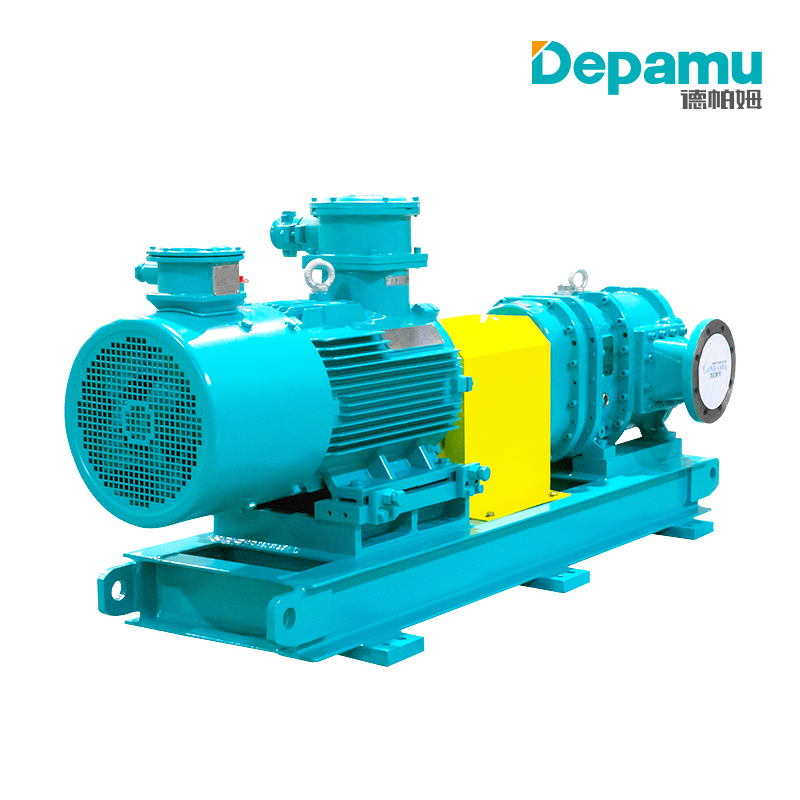
Positive Displacement, Gentle by Design
The Depamu rotary lobe pump belongs to the family of positive displacement pumps and is designed in accordance with API 676, a standard associated with robustness in demanding industrial service. Two synchronised rotors—typically bi-lobe or tri-lobe in configuration—rotate within a stationary casing without contacting one another or the casing walls. As the rotors turn, an expanding cavity at the suction port draws fluid into the pump chamber; the fluid is then carried around the periphery and forced out at the discharge side as the inter-lobe volume diminishes. The critical design parameter is the clearance between rotors and between rotor and casing, typically maintained in the range of 0.05 to 0.3 millimetres, selected according to the viscosity and characteristics of the fluid being handled. Because there is no metal-to-metal contact within the pumping chamber, wear is minimised, and the fluid itself acts as a lubricant and sealant.
This architecture produces a set of behaviours that matter profoundly in food processing. Rotational speeds are low—typically between 10 and 650 revolutions per minute—and the positive displacement action delivers a smooth, continuous flow with minimal pulsation. Unlike a centrifugal pump, whose shear forces rise with impeller speed and which loses efficiency as viscosity increases, the lobe pump’s volumetric efficiency actually improves with thicker fluids, because viscous media fill the running clearances more effectively and reduce internal slip. The result is a pumping action that transports rather than agitates, preserving the structure of emulsions, the texture of cultured dairy products, and the particulate integrity of fruit preparations.
Hygienic Construction: Materials, Surfaces, and Cleanability
The designation “food-grade” is not a marketing gloss; it is a statement about every wetted surface. Depamu specifies AISI 316L austenitic stainless steel for all product-contact components, a grade chosen for its resistance to chlorides and the aggressive cleaning chemicals encountered in food processing environments. Internal surface finish is held to roughness values typically below 0.8 micrometres Ra, creating a non-porous surface that resists product adhesion and bacterial biofilm formation and supports effective clean-in-place (CIP) procedures without manual dismantling. Elastomeric gaskets and seals are selected from FDA-compliant compounds—commonly EPDM—chosen for compatibility with food products, cleaning agents, and temperature fluctuations, and often designed with deformation limiters to prevent the formation of dead legs where product could stagnate. Mechanical seals are available in single or double sanitary configurations, with silicon carbide or carbon faces, and are assembled internally so that they can be accessed and replaced from the front of the pump without disconnecting the casing or pipework.
This hygienic logic extends to the rotor options. Metal rotors, often with replaceable tips, serve general-purpose duties, while rubber rotors offer greater flexibility for fluids containing larger solid particles or for applications demanding extremely low shear. The modular design philosophy means that a single pump series shares common rotors, gears, bearings, axial lining boards, and mechanical seals, simplifying spare-parts inventory and maintenance. CIP compatibility is not an afterthought but a design premise: the smooth wetted surfaces, the absence of dead spaces, and the front-access seal arrangement together allow the pump to be cleaned and sanitised in place, reducing downtime and supporting the validation regimes that modern food safety systems require.
Performance Envelope: Viscosity, Solids, and Temperature
The Depamu food-grade lobe pump is engineered for a remarkably broad operating window. It can handle fluids with viscosities up to two million centipoise and transport media containing up to 60% solid content—capabilities that place it comfortably in the territory of fruit jams, vegetable purées, and particulate-laden sauces. For the food-grade sanitary models, typical flow rates span 0.2 to 1,500 cubic metres per hour, with discharge pressures reaching up to 1.5 megapascals for standard single-stage configurations; the broader lobe pump series extends to 2.0 MPa, and multi-stage arrangements can achieve pressures as high as 3.0 MPa. Self-priming capability, with a maximum suction lift of up to nine metres, eliminates the need for auxiliary priming devices, while reverse rotation enables rapid clearing of blockages and facilitates loading and unloading operations. Temperature tolerance from −40°C to 280°C accommodates duties ranging from the chilling of dairy products to the high-temperature handling of melted chocolate and sugar masses. These are not merely catalogue figures; they define the process envelopes within which the pump can replace multiple equipment types on a single line.
Applications Across the Food and Beverage Spectrum
The practical value of the Depamu sanitary lobe pump becomes clearest when mapped onto specific product families. In confectionery manufacturing, the pump is used for transferring chocolate, compounds, and sugar syrups. The low-shear action preserves chocolate temper and texture, preventing the formation of undesirable fat crystals, while precise flow control supports consistent enrobing and moulding; for toffee and caramel, the high-viscosity capability is indispensable. In dairy processing, the pump handles cream, yoghurt, curd, and processed cheese. Gentle handling preserves the texture of curd and cultured products, and the hygienic design with CIP compatibility maintains the microbiological standards that dairy products demand. In fruit and vegetable processing, purées, concentrates, and products containing diced fruit, seeds, and pulp pass through large, unobstructed flow passages; the option of rubber rotors ensures that delicate solids are not damaged, preserving both visual appeal and texture. Sauces and condiments—ketchup, mayonnaise, mustard, barbecue sauce—benefit from accurate metering and gentle transfer of abrasive, viscous formulations, with corrosion-resistant construction withstanding the acidity of many products. In beverages, the pump transfers fruit juices, concentrates, and syrups, handling both clear and pulpy products with equal competence.
Quality Infrastructure and the Logic of Selection
Depamu’s manufacturing and quality systems are certified to ISO 9001, ISO 14001, and ISO 45001, and the company holds API and CE certifications; its elastomeric components are selected to comply with FDA regulations including 21 CFR 177.2600 and 21 CFR 177.1550, as well as BfR Recommendation XXI (Category 3) for food-contact materials. These certifications do not in themselves make a pump suitable for a given duty; they establish the baseline of material safety and traceability upon which application-specific engineering must be built. The deeper argument for the Depamu food-grade lobe pump is systemic: it replaces the fragile compromise between gentle handling and hygienic assurance with a single engineered solution. Where a centrifugal pump would shear a shear-sensitive product and struggle with viscosity, the lobe pump transports it intact. Where a simpler positive displacement pump might pulse or damage solids, the lobe pump delivers a steady, low-shear flow through an unobstructed path. And where cleanability is concerned, the combination of 316L stainless steel, sub-0.8-micrometre surface finish, dead-space-free geometry, and front-access seals makes CIP a design property rather than a maintenance burden. In an industry where product quality and consumer safety are inseparable, that systemic coherence is the pump’s most consequential specification.