

Depamu Chemical Dosing Skids for Coagulation and Flocculation in Water Treatment: Engineering Coherence over Component Assembly
Introduction
Coagulation and flocculation sit at the hydraulic and chemical heart of most surface-water and wastewater treatment trains. Coagulants—aluminium sulphate, ferric chloride, polyaluminium chloride (PAC)—destabilise the electrostatic charges that keep colloidal particles in suspension; flocculants, typically high-molecular-weight polyacrylamides (PAM), bridge those destabilised particles into settleable floc. The chemistry is well understood. The engineering challenge lies elsewhere: delivering two chemically incompatible reagents, at two different mixing energies, into a flow whose quality can change hourly, without shearing the delicate polymer chains that make flocculation work. A dosing skid that treats pumps, tanks, and controls as separately procured commodities will eventually reveal its discontinuities at commissioning—mismatched hydraulic characteristics, incompatible materials, and control loops that fight rather than follow the process.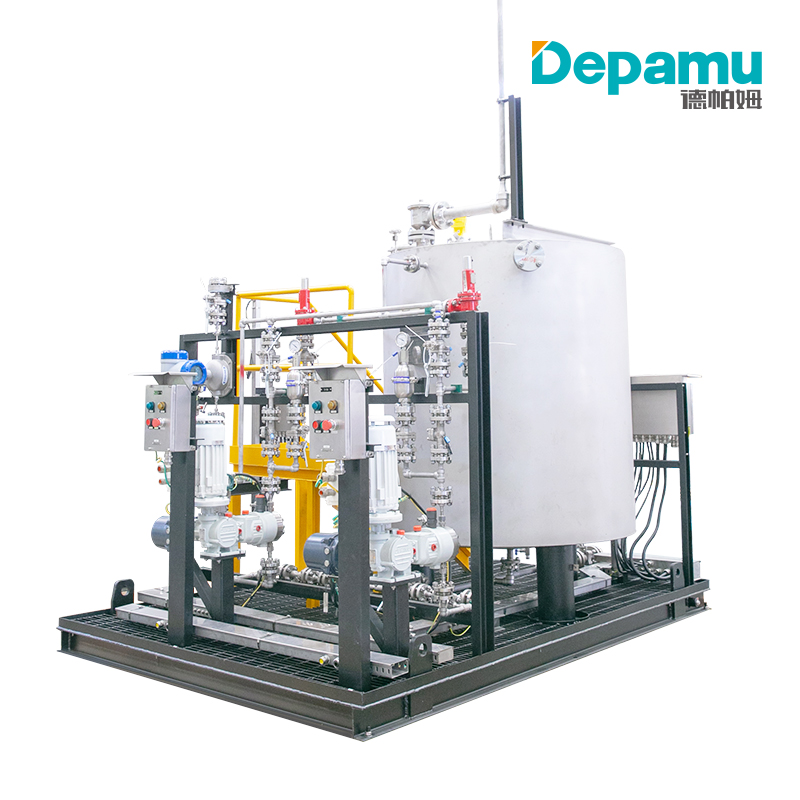
Depamu (Hangzhou) Pumps Technology Co., Ltd. approaches this problem from the opposite direction. Founded in 2003 in the Hangzhou Economic and Technological Development Zone, the company built its position on metering-pump engineering before extending into packaged dosing systems, and its DPJY-series Chemical Injection Skids are designed as integrated systems rather than catalogues of parts. For coagulation and flocculation duty, that systemic logic is not a marketing preference; it is the condition under which the chemistry performs as intended.
The Skid as a System, Not a Shopping List
The first design decision in any coagulation/flocculation installation is whether to field-erect the system from individually purchased components or to specify a factory-tested package. Depamu’s DPJY series commits to the latter. The Metering Pump’s hydraulic behaviour is matched at the engineering stage to the chemical’s viscosity and the piping network’s pressure profile; the skid arrives pre-piped, pre-wired, and wet-tested, collapsing both installation risk and commissioning time. This matters most with polymers. A PAM solution is shear-sensitive: every unnecessary valve, elbow, or improperly sized pump head introduces a point at which long molecular chains can be broken, and broken chains do not flocculate. A system designed as a whole can place the polymer make-up, dilution, and dosing stages in a sequence that protects the molecule from preparation through injection. A system assembled from parts cannot guarantee that protection.
The component architecture reflects this integrated philosophy. Solution tanks are available in 304/316L stainless steel, fiber-reinforced plastic (FRP), and polyethylene (PE), allowing material selection to follow the corrosivity of the reagent rather than forcing the reagent to accommodate a single metallurgy. For PAC and ferric chloride, FRP or PE is often appropriate; for acid or caustic pH-trim streams, 316L stainless steel may be specified. This material flexibility is not a catalogue nicety. Coagulation and flocculation skids frequently sit upstream of, or alongside, pH correction and disinfection, and a material decision that suits the coagulant may be unacceptable for the alkali dosed metres away.
At the centre of the skid is the metering pump. Depamu’s hydraulic diaphragm series spans flow rates from 15 L/H to 5,400 L/H and discharge pressures from 0.4 MPa to 72 MPa, with metering accuracy of ±0.5% and stepless stroke adjustment from 0% to 100%. For coagulation/flocculation duty specifically, the relevant operating envelope is narrower but no less demanding: polymer make-up and Dosing Pumps must deliver smooth, low-pulsation flow because pulsation itself imposes cyclic shear on the flocculant. The hydraulic diaphragm principle provides zero leakage to atmosphere, a characteristic that becomes non-negotiable when the skid is handling not only polymers but also adjacent acid or hypochlorite streams. Depamu also offers Mechanical Diaphragm Metering Pumps whose gentle, low-pulsation action is explicitly intended to minimise polymer shear and preserve the long molecular chains required for effective flocculation.
Dissolution, Ageing, and the Dry-Powder Problem
Many coagulation/flocculation programmes use liquid coagulant delivered in bulk, but polymer flocculants are frequently supplied as dry powder or granular solids that must be dissolved and aged before they can be dosed. This is the step where many otherwise adequate dosing systems fail. Dry polymer particles that contact water too quickly form “fish-eyes”—agglomerates with dry cores that never fully dissolve and can blind downstream filters or injector quills.
Depamu’s automatic dissolving and dosing devices address this with a dedicated dry-powder handling architecture. The system comprises a PLC automatic control system, a dry-powder storage system, a precise dry-powder dosing device, an anti-humidity heater, and a stainless-steel stirring device. The powder conveying system is designed so that the powder does not heat, does not agglomerate, and does not touch surfaces that would promote premature hydration; it is dispersed into the dissolving water under controlled conditions, and the resulting solution is stirred and aged before the metering pump draws from it. The device can prepare liquid media of different concentrations from a range of powdered and granular chemicals and then inject them precisely into the process. For a coagulation/flocculation skid, this means the same package can accommodate a powdered PAC coagulant and a powdered PAM flocculant, each prepared at its own concentration and dosed at its own point in the treatment train.
Mixing Energy and the Sequence of Chemistry
A dosing skid does not perform coagulation and flocculation by dosing alone; it must also impose the correct mixing energy at the correct moment. The chemistry requires a sequence: rapid, high-shear dispersion of coagulant into the raw water (velocity gradients on the order of 500–1,000 s⁻¹), followed by gentle, tapered flocculation at low shear to grow floc without breaking it. If the skid is configured as a complete chemical-conditioning package, it integrates dosing pumps for coagulant and polymer with an in-line static or flash mixer and a tapered flocculation stage whose retention times and velocity gradients are pre-engineered to the treatability data.
This is where the distinction between a dosing skid and a coagulation/flocculation skid becomes operationally meaningful. A dosing skid can inject the right chemical at the right rate; a coagulation/flocculation package also guarantees that the chemical meets the water under the right hydrodynamic conditions. Depamu’s skids can be specified with this broader scope, incorporating mixing and flocculation stages on the same frame as the tanks, pumps, and controls. The dosing is flow-paced and can be trimmed on process feedback—turbidity, streaming current, or pH—so that the chemistry tracks raw-water quality without continuous operator intervention.
Automation: From Manual Mode to Closed-Loop Control
The control philosophy of a Depamu skid is deliberately layered. At the simplest level, the system can run in local manual mode, with the operator setting pump stroke or speed directly. At the other end, the skid operates in fully automatic closed-loop control: PLC or DCS receives signals from flow meters, pH sensors, conductivity monitors, and turbidity meters, and adjusts pump speed and stroke to maintain the target dose. Variable-frequency drives accept standard 4–20 mA control signals, allowing seamless integration with existing plant control systems. Status and fault signals can be transmitted to a plant DCS or host system for remote monitoring, and the system can be started, stopped, or adjusted remotely.
For coagulation and flocculation, the most useful automation is not simply flow-proportional dosing but dose trimming against a process variable. Jar-test set-points loaded at commissioning provide the baseline dose–turbidity relationship; the control system then adjusts around that baseline as raw-water turbidity or pH moves. This is particularly valuable in surface-water treatment, where storm events can change coagulant demand within hours. Depamu’s automatic dissolving and dosing devices include self-diagnosis and alarm output, so that a failure in powder feed, dilution water, or pump delivery is annunciated rather than silently under-dosing.
Application Fit: Drinking Water, Municipal Wastewater, and Industrial Streams
Depamu’s automatic dissolving and dosing devices are specified for flocculation treatment of municipal or industrial wastewater, flocculation in sludge dewatering, drinking-water purification, and wastewater treatment in the chemical, papermaking, and metallurgical industries. These are not interchangeable duties. Drinking-water coagulation demands tight control of coagulant dose and pH to avoid residual aluminium or iron and to satisfy turbidity limits; the skid’s closed-loop control and material compliance are therefore central. Municipal wastewater flocculation, by contrast, often prioritises polymer make-up reliability and resistance to variability in sludge characteristics. Sludge dewatering is the most demanding polymer application: the flocculant must be prepared at low concentration, aged properly, and dosed with minimal shear, because the floc is subjected to mechanical pressing or centrifugation immediately after conditioning.
Depamu’s product structure reflects these differences. The DPJY series is a modular injection-package family, with configurations such as one tank plus two pumps or two tanks plus three pumps, allowing coagulant and flocculant to be prepared and dosed from separate tanks on a common frame. The company’s circulating-water dosing devices are explicitly categorised into PAC dosing systems and PAM dosing systems, alongside scale-inhibitor, biocide, and sodium hypochlorite packages, showing that the same skid architecture is adapted to the specific chemical duty rather than offered as a universal platform. For raw-water pretreatment, Depamu cites the DPJY-0.3X1-DPMSWAB10-14.5 model as a configuration designed for coagulant and flocculant injection, including PAC and PAM, together with pH adjustment and disinfection.
Manufacturing Depth and the Credibility of the Package
A skid is only as reliable as the engineering culture behind it. Depamu introduced advanced production technologies from Germany and has obtained more than 100 patents; its metering-pump portfolio extends to over 4,000 varieties, and the company reports a substantial share of the Chinese metering-pump market. Manufacturing is supported by digital test systems and strict quality control, and the company offers OEM/ODM customisation with global technical service. For water-treatment projects, this depth matters in two ways. First, the metering pump—the component most directly responsible for dose accuracy—is engineered in-house rather than sourced as a commodity. Second, the packaged skid can be certified and tested against recognised standards; Depamu’s dosing devices are produced to API 675 standards for metering pumps, and its broader skid portfolio references DNV and ISO practices. These credentials do not replace jar testing or pilot trials, but they reduce the probability that a commissioning delay will originate in the dosing package itself.
Conclusion
Coagulation and flocculation are chemistry, but their success in a treatment plant is an engineering outcome. The reagents must be prepared without agglomeration, dosed without shear, mixed with the right energy at the right moment, and controlled against a raw-water quality that is never static. Depamu’s chemical dosing skids for coagulation and flocculation are built around the proposition that these requirements are interdependent and should be engineered together. The DPJY-series architecture, the automatic dry-powder dissolving devices, the hydraulic diaphragm and mechanical Diaphragm Pump options, and the layered automation from manual to closed-loop control all serve a single objective: delivering a package whose hydraulic, material, and control characteristics are already reconciled before the first litre of water is treated. In a treatment train where the coagulation step governs everything downstream, that systemic coherence is not a refinement. It is the design basis.