

Application of Depamu Chemical Injection Skids in the Oil & Gas Industry
The movement of hydrocarbons from reservoir to refinery is never a passive process. Produced fluids carry water, hydrogen sulfide, carbon dioxide, paraffin, and dissolved salts; as pressure and temperature shift along the production path, these constituents conspire to corrode steel, deposit scale, and form gas hydrates that can block a flowline in hours. The discipline that counters these threats is flow assurance, and its most persistent instrument is continuous chemical injection. A chemical injection skid—a pre-engineered, skid-mounted assembly of tanks, Metering Pumps, piping, and controls—transforms a catalogue of specialty chemicals into a precisely dosed defense system. Among the manufacturers serving this niche, Depamu (Hangzhou) Pumps Technology Co., Ltd. has built a distinctive position: a Chinese firm that absorbed German hydraulic diaphragm metering technology in the early 1990s and scaled it into a portfolio of over 4,000 metering-pump varieties, more than 126 patents, and a reported 47% share of the domestic Chinese metering-pump market. This article examines how Depamu’s chemical injection skids—principally the DPJY series—are engineered and deployed across the oil and gas value chain, from offshore platforms in the South China Sea to the first commercial oil field in Uganda.
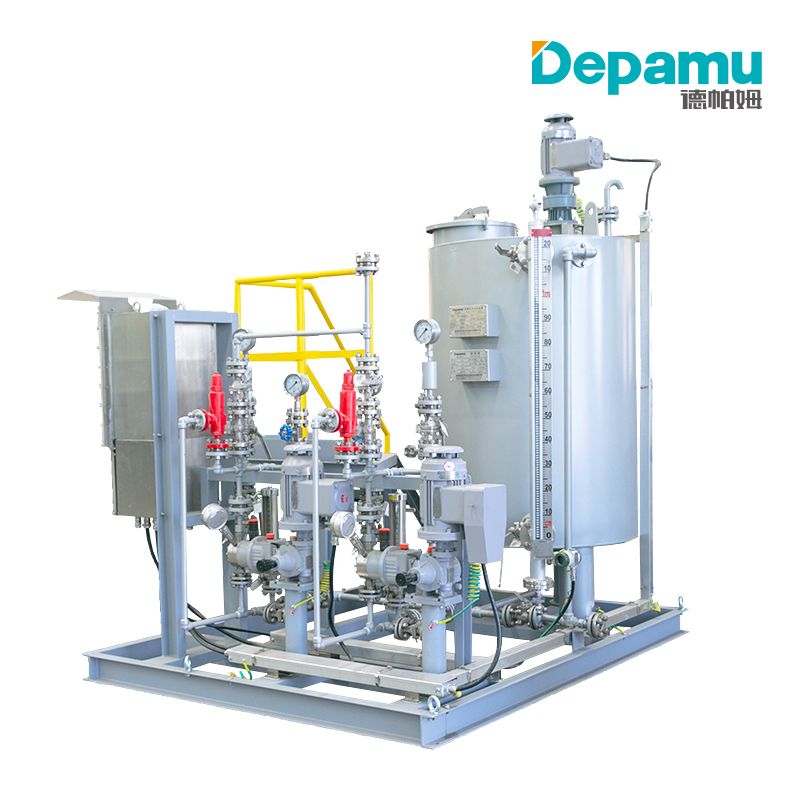
Engineering Architecture: The Skid as an Integrated System
The fundamental argument for a skid-mounted package over a field-erected “stick-built” installation is systemic coherence. When pumps, tanks, and controls are procured separately, mismatches in hydraulic characteristics, viscosity handling, and suction/discharge dynamics introduce bottlenecks that only surface during commissioning. Depamu’s DPJY series responds with a systematic design philosophy: the metering pump’s hydraulic behavior is matched at the engineering stage to the chemical’s viscosity and the piping network’s pressure profile, removing the guesswork that plagues field assembly. The package arrives as a pre-piped, pre-wired, factory-tested unit, collapsing installation risk and commissioning time.
The component architecture reflects the demands of continuous oilfield duty. Solution tanks range from 0.5 m³ to 20 m³ and are available in 304/316L stainless steel, carbon steel with rubber or plastic lining, fiber-reinforced plastic, and polyethylene, allowing material selection to follow chemical corrosivity rather than forcing the chemical to accommodate a single metallurgy. At the heart of the skid sits the metering pump. Depamu’s 3DP(M)ZA hydraulic diaphragm series spans flow rates from 15 L/H to 5,400 L/H and discharge pressures from 0.4 MPa to 72 MPa, with metering accuracy of ±0.5% and stepless stroke adjustment from 0% to 100%. For the DPJY skid configurations most commonly deployed in oil and gas, capacities from 10 L/H for corrosion inhibitor dosing up to 1,500 L/H for scale inhibitor service are typical, with discharge pressures reaching 32 MPa (approximately 4,600 psi) for deep-well and high-wellhead-pressure applications. The hydraulic diaphragm design is not incidental: it provides zero leakage to atmosphere, a non-negotiable safety characteristic when the injected fluid is methanol, benzene-containing streams, or other volatile and toxic media.
Modularity completes the architecture. A DPJY skid can begin as a single-tank, dual-pump configuration and later add pump heads or tanks as production profiles evolve, without redesigning the entire package. This scalability matters most in phased field developments, where capital exposed to uncertain future production is a persistent concern. Control philosophy is equally modular: skids can run in local manual mode for simple remote wells, semi-automatic mode, or fully automatic closed-loop control in which injection rate tracks real-time process parameters from online instrumentation, with status and fault signals transmitted to a DCS for remote monitoring.
Upstream Applications: Flow Assurance at the Wellhead and Flowline
The upstream segment is where chemical injection skids earn their keep most visibly, because the consequences of under-dosing are immediate. Hydrate inhibition is the most technically demanding application. In subsea flowlines and cold-climate gathering systems, low temperatures and high pressures cause water and methane to crystallize into ice-like solids that can plug a line entirely. Depamu skids configured for methanol (CH₃OH) or monoethylene glycol (MEG) injection operate at the upper end of the pressure spectrum; the pump’s precision is critical because under-injection risks hydrate plugs while over-injection wastes expensive solvent. Corrosion inhibitor injection protects production tubing and flowlines from the combined attack of CO₂, H₂S, and produced water, while scale inhibitor dosing prevents mineral deposition in downhole and topside equipment. Demulsifier packages break oil-water emulsions that would otherwise increase viscosity and burden surface separation; H₂S scavenger injection is required in sour service; and biocide packages control bacterial growth that drives microbiologically influenced corrosion. Depamu’s package catalogue maps directly onto this chemical taxonomy—demulsifier, corrosion inhibitor, deoxidant, reverse demulsifier, germicide, methanol, and ethylene glycol Injection Packages—each configured around the specific chemical’s handling requirements rather than offered as a generic dosing platform.
Enhanced oil recovery extends the skid’s role beyond flow assurance into reservoir management. In secondary and tertiary recovery, polymer injection increases the viscosity of injected water to improve sweep efficiency; Depamu’s high-pressure Reciprocating Pumps, designed in accordance with API 674, serve as polymer and Water Injection Pumps, with the HD series covering 3.37 to 78.99 m³/h and pressures from 3.0 to 83.5 MPa. The company signed a landmark polymer high-pressure reciprocating pump contract for an Indian oilfield in 2018, breaking a monopoly previously held by European and American manufacturers in that equipment segment.
Midstream and Downstream: Protecting the Long Arteries
The midstream value chain—gathering systems, trunklines, and pipeline networks—presents a different injection problem: access for maintenance is limited, and the cost of a corrosion-related failure is measured not only in repair but in lost throughput and environmental exposure. Chemical injection skids on midstream pipelines dose corrosion inhibitors to protect long, often inaccessible pipeline interiors from internal corrosion; drag-reducing agents (DRA) to improve flow efficiency; and scale inhibitors to prevent mineral deposits that throttle flow. The same skid architecture used upstream adapts to these duties, with the chemical package selected according to the pipeline’s specific threat profile. In downstream refining and petrochemical service, Depamu’s DPJY packages are specified for process automation requirements across petroleum, natural gas, refining, and chemical processing, handling chemicals ranging from caustic and acid streams to volatile solvents.
Field Validation: From the South China Sea to the Albert Basin
Engineering claims acquire credibility through deployment, and Depamu’s project record illustrates how the skid architecture performs under divergent constraints. For China National Offshore Oil Corporation (CNOOC), the company delivered multiple sets of offshore platform chemical injection skids and High-Pressure Reciprocating Pumps for service in the South China Sea and Bohai Sea, environments characterized by high temperature, extreme humidity, and corrosive salt spray. The engineering response was shaped by the offshore platform’s defining constraint: space. Depamu abandoned single-layer layouts and pioneered a three-tier skid design that vertically integrates IBC totes, storage tanks, and pump assemblies, reducing equipment footprint by 40 to 50 percent compared with conventional designs while using height differentials to minimize pump cavitation risk and extend service life. Welding processes were optimized, full-penetration welds specified on critical steel structures, and materials upgraded to duplex stainless steel and titanium to resist marine corrosion.
The Uganda Kingfisher project tested a different capability: adaptation to a frontier operating environment. Depamu designed, manufactured, and delivered 29 custom chemical injection skids for Uganda’s first commercial oil field, located in the Albert Basin and representing the largest Chinese-invested project in the country. Uganda’s crude production processes are exceptionally complex, and local content requirements demanded equipment that could be supported and maintained with limited industrial infrastructure. The skids were built around a modular, integrated design with a high degree of automation and flexible operation to meet these conditions, and all 29 units completed factory testing and shipment on schedule. Elsewhere, deliveries of chemical injection skids to the Nigerian LNG fields at Soku and Gbaran required bespoke frames to match existing concrete plinths, containerized transport for difficult road networks, and remote monitoring capability—a reminder that the skid’s physical envelope is often as decisive as its dosing accuracy. In the Middle East, the market is beginning to demand solar-powered injection packages with battery autonomy for two days without sunlight, a trend that Depamu’s modular design philosophy is positioned to accommodate through configuration rather than redesign.
Compliance, Safety, and the Direction of the Technology
For the oil and gas operator, a chemical injection skid is a safety-critical asset as much as a process instrument. Depamu’s DPJY packages are designed to comply with explosion-proof requirements for Zone 2 hazardous areas, utilizing flameproof motors and enclosures suitable for volatile hydrocarbon atmospheres, and the company holds CE and ISO certifications for its dosing equipment. The Hydraulic Diaphragm Metering Pump’s zero-leakage characteristic is itself a safety architecture: internal safety valves and compensation valves provide automatic air discharge and oil replenishment, supporting reliable continuous duty, while the sealed diaphragm barrier isolates the hydraulic system from the process fluid. Instrumentation and control integration—DCS communication, remote start-stop, closed-loop ratio control—increasingly determines not only chemical consumption efficiency but also the degree to which operators can reduce personnel exposure in hazardous areas.
The trajectory of the technology points toward greater configurability rather than greater complexity. Skids that can shift from manual to fully automatic control, that accept solar power as readily as grid power, and that expand from two pump heads to twelve without a new engineering package are responding to a structural reality of the oil and gas industry: fields are developed in phases, operating conditions change over decades, and the injection skid must remain useful across that entire life cycle. Depamu’s contribution to this landscape is not a single breakthrough component but an integrated system—a marriage of German-origin diaphragm metering precision, a vertically integrated manufacturing base, and field experience spanning offshore China, East African frontier basins, and West African LNG complexes. In an industry where a blocked flowline or a corroded riser carries costs measured in production days and environmental consequence, the quiet, continuous work of a well-engineered chemical injection skid is a form of insurance that pays out every hour of every day.