

Depamu Hydraulic Diaphragm Metering Pumps: Precision Fluid Handling for Chemicals and Water Treatment
In industrial fluid handling, the difference between a well-run process and a costly failure often comes down to the accuracy of a single dose. Whether neutralizing a corrosive effluent stream, scavenging oxygen in a high-pressure boiler, or injecting a corrosion inhibitor into a subsea pipeline, the metering pump is the component that translates process intent into chemical reality. Among the technologies available for this task, the Hydraulic Diaphragm Metering Pump occupies a distinct position: it combines the leak-free containment of a diaphragm with the pressure capability and hydraulic stability of a plunger system. Depamu (Hangzhou) Pumps Technology Co., Ltd., a manufacturer with over 4,000 specifications and models in its portfolio, has built its hydraulic diaphragm range around this principle, targeting the dual demands of chemical processing and water treatment. This article examines the Depamu hydraulic diaphragm metering pump—its working principle, technical characteristics, material options, and application profile—with particular attention to its role in water treatment and diverse chemical dosing duties.
The Hydraulic Diaphragm Principle: Isolation Without Compromise
A metering pump is a positive displacement device engineered to deliver a precise, adjustable flow against a system pressure. In a hydraulic Diaphragm Pump, the mechanical drive does not act directly on the process diaphragm. Instead, a piston reciprocates within a hydraulic oil chamber, pressurizing the oil, which in turn deflects the diaphragm. The diaphragm separates the hydraulic fluid from the pumped chemical, so the process fluid contacts only the diaphragm and the wetted pump head components—never the moving mechanical parts.
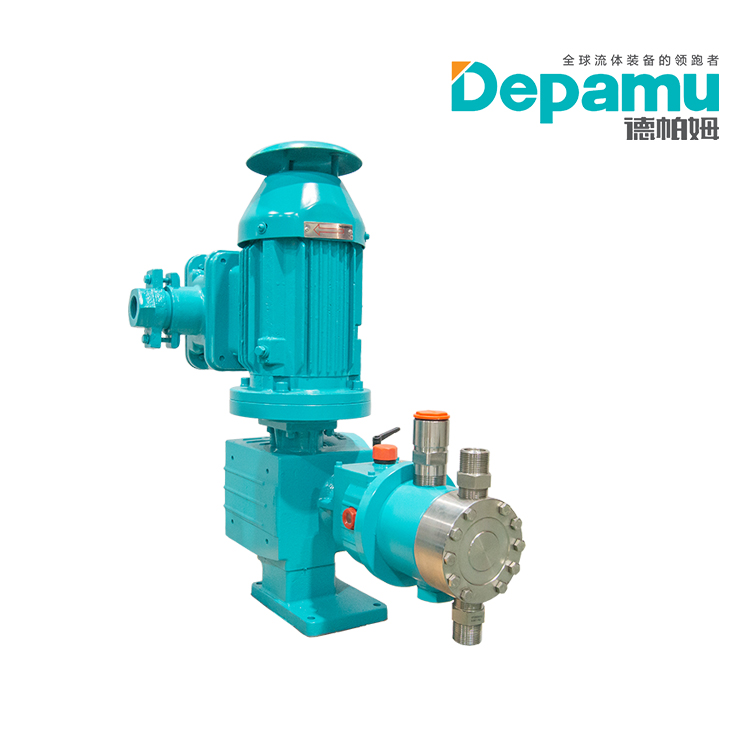
This hydraulic intermediation produces several operational consequences. The oil acts as a cushion, smoothing shock loads and distributing force uniformly across the diaphragm, which extends diaphragm life and supports stable volumetric output. The design also accommodates high discharge pressures that would challenge mechanically actuated diaphragm pumps, because the hydraulic system transmits force efficiently without a direct mechanical link that could induce stress concentrations. For chemical and water treatment duties, the most consequential benefit is containment: because the diaphragm physically isolates the process fluid, the risk of leakage through packing seals—a persistent concern with plunger designs handling hazardous or valuable media—is eliminated.
Depamu’s Hydraulic Diaphragm Platform: Architecture and Precision
Depamu’s flagship hydraulic diaphragm line, the DP(M)WA series, delivers a flow rate adjustment range of 10% to 100% with a metering accuracy of ±0.5%. The pump head can be configured as hydraulic diaphragm, plunger, or piston type, allowing the same drive platform to serve different fluid and pressure requirements. Motor power options begin at 0.37 kW and extend upward, with models such as the DP(M)WA75/2.7/4.0 providing 75 L/h at discharge pressures of 2.7 MPa and 4.0 MPa, and the DP(M)WA212/1.0/1.4 delivering 212 L/h at 1.0 MPa and 1.4 MPa.
The precision originates partly in the transmission. Depamu employs a patented integrated sleeve adjustable eccentric mechanism that converts rotary motor motion into reciprocating stroke, enabling stepless adjustment from 0% to 100%. The low-speed connecting rod uses roller bearings rather than conventional bushings; at low operating speeds, roller bearings maintain an oil film that bushings cannot, reducing friction and heat while supporting high bearing loads. An integrated worm gear pair and oil-immersion lubrication further contribute to low noise and long-term transmission reliability.
Diaphragm technology is equally central. Depamu uses PTFE polymer composite diaphragms processed through multi-directional rolling and surface quenching to achieve a homogenization degree of 99.92%, reducing cold flow under pressure and improving compressive strength. The limit valve is manufactured to ±0.002 mm precision with surface hardness of 60–70 HRC and roughness of 0.4 μm, supporting reliable operation across 80 million cycles and temperatures from −80°C to 160°C. These are not incidental specifications: in water treatment and chemical dosing, diaphragm fatigue and hydraulic drift are among the principal causes of metering error, so diaphragm durability and valve precision translate directly into dose consistency.
Safety and Hydraulic Self-Regulation
A hydraulic diaphragm pump depends on a stable volume of oil in the hydraulic chamber. If oil is lost or air enters the system, the diaphragm stroke becomes inconsistent and metering accuracy degrades. Depamu addresses this with built-in safety and compensation valves that perform automatic air discharge and oil replenishment, allowing the hydraulic system to self-regulate without routine manual intervention. The limit valve, compensation valve, and internal relief valve work in coordination to maintain a stable oil volume in the hydraulic chamber over extended operation. For hazardous media—toxic, flammable, explosive, or highly corrosive—Depamu pumps can be equipped with dual diaphragm configurations and rupture alarm systems, so that a primary diaphragm failure is detected before process fluid can reach the hydraulic side. The vertical motor installation adds a further containment layer: even in the event of a seal failure, fluid is retained rather than migrating along a horizontal shaft path.
Materials and Chemical Compatibility
The breadth of chemicals encountered in water treatment and chemical processing makes wetted-material selection a primary engineering decision. Depamu offers pump heads in 304, 316, 316L, 904 stainless steel, Hastelloy C, and polymeric materials including PVC, PVDF, PP, and PTFE. The PTFE composite diaphragm provides broad chemical resistance, and the allowable pumping temperature depends on the wetted material—PVC components are generally limited to 40°C, while PTFE-based wetted surfaces accommodate up to 80°C in comparable mechanical diaphragm configurations. This material flexibility allows a single pump platform to be specified for aggressive mineral acids, alkaline solutions, high-purity amine streams, and specialized polymer solutions without compromising either containment or metering performance.
Water Treatment Applications: Precision Across the Treatment Train
Water treatment is arguably the most exacting volumetric challenge for metering pumps, because chemical dose must track variable flow, pH, conductivity, or dissolved oxygen in real time. Depamu’s hydraulic diaphragm pumps and DPJY-series Injection Packages are deployed across four principal water treatment domains.
In boiler water treatment, feedwater chemistry directly governs equipment life. Depamu supplies phosphate injection systems to control scale, hydrazine injection systems for oxygen scavenging, and ammonia injection systems for pH regulation. These are not simple fixed-rate dosing duties: the systems adjust dosing based on feedback from flow, pH, and dissolved oxygen measurements, maintaining water chemistry within narrow limits as load and condensate quality change. The hydraulic diaphragm’s pressure capability is relevant here, because boiler chemical injection often occurs against elevated system pressures where mechanically actuated diaphragm pumps would be limited.
Circulating water treatment—cooling towers and closed-loop systems—presents a different challenge: scaling, corrosion, and biological fouling must be controlled simultaneously, often with multiple chemical streams. Depamu systems inject scale inhibitors, corrosion inhibitors, and biocides to protect heat exchange surfaces and maintain thermal efficiency. Precise dosing is doubly important in this context: under-treatment allows fouling to establish, while over-treatment wastes chemical and may create environmental compliance issues in blowdown streams.
In wastewater and sewage treatment, the dosing targets are flocculants and coagulants for suspended solids removal, along with acids and alkalis for pH correction before discharge. Influent quality in municipal and industrial wastewater varies considerably, so the pump must retain accuracy across a wide adjustment range—precisely the operating envelope in which the ±0.5% accuracy and 10–100% turndown of the Depamu hydraulic diaphragm pump are advantageous.
Raw water pretreatment and membrane protection represent a further application layer. Depamu’s DPJY-series packages are configured for raw water pretreatment injection as well as wastewater, sewage, and circulating water duties, integrating solution preparation, metering, and injection into skid-mounted units that simplify installation in space-constrained dosing rooms.
Chemical Processing and Diverse Industrial Duties
Beyond water treatment, the hydraulic diaphragm pump’s combination of leak-free containment and high-pressure capability makes it suitable for a wide spectrum of chemical dosing. In oil and gas operations, Depamu hydraulic diaphragm pumps are specified where zero leakage is paramount—offshore platforms and environmentally sensitive production areas—for injecting corrosion inhibitors, demulsifiers, scale inhibitors, and hydrate preventatives. The same platform serves petrochemical and chemical processing duties including catalyst injection, additive dosing, and proportioning of multiple media, supported by the DP(M)XAA series, which can accommodate up to twelve pump heads in parallel.
The multi-head architecture merits particular attention because it changes the pump’s role from a single-stream dosing device to a fluid management system. Connecting multiple heads to the same medium and phasing their discharge strokes smooths pulsation, which is beneficial when feeding a reactor or filter press that requires steady flow. Alternatively, separate heads can draw different media from independent sources and combine them at a discharge manifold in a precise ratio, functioning as a proportioning pump without external mixing equipment or complex control loops. In chemical processing, where formulations may involve multiple additives introduced at different points, this modularity reduces the number of standalone injection skids and simplifies the control architecture.
Control and Automation
Metering accuracy is only useful if the pump can be commanded to the correct setpoint and can hold it. Depamu hydraulic diaphragm pumps offer manual, electrical, pneumatic, and frequency-conversion flow adjustment, with electric actuator options enabling remote automatic control. In automated water treatment systems, the pump can be integrated with a PLC or DCS, receiving signals from flow meters, pH sensors, conductivity meters, or turbidity meters and adjusting stroke speed or length accordingly. The systems can operate in manual, semi-automatic, or fully automatic modes, and pump status and fault signals can be transmitted to a central control system for remote monitoring.
This control flexibility is important because the hydraulic diaphragm pump itself is a precision positive-displacement device, but its accuracy depends on stable hydraulic conditions and a repeatable stroke. The self-regulating hydraulic features described earlier—automatic air discharge and oil replenishment—support that stability, so the commanded setpoint is maintained without hydraulic drift between maintenance intervals.
Conclusion
The Depamu hydraulic diaphragm metering pump is best understood not as a single product but as a precision platform adapted through materials, head configuration, control options, and multi-head architecture to a wide application space. Its hydraulic transmission isolates the process fluid, smooths diaphragm loading, and supports pressures beyond the practical range of direct mechanical actuation. Its PTFE composite diaphragm and precision valve system sustain metering accuracy of ±0.5% over a 10–100% adjustment range, while built-in safety and compensation valves preserve hydraulic stability without constant attention. In water treatment—from boiler oxygen scavenging to wastewater pH correction—these characteristics translate into dose consistency against variable process conditions and aggressive chemistries. In chemical processing, petrochemicals, and oil and gas, the same platform provides leak-free containment for hazardous media and, in multi-head form, a compact means of proportioning multiple streams. For engineers specifying dosing equipment, the practical significance is straightforward: the hydraulic diaphragm design reduces the number of failure modes that compromise either containment or accuracy, and Depamu’s breadth of wetted materials and control interfaces allows that design to be matched closely to the chemical and the process, rather than forcing the process to accommodate the pump.