

Depamu vs. ProMinent Plunger Metering Pumps: A Comparative Analysis of Specifications, Engineering Maturity, and Lifecycle Economics
Introduction
In the landscape of industrial Plunger Metering Pumps, two names increasingly appear in the same procurement conversation: ProMinent, the German process metering incumbent, and Depamu, a Chinese manufacturer that has moved from the periphery to direct consideration in medium- to high-pressure chemical injection and petrochemical duty. On a specification sheet, the two can look closer than their brand positioning suggests. Both claim metering accuracy of ±0.5% across the 10–100% stroke adjustment range; both offer packed-plunger liquid ends in stainless steel and higher alloys; both can be configured with multiplex pump heads to reduce pulsation or proportion multiple fluids.
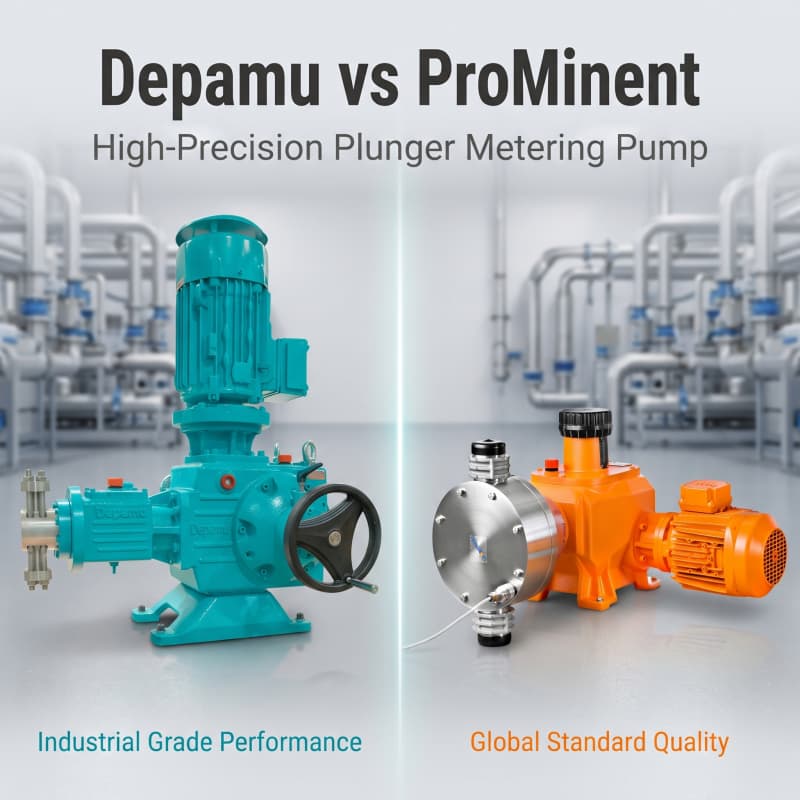
The decision, however, rarely hinges on a single line item on a datasheet. It hinges on what happens in the third year of continuous duty, when a seal begins to weep, a valve seat erodes, or a spare part is needed within seventy-two hours. This analysis compares the two brands across four dimensions that determine lifecycle outcomes: performance envelope and specification claims, engineering maturity and field reliability, total cost of ownership (TCO), and supply-chain and service architecture. The conclusion is not that one brand is universally superior, but that the appropriate choice depends on whether the application’s risk profile rewards specification flexibility or validated reliability.
1. Performance Envelope: Where the Specifications Converge and Diverge
1.1 Flow and Pressure Capability
Depamu’s plunger portfolio, particularly the DP(M)ZA and DP(M)DA series, advertises a single-pump-head flow capacity of up to 12,100 L/h and discharge pressures reaching 228 MPa (approximately 2,280 bar). This is an extraordinarily high pressure ceiling—higher, on paper, than the standard ProMinent plunger lines. The DP(M)WAA series extends into lower-flow, high-pressure territory, with models delivering 1.0–61.7 L/h at pressures up to 55.7 MPa for a 8 mm plunger, scaling to 105 L/h at 5.7 MPa with a 30 mm plunger.
ProMinent’s packed-plunger range is segmented more deliberately. The Sigma/2 (Basic Type) covers 2–76 L/h at 320–12 bar, with capacity adjustable in 0.2% increments and reproducibility better than ±1% across the 30–100% stroke range. The MAKRO TZKa packed-plunger version covers 8–1,141 L/h at 320–11 bar, with dosing precision better than ±0.5% across the 10–100% stroke range. At the extreme end, the ORLITA DR rotating plunger pump reaches 400 bar and 4,125 L/h, albeit with a valveless rotary design rather than a conventional reciprocating packed plunger. The ORLITA PS plunger line, which Depamu directly benchmarks against, tops out at approximately 2,800 L/h in flow, a limitation Depamu highlights as making it unsuitable for high-volume transfer.
Comparative verdict on envelope: Depamu wins on the absolute upper bound of pressure and flow for a single conventional plunger head. A project requiring 200 MPa at several thousand liters per hour will find a more direct catalog match in Depamu’s DP(M)ZA than in ProMinent’s standard plunger portfolio. ProMinent, by contrast, wins on the granularity of its range: the Sigma/2 and MAKRO TZ families offer a continuum of models that allow an engineer to optimize closely around a specific duty point without over-specifying pressure class or sacrificing controllability.
1.2 Metering Accuracy and Controllability
Both brands claim ±0.5% accuracy in the normal operating range. Depamu specifies ±0.5% within the 10–100% stroke length adjustment range, with stepless adjustment from 0–100% via a patented integrated sleeve adjustable eccentric mechanism. ProMinent’s Sigma/2 plunger achieves better than ±1% reproducibility in the 30–100% range, while the MAKRO TZ packed-plunger achieves better than ±0.5% across 10–100%. The ORLITA DR claims better than ±0.5% across 10–100% for viscous and high-pressure duty.
The numerical claims are comparable. The meaningful difference lies in the conditions under which those claims are validated. ProMinent’s published figures are tied to “defined conditions and correct installation,” a caveat that appears across its technical literature—an acknowledgment that repeatability depends on suction conditions, fluid properties, and installation quality. Depamu’s literature makes the same claim but with less explicit qualification, which places a greater burden on the specifying engineer to verify that the pump’s actual duty matches the conditions under which the accuracy figure was generated.
2. Engineering Maturity: The Gap Between the Datasheet and the Plant Floor
This is where the comparison becomes less about numbers and more about accumulated engineering knowledge. ProMinent’s plunger designs benefit from decades of refinement across a very large installed base—approximately 1.5 million ProMinent pumps in service worldwide. That scale of field experience translates into design details that do not appear on a specification sheet: the specific metallurgy of a valve seat that resists erosion under a particular abrasive slurry, the packing formulation that maintains elasticity across a temperature cycling profile, or the crank geometry that minimizes torsional vibration at a given stroke rate.
Depamu’s engineering trajectory is different. The company holds CE, ISO 9001, and ISO 45001 certifications and has participated in drafting Chinese pump industry standards. Its reciprocating mechanism uses an integrated worm gear pair for noise reduction and a patented eccentric adjustment for stepless stroke control—design choices that are mechanically sound and, in some respects, more maintenance-friendly than older cam-based systems. However, field reports from Depamu installations reveal a pattern of iteration-driven maturity rather than validated maturity from the outset. One user account describes early-generation G3 series pumps exhibiting resonance-induced failures in a coagulant dosing line—three out of ten pumps failed due to vibration—with the manufacturer subsequently adding standard vibration-damping plates in later models. The same account notes that the calibration curve of Depamu plunger pumps exhibited two non-linear regions where the datasheet implied a straight line, a characteristic attributed to elasticity in the drive mechanism.
These are not disqualifying observations; they are the normal signature of a manufacturer climbing the learning curve. ProMinent’s advantage is that much of that learning curve has already been climbed across a broader installed base and a longer time horizon in Western process industries. For an application where a pump failure carries production-loss consequences measured in six or seven figures per day, the premium paid for ProMinent’s accumulated field validation may be rational even if the datasheet specifications are indistinguishable.
3. Total Cost of Ownership: Purchase Price Is Only the First Line
3.1 Initial Capital Cost
Depamu positions itself explicitly as an intermediate-price alternative to American and European premium brands. Public transaction data supports this: a Depamu plunger pump for oil and gas field duty was listed at $2,475** for a single unit, while other Depamu high-precision plunger models have appeared at **$1,048 on B2B platforms. A Russian-language user comparison cited a price differential of approximately 40% between a Grundfos DDA and a Depamu DMS-100 for comparable dosing duty, with metering deviation remaining within 0.8%. More recent commentary from the same market suggests the gap has narrowed to 15–20% against mid-segment brands, reflecting Depamu’s upward price movement as its product quality has improved.
ProMinent’s pricing is segmented by product family. Solenoid-driven Diaphragm Pumps for water treatment can be found in the $2,600–$4,200 range, while a high-end hydraulic diaphragm process pump such as the MF 100 carries an indicative price of $87,000–$118,000. Plunger process pumps sit between these poles, with large ORLITA and MAKRO configurations commanding project-level pricing. The direct price comparison is therefore not a single ratio: for a modest-duty plunger pump, Depamu may be 20–40% less expensive; for a highly engineered, API-compliant process plunger package with exotic metallurgy and certification requirements, the absolute cost difference can be several times larger.
3.2 Maintenance, Downtime, and Spares
Plunger pumps are maintenance-intensive by design. Packed plungers require periodic packing replacement; check valves wear; plungers and stuffing boxes are consumable interfaces. The TCO calculation therefore depends heavily on parts cost, parts availability, and the labor hours required to restore the pump to service.
Depamu’s simple mechanical architecture is an advantage here. The integrated worm gear and eccentric drive are accessible, and the pump is designed for “convenient maintenance” with a “simple structure”. However, the cost of a maintenance event is not primarily the cost of the parts—it is the cost of the downtime. A pump that can be rebuilt in four hours with locally stocked parts has a lower TCO than a pump that requires a two-week parts shipment, even if the second pump’s parts are cheaper.
ProMinent’s global service infrastructure is designed precisely to compress the downtime component of TCO. The company operates approximately 50 own sales and service companies and 12 production sites, serving customers in about 100 countries. For a plant in Western Europe, North America, or a well-served Asian industrial hub, ProMinent can typically place a service technician or ship a critical spare within days, not weeks. Depamu’s export footprint covers more than 50 countries, and it has established regional spare-parts arrangements—one Russian distributor reports critical parts delivery within 3–7 days from a local stock—but that depth of local support is not universal. In regions without a Depamu stocking distributor, the supply-chain risk shifts to the operator.
4. Supply Chain and Lead Time: Speed vs. Predictability
Depamu’s China-based manufacturing and inventory model produces short lead times for standard configurations. Public listings indicate shipment within 10–15 working days for some Hydraulic Diaphragm Metering Pump models. For projects where schedule certainty matters more than brand pedigree, this is a material advantage. ProMinent’s lead times are more variable: standard solenoid pumps and accessories may ship in 1–3 weeks or be held in stock, while engineered process plunger packages and large ORLITA configurations can extend to 4–6 weeks or longer depending on the degree of customization and certification required.
The trade-off is not simply “fast versus slow.” Depamu’s short lead time applies to catalog configurations; a custom-engineered plunger package with exotic wetted materials or API-specific documentation will lengthen the timeline. ProMinent’s lead times reflect a more complex engineering and quality-assurance process, but they are also more predictable once a configuration is frozen. For a brownfield maintenance replacement where the objective is to restore service quickly with a drop-in equivalent, Depamu’s responsiveness is attractive. For a greenfield project with a twelve-month engineering, procurement, and construction schedule, the difference between three weeks and six weeks is immaterial relative to the risk of a commissioning delay caused by an under-validated pump design.
5. Application Fit: A Decision Framework
The appropriate choice between Depamu and ProMinent is not a statement about which brand is “better” in the abstract. It is a function of application criticality, fluid hazard, operating environment, and the organization’s maintenance and spares strategy.
Scenarios Favoring Depamu
Medium-pressure chemical dosing in well-supported industrial environments. For a chemical plant in a region with Depamu distributor coverage, dosing a compatible chemical at 5–50 MPa, where a pump failure degrades production but does not create an immediate safety or environmental catastrophe, Depamu’s cost-performance ratio is compelling. The 20–40% capital saving relative to a premium brand can be reinvested in critical spares or redundant pump capacity.
High-pressure, high-flow duty points that exceed standard ProMinent plunger limits. When the duty point sits at 100–200 MPa and several thousand liters per hour, Depamu’s DP(M)ZA provides a catalogued solution where a ProMinent standard plunger would require a larger ORLITA rotary or hydraulic diaphragm configuration, potentially at a different cost and footprint.
Schedule-driven replacements with known, moderate duty. When the pump is a like-for-like replacement and the operator has the maintenance capability to manage packing and valve maintenance in-house, Depamu’s short lead time reduces the window of process interruption.
Scenarios Favoring ProMinent
Extreme-consequence duty: toxic, flammable, or environmentally sensitive fluids at high pressure. ProMinent’s packed-plunger designs and the broader ORLITA and MAKRO families have accumulated field validation across offshore, refinery, and petrochemical applications where a packing weep or a valve failure is not an acceptable planned event. The premium buys a lower probability of unplanned release and a more extensively documented failure-mode analysis.
Applications requiring fine control resolution and validated repeatability. The Sigma/2’s 0.2% capacity adjustment increments and its explicit ±1% repeatability claim, combined with a wide range of power-end and ATEX-certified configurations, make it easier to engineer a control loop with predictable behavior. For catalyst dosing or additive injection where a 1% deviation in flow rate affects product specification, the engineering effort required to validate a Depamu pump’s actual repeatability may consume the capital savings.
Global operations with centralized maintenance and spares strategy. A multinational operator with plants in multiple jurisdictions benefits from a single service network, standardized spare-parts catalogs, and a manufacturer that can support a pump in any of its locations within a consistent response time. ProMinent’s 100-country service footprint is an operational asset that Depamu cannot yet replicate uniformly.
Conclusion
Depamu and ProMinent are not interchangeable, but they are increasingly comparable. Depamu has closed the specification gap to the point where, for a large subset of medium-pressure plunger applications, the datasheet differences are smaller than the commercial difference. Its pressure and flow ceilings are genuinely impressive, and its pricing and lead times make it a rational first consideration for cost-sensitive projects with manageable consequence profiles.
ProMinent’s advantage lies not in a single superior specification but in the accumulated engineering knowledge embedded in its designs and the service architecture that surrounds them. That advantage is most valuable when the cost of a pump failure is high, when the fluid is hazardous, when the operating environment is remote or technically demanding, or when the organization values supply-chain predictability over acquisition speed.
The disciplined procurement question is therefore not “Which brand is better?” but “What is the cost of being wrong?” If a pump failure means a maintenance work order and a few hours of reduced dosing, Depamu’s value proposition is strong. If a pump failure means an unplanned shutdown, an environmental release, or a product batch rejection, ProMinent’s premium is better understood as an insurance premium against consequences that are difficult to quantify on a purchase order—and that is a calculation no specification sheet can perform on the buyer’s behalf.