

Depamu Air-Operated Diaphragm Pumps: Working Principle, Architecture, and Operational Characteristics
1. Introduction
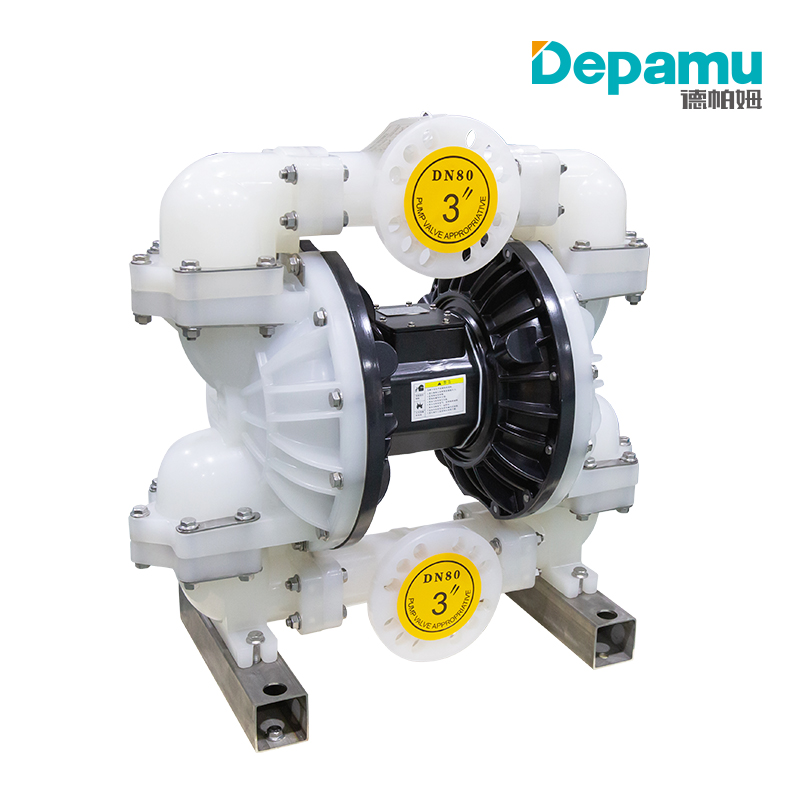
The air-operated double diaphragm (AODD) pump occupies a distinctive niche in industrial fluid handling: it is the pump of choice when the fluid is hazardous, the environment is classified, or the process demands the ability to run dry without consequence. Depamu (Hangzhou) Pump Technology Co., Ltd., headquartered in Hangzhou’s Qiantang New District, has developed a range of AODD pumps that integrate American, German, and Japanese process technologies to meet these demanding requirements. Unlike pumps that rely on rotating shafts, impellers, or crankshafts, the Depamu AODD pump uses compressed air as its sole power source and operates on a principle of balanced pneumatic reciprocation. Understanding how this principle is implemented—through the coordinated action of diaphragms, an air distribution valve, and check valves—is essential to appreciating why these pumps behave the way they do in chemical transfer, agricultural spraying, and other critical services. This article examines the working principle of the Depamu air-operated diaphragm pump in detail, from the fundamental stroke sequence to the architectural features that govern its performance envelope.
2. The Core Principle: Balanced Pneumatic Reciprocation
At its most fundamental level, the Depamu AODD pump is a positive-displacement device in which two flexible diaphragms, linked by a common shaft, reciprocate in opposition to each other. The pump comprises two symmetrical fluid chambers, each bounded by a flexible diaphragm, connected by a common center block that houses the air distribution valve. Compressed air—typically supplied at 2 to 7 kgf/cm² (approximately 30 to 100 psi)—is directed alternately behind each diaphragm by the air distribution valve. This alternating pressurization is the engine of the pump: it is what converts a steady supply of compressed air into a reciprocating mechanical motion, and that motion, in turn, into a pulsating but continuous flow of liquid.
The “balanced” aspect of the principle refers to the fact that the two diaphragms are mechanically linked through a connecting rod or diaphragm shaft. When one diaphragm is pushed forward into its fluid chamber by air pressure, the other is simultaneously pulled backward. The two strokes are not independent events but two halves of a single, coordinated cycle. This linkage is what allows the pump to draw liquid into one chamber while discharging liquid from the other, producing a flow that, while technically pulsating, can be smoothed to a remarkable degree by the pump’s internal geometry and the compliance of the piping system. Depamu specifies that its pneumatic diaphragm pumps can eliminate 90 to 95 percent of pulsation, yielding a flow that is effectively steady for many practical purposes.
3. The Stroke Sequence: From Air Pressure to Fluid Motion
The operating cycle of the Depamu AODD pump can be understood as a repeating sequence of two power strokes and two suction strokes, with the transitions between them governed by the air distribution valve. The sequence begins with the diaphragm pair in one extreme position. Compressed air is admitted behind diaphragm A, pushing it outward into fluid chamber A. Because the two diaphragms are linked, diaphragm B is simultaneously drawn inward, away from fluid chamber B. The outward movement of diaphragm A pressurizes the liquid in chamber A, forcing it through the discharge check valve and out into the discharge manifold. At the same time, the inward movement of diaphragm B creates a vacuum in chamber B, which lifts the inlet check valve and draws a fresh charge of liquid into chamber B from the suction line.
When the diaphragm assembly reaches the end of its stroke, the air distribution valve shifts, redirecting the compressed air from the backside of diaphragm A to the backside of diaphragm B. The cycle then reverses: diaphragm B is pushed outward, discharging the liquid that was drawn into chamber B, while diaphragm A is drawn inward, pulling a new charge into chamber A. This reversal is not a passive consequence of the diaphragms reaching a mechanical stop; it is actively triggered by a pilot mechanism that senses the end of stroke and signals the main air valve to change state. The result is a self-sustaining oscillation, driven entirely by the compressed air supply, that continues as long as air is admitted to the pump and liquid is available at the suction.
4. The Air Distribution Valve: The Pump’s Control Center
The air distribution valve is the component that distinguishes a well-engineered AODD pump from a marginal one. In the Depamu design, the air distribution valve—sometimes referred to as an air reversing valve—is a no-lube, no-stall mechanism that alternately pressurizes and exhausts the air chambers behind the two diaphragms. Its function is deceptively simple: it must route compressed air to one side while venting the other, and then reverse that routing at precisely the right moment. But the execution of that function determines the pump’s reliability, its air consumption, and its ability to restart after a stall.
The reversal is typically initiated by a pilot spool or pilot valve that is mechanically linked to the diaphragm assembly. As the diaphragm shaft reaches the end of its travel, it shifts the pilot spool, which in turn directs a pressure signal to the main air valve, causing it to change position. Depamu’s pumps are equipped with simple and highly reliable air reversing valves that ensure reliable operation across a wide range of applications, and the air distribution valve is designed for no-lube, no-stall performance. The no-stall characteristic is particularly important in services where the pump may be required to restart against a head or after a dry period: a stalled air valve can leave the pump immobilized even when air is available, whereas a no-stall design ensures that the pump will resume cycling as soon as the demand for flow returns.
5. The Diaphragm Assembly and the Seal-Less Architecture
The diaphragm is the heart of the AODD pump and the component that defines its most important operational characteristics. In the Depamu pump, the process fluid is contained entirely within the fluid chambers and the piping connections; the only dynamic interface between the process fluid and the outside world is the diaphragm itself. There is no rotating shaft seal, no packing gland, and no mechanical seal sliding against a shaft. This seal-less geometry eliminates what is, in conventional centrifugal and rotary pumps, the dominant leak path. In a pump handling hydrochloric acid or sodium hydroxide, the shaft seal is the component most likely to fail first, and its failure mode is a directed leak of hazardous fluid. In the Depamu AODD pump, that failure mode is architecturally removed.
The diaphragm assembly typically consists of a flexible diaphragm membrane, often constructed from a chemically resistant elastomer or a composite of PTFE and rubber, clamped between the air side and the fluid side of the pump. Depamu offers diaphragms in materials including PTFE, with compression-moulded construction to address the historical weakness of PTFE—its susceptibility to flex fatigue in cyclic service. The double-diaphragm construction provides a secondary containment barrier: even if the primary diaphragm on one side breaches, the opposite diaphragm and the center block geometry prevent an immediate release of process fluid to the atmosphere. This secondary containment is not a substitute for proper diaphragm maintenance, but it provides an additional margin of safety in critical chemical service.
6. Check Valves: Enforcing One-Way Flow
The check valves are the passive components that rectify the oscillating motion of the diaphragms into a directed flow. Each fluid chamber is equipped with an inlet check valve and a discharge check valve, typically of the ball, flap, or diaphragm type. In the most common configuration, four ball check valves are used: two at the inlets and two at the discharges of the two chambers. At any given moment during the cycle, two of these checks are unseated (open) and two are seated (closed), enforcing the one-way flow of liquid from suction to discharge.
The operation of the check valves is entirely hydraulic, driven by the pressure differential created by the diaphragm motion. When a diaphragm moves outward on its discharge stroke, it pressurizes the fluid in its chamber, seating the inlet check ball and unseating the discharge check ball, so that liquid is forced into the discharge manifold. Simultaneously, the opposite diaphragm moves inward on its suction stroke, creating a low-pressure region in its chamber that unseats the inlet check ball and seats the discharge check ball, so that liquid is drawn from the suction line. The check balls are typically gravity-assisted or spring-assisted in their seating, and their proper functioning depends on the cleanliness and viscosity of the fluid. Depamu’s pumps are designed to handle liquids with viscosity below 10,000 cP and to pass solid particles up to 10 mm in diameter under smooth flow conditions, which places practical limits on the types of slurries and suspensions that can be handled without check valve fouling.
7. Performance Characteristics Arising from the Principle
The working principle of the Depamu AODD pump gives rise to a set of performance characteristics that are not incidental features but direct consequences of the seal-less, air-driven, reciprocating architecture. The pump is self-priming: because the diaphragms can create a vacuum in the suction chamber, the pump can lift liquid from a source below the pump without external priming equipment. Depamu specifies a suction head lift of 7 meters and a head lift of 50 meters, with an outlet pressure of 6 kgf/cm². Head and flow can be steplessly adjusted by throttling the air valve opening, providing a simple and effective means of control without variable-speed drives or complex instrumentation.
The pump can run dry without damage, a capability that follows from the fact that the diaphragms are not lubricated by the process fluid and the air distribution valve requires no oil lubrication. It can also operate against a closed discharge valve for extended periods, because the air pressure simply stalls against the diaphragm without generating the heat and mechanical stress that would destroy a seal-dependent centrifugal pump. These characteristics simplify system design considerably: a tank can be emptied to the heel without dry-run protection interlocks, and a downstream valve can be closed for maintenance without tripping the transfer operation.
The pumping medium is completely separated from the working medium (compressed air), ensuring that the conveyed liquid cannot leak outward and allowing the pump to operate safely even when immersed in the medium. This separation is also the basis of the pump’s suitability for hazardous areas: because the pump is driven by compressed air rather than electricity, it introduces no electrical spark risk, making it inherently appropriate for classified environments where every electrical component becomes a potential ignition source.
8. Limitations and Operational Considerations
No pump principle is without its limitations, and a complete account of the Depamu AODD working principle must acknowledge the constraints that arise from it. The reciprocating action produces a pulsating flow, and while Depamu’s design smooths 90 to 95 percent of that pulsation, some residual pulsation remains and may require surge suppressors or flexible piping in sensitive applications. The pump’s flow rate is dependent on air supply pressure and volume; an undersized air compressor or a restrictive air line will directly limit pumping capacity. Air consumption can be significant, particularly at higher discharge pressures, and the energy efficiency of an air-driven pump is generally lower than that of a comparable electric-motor-driven pump, because compressed air is an expensive energy vector. The check valves are the components most vulnerable to fouling, wear, and obstruction by solids, and their condition directly affects priming, flow stability, and volumetric efficiency. Finally, the diaphragms are wear items: despite advances in PTFE compounding and elastomer formulation, cyclic flexure eventually produces fatigue, and diaphragm replacement is a routine maintenance event that must be planned for in critical services.
9. Conclusion
The Depamu air-operated diaphragm pump works on a principle that is elegant in its simplicity and demanding in its execution. Two linked diaphragms, alternately pressurized by an air distribution valve, create a coordinated sequence of suction and discharge strokes that moves liquid through check valves without any rotating seal, any electrical component, or any oil lubrication in the air path. The seal-less architecture eliminates the dominant leak path of conventional pumps; the air-driven reciprocation enables dry running, closed-valve operation, and stepless flow control; and the double-diaphragm construction provides a secondary containment barrier that is particularly valuable in chemical service. These characteristics are not add-on features but direct expressions of the underlying working principle. Understanding that principle—the balanced pneumatic reciprocation of two diaphragms, the pilot-triggered reversal of the air valve, and the hydraulic rectification of the check valves—is the foundation for specifying, operating, and maintaining Depamu AODD pumps in the services where they are most valuable: the transfer of aggressive, viscous, shear-sensitive, or hazardous fluids in environments where reliability and containment are not optional.