

Depamu Air-Operated Diaphragm Pumps for Chemical Transfer Applications
Chemical transfer is one of the most unforgiving duties in industrial pumping. The fluid may be a concentrated mineral acid, a caustic solution at elevated temperature, a flammable solvent, a shear-sensitive polymer emulsion, or a slurry carrying abrasive solids. The environment may be a classified hazardous area where every electrical component becomes a potential ignition source. The consequence of leakage is rarely limited to equipment damage; it extends to personnel safety, environmental release, and regulatory exposure. It is within this narrow window of operational risk that the air-operated double diaphragm (AODD) pump has earned a durable place, and it is within that same window that Depamu has built a focused engineering proposition for chemical processors.
The engineering logic of air operation in chemical service
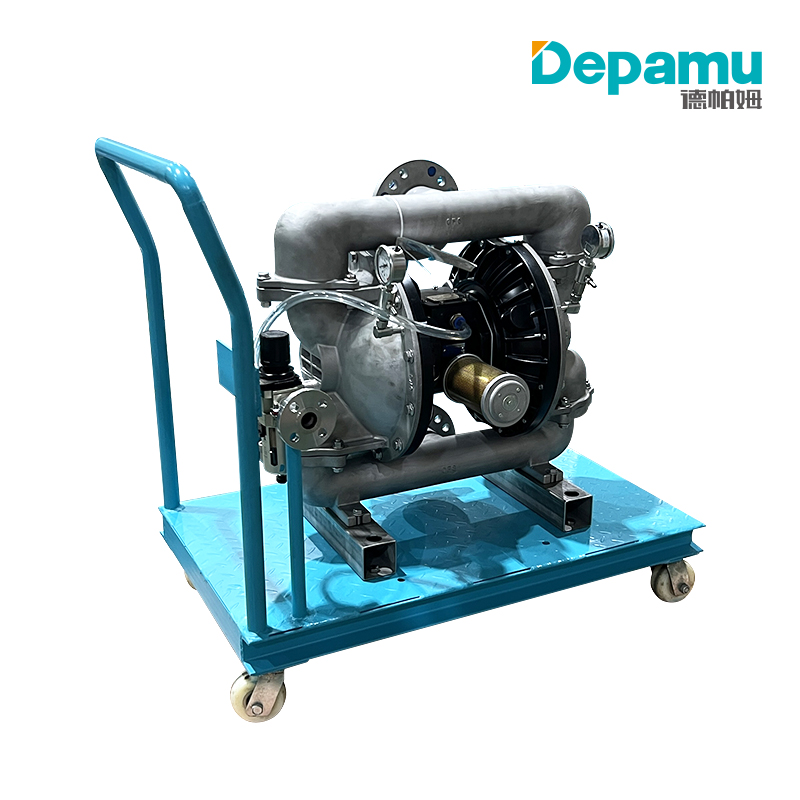
The defining architectural feature of the Depamu AODD pump is the absence of a rotating shaft seal. Two symmetrical fluid chambers, each bounded by a flexible diaphragm, are linked by a common diaphragm shaft. Compressed air—typically at 2 to 7 kgf/cm² (approximately 30 to 100 psi)—is directed alternately behind each diaphragm by an air distribution valve. As one diaphragm is pushed forward into its fluid chamber, the opposite diaphragm is drawn back, creating a vacuum that lifts the inlet check valve and draws a new charge of liquid. The cycle then reverses, producing a continuous, positive-displacement flow without any mechanical seal interfacing with the process fluid.
For chemical transfer, this seal-less geometry produces several consequences that are not merely convenient but operationally decisive. The most immediate is the elimination of the dominant leak path. In a centrifugal or rotary pump handling hydrochloric acid or sodium hydroxide, the shaft seal is the component most likely to fail first, and its failure mode is a directed leak of hazardous fluid. In the Depamu AODD, the process fluid is contained entirely within the fluid chambers and the piping connections; the only dynamic interface is the diaphragm itself, and the double-diaphragm construction creates a secondary containment barrier so that even a primary diaphragm breach does not immediately release process fluid to the atmosphere. The pump can also run dry without damage and can operate against a closed discharge valve for extended periods—conditions that would rapidly destroy a seal-dependent centrifugal pump. In practical chemical transfer terms, this means a tank can be emptied to the heel without a dry-run protection interlock, and a downstream valve can be closed for maintenance without tripping the transfer operation.
Material configuration as the primary chemical-compatibility tool
An AODD pump is only as chemically capable as its wetted path. Depamu’s wetted-material offering spans metals and polymers: pump heads and wetted components can be specified in 304, 316, and 316L stainless steel, PVC, PVDF, polypropylene, and PTFE. This range allows the pump to be configured against the actual corrosion map of the transferred fluid rather than against a single “chemical duty” compromise. Strong mineral acids such as sulfuric and hydrochloric acid generally direct the specification toward PTFE or PVDF wetted surfaces and PTFE diaphragms, while caustic service may permit polypropylene or stainless steel depending on temperature and concentration. Depamu’s PTFE diaphragms are compression-moulded for mechanical integrity in addition to chemical resistance, addressing the historical weakness of PTFE—its susceptibility to flex fatigue in cyclic diaphragm service.
The material decision is not a secondary purchasing detail; it is the point at which the pump either becomes a reliable chemical-transfer asset or a maintenance liability. Depamu’s published guidance is explicit that different diaphragm modifications are required for acid versus alkali service, and that a pump assembled for hydrochloric acid will not survive prolonged exposure to 40% sodium hydroxide without appropriate material adaptation. For the chemical processor, this translates into a selection workflow that begins with fluid chemistry and temperature, proceeds through wetted-material and diaphragm-elastomer selection, and only then addresses flow and pressure.
Hazardous-area operation and the ATEX dimension
Chemical transfer frequently occurs in areas classified for explosive atmospheres, whether because the transferred fluid itself is flammable or because solvent vapors are present in the surrounding environment. The pneumatic drive of the Depamu AODD removes the motor, starter, and electrical control from the pump entirely; the only energy input is compressed air. This does not automatically certify a pump for Zone 0 or Zone 1 service, but the Depamu technology platform, drawing on the DEPA pump heritage, holds ATEX Zone 0 certification—the most stringent classification, covering areas where an explosive gas atmosphere is present continuously or for long periods. Zone 0 certification is uncommon among AODD manufacturers and is particularly relevant to chemical transfer duties involving flammable solvents, methanol injection, or vapor-rich headspaces where the pump may be located in or near the hazardous zone rather than safely outside it.
The practical value of this certification is not simply regulatory compliance. In a chemical plant, the cost of creating a pressurized or purged electrical enclosure around a transfer pump can exceed the cost of the pump itself. A pneumatically driven, Zone 0-certified AODD pump simplifies the area classification strategy: the pump does not introduce an ignition source, and the surrounding instrumentation and control can be designed around a reduced electrical footprint.
Field evidence: offshore chemical transfer and the CNOOC deployment
The most demanding validation of Depamu AODD technology in chemical transfer comes from offshore oil and gas service, where the pump must simultaneously survive salt-laden marine corrosion, explosive hydrocarbon atmospheres, and the space constraints of a platform deck. Depamu AODD pumps have been deployed with China National Offshore Oil Corporation (CNOOC) in the South China Sea and Bohai Bay, transferring produced fluids, chemical additives, completion fluids, and viscous oily sludge with varying solids content and viscosity. The offshore case illustrates several AODD characteristics in combination: self-priming from a tank or sump without a foot valve, dry-running tolerance during tank stripping, the ability to handle solids and high-viscosity fluids without the close-clearance blockage risk of a rotary pump, and stepless flow adjustment by regulating supply-air pressure rather than by electrical speed control. The double-diaphragm containment barrier is particularly relevant for offshore chemical injection, where the transferred fluid may be a toxic corrosion inhibitor or flammable methanol and a leak is both a safety and an environmental event.
This offshore experience does not imply that the AODD is the correct choice for every chemical transfer duty on a platform or in a plant. It does demonstrate that the seal-less, pneumatically driven architecture is not a low-technology fallback; it is a deliberate engineering choice for services where leakage consequence, hazardous-area classification, and fluid variability outweigh the efficiency advantages of a centrifugal or electrically driven positive-displacement pump.
Where the AODD reaches its limits—and how Depamu’s wider portfolio responds
A candid assessment of chemical transfer must acknowledge the boundaries of AODD technology. The air motor is inherently less energy-efficient than a direct electric drive, and in continuous, high-flow chemical transfer the compressed-air consumption becomes an operating-cost penalty. Pulsation is intrinsic to the reciprocating diaphragm cycle; while it is tolerable in many transfer duties, it becomes problematic when the pump is required to meter a catalyst or a polymerization modifier with tight stoichiometric control. Depamu’s response to these limits is not to overstate the AODD’s range but to position it within a broader diaphragm-pump portfolio. For high-pressure chemical services—liquid ammonia transfer, urea synthesis, or high-pressure process injection—Depamu supplies hydraulically actuated process diaphragm Reciprocating Pumps built to API 674, with contained liquid ends that preserve the leak-free principle while reaching discharge pressures that an air-driven AODD cannot achieve. For precise chemical metering, particularly in fluorochemical and fine-chemical production where metering accuracy of ±0.5% and zero dead volume are required, Depamu’s hydraulic and mechanical diaphragm Metering Pumps provide the controlled reciprocating displacement that an AODD cannot deliver. The AODD, the high-pressure process diaphragm pump, and the metering pump are therefore complementary answers to different chemical-transfer questions: the AODD for safe, flexible, hazardous-area transfer under variable fluid conditions; the high-pressure diaphragm pump for contained transfer at elevated pressure; and the metering pump for precise, low-pulsation dosing.
Conclusion: the AODD as a risk-management instrument in chemical transfer
The chemical transfer duty is rarely defined by flow rate alone. It is defined by consequence: what happens if the seal leaks, if the pump runs dry, if the motor becomes an ignition source, or if the transferred fluid changes from a benign solvent to a corrosive slurry. Depamu’s air-operated diaphragm pump addresses those consequence dimensions directly through its seal-less, pneumatically driven architecture, its broad wetted-material configuration range, its ATEX Zone 0 certification path, and its field-proven record in offshore chemical service. It is not the most efficient pump for every chemical transfer duty, nor is it the correct choice for high-pressure synthesis loops or precision metering. But within its intended envelope—corrosive, hazardous, variable, and leak-sensitive chemical transfer—the Depamu AODD represents a mature engineering answer to a persistent operational problem, and a component whose value is measured less by its own service life than by the incidents it prevents.