

Depamu Chemical Dosing System: Hydraulic Diaphragm Metering Pumps for Chemicals and Water Treatment
In industrial fluid handling, the margin between a well-controlled process and a costly operational failure is often measured in milliliters per hour. Whether neutralizing a corrosive effluent stream, scavenging dissolved oxygen in a high-pressure boiler, or maintaining a residual disinfectant concentration in municipal drinking water, the metering pump is the component that translates process intent into chemical reality. Among the technologies deployed for this task, the Hydraulic Diaphragm Metering Pump occupies a distinctive position: it combines the absolute containment of a diaphragm barrier with the pressure capability and hydraulic stability of a plunger system. Depamu (Hangzhou) Pumps Technology Co., Ltd., a manufacturer whose portfolio encompasses more than 4,000 specifications and models, has built its hydraulic diaphragm range around this hybrid principle, addressing the twin demands of chemical processing and water treatment. This article examines the Depamu hydraulic diaphragm platform—its operating logic, its engineering architecture, its technical safeguards, and its application profile across the chemical and water sectors.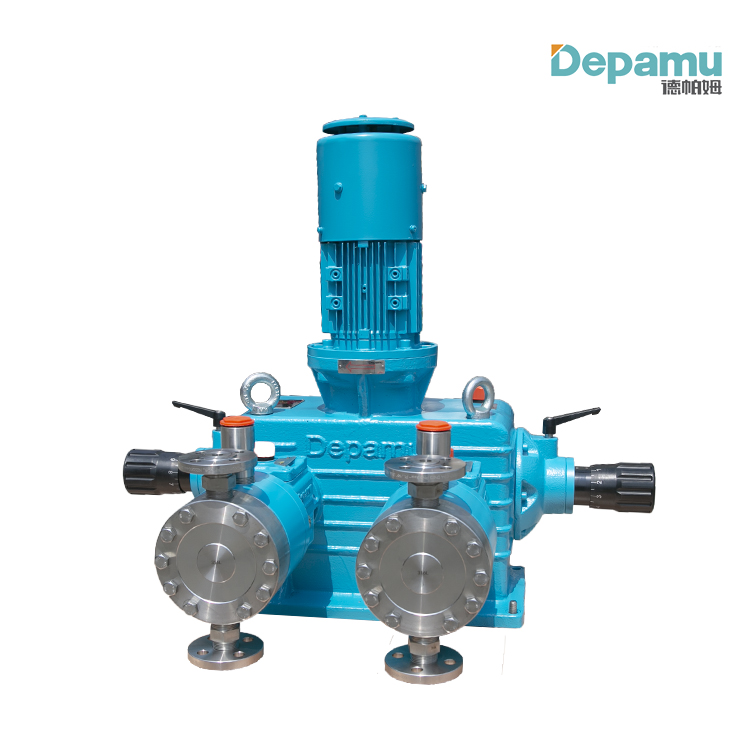
The Hydraulic Diaphragm Principle: Isolation Without Mechanical Compromise
A metering pump is, by definition, a positive displacement device engineered to deliver a precise and adjustable flow against a system pressure. In a conventional mechanically actuated Diaphragm Pump, the drive acts directly on the diaphragm, creating stress concentrations at the point of mechanical attachment and limiting the pressures the diaphragm can reliably withstand. The hydraulic diaphragm design interposes a chamber of hydraulic oil between the mechanical drive and the process diaphragm. A piston reciprocates within this oil chamber, pressurizing the hydraulic fluid, which in turn deflects the diaphragm uniformly across its entire surface.
This hydraulic intermediation produces three operational consequences of direct relevance to chemical and water treatment duty. First, the oil cushion absorbs shock loads and distributes force evenly, extending diaphragm service life and supporting stable volumetric output even against fluctuating discharge pressures. Second, because the hydraulic system transmits force without a direct mechanical link, the pump can achieve discharge pressures that would rapidly fatigue a mechanically driven diaphragm. Third—and most consequentially for hazardous or valuable media—the diaphragm physically isolates the process fluid from every moving mechanical component. The pumped chemical contacts only the diaphragm and the wetted pump head; the risk of leakage through dynamic packing seals, a persistent concern with plunger designs, is eliminated by architecture rather than by maintenance intervention.
The Depamu DP(M)WA Platform: Architecture and Precision
Depamu’s flagship hydraulic diaphragm line, the DP(M)WA series, illustrates how this principle is translated into a production platform. The series delivers a flow rate adjustment range of 10% to 100% with a metering accuracy of ±0.5%. The pump head can be configured as hydraulic diaphragm, plunger, or piston type, allowing a single drive platform to serve different fluid and pressure requirements without redesigning the entire machine. Motor power options begin at 0.37 kW, with representative models spanning the application spectrum: the DP(M)WA75/2.7/4.0 delivers 75 L/h at discharge pressures of 2.7 MPa and 4.0 MPa, while the DP(M)WA212/1.0/1.4 provides 212 L/h at 1.0 MPa and 1.4 MPa. For duties requiring higher pressure, the DP(M)WA plunger variant extends single-pump-head flow to 12,100 L/h and pressure ratings to 228 MPa, underscoring the scalability of the underlying drive concept.
The precision originates partly in the transmission. Depamu employs a patented integrated sleeve adjustable eccentric mechanism that converts rotary motor motion into reciprocating stroke with stepless adjustment across the full 0% to 100% range. The low-speed connecting rod uses roller bearings rather than conventional bushings, and the worm gear pair runs in an oil bath—choices that reduce wear and maintain stroke consistency over extended service intervals. High-precision inlet and outlet check valves complete the metering loop, ensuring that the volume displaced by each stroke corresponds closely to the volume delivered. The result is not merely nominal accuracy at a single set point but repeatable accuracy across the operating range, a distinction that matters in water treatment, where regulatory compliance and chemical consumption are both tied to the consistency of dose over thousands of operating hours rather than to a single calibration certificate.
Safety Architecture: Protecting the Pump, the Process, and the Environment
The hydraulic diaphragm pump’s containment advantage is only as reliable as its internal safeguards. Depamu addresses this through an integrated protection scheme built around the interaction of four elements: the diaphragm itself, a limit valve, a compensation valve, and an internal safety valve. The limit valve is manufactured to an accuracy of ±0.002 mm, with surface hardness of 60–70 HRC and roughness of 0.4 μm, allowing it to respond precisely to diaphragm position and prevent over-stroke or under-stroke conditions that would degrade metering accuracy or stress the diaphragm. The compensation valve and internal safety valve work in concert to perform automatic air discharge and oil replenishment, purging gas that may accumulate in the hydraulic chamber and maintaining the correct oil volume without manual intervention. This self-regulating behavior is particularly valuable in unattended or remote installations, where the pump must maintain performance across varying process conditions without routine operator attention.
The diaphragm itself is a critical determinant of service life. Depamu uses a PTFE macromolecule composite diaphragm subjected to multi-directional rolling and surface quenching treatment, achieving an evenness of 99.92%. This treatment reduces cold flow—the gradual deformation of PTFE under sustained compressive load—and enhances compressive strength, allowing the diaphragm to withstand repeated cycling across a temperature range of −80 °C to 160 °C and a service life of up to 80 million cycles. For hazardous media—toxic, flammable, explosive, or strongly corrosive fluids—double or multiple diaphragms can be specified, and a diaphragm rupture alarm device provides real-time monitoring. Should a diaphragm fail, the alarm prevents process fluid from contacting the hydraulic oil, containing the breach before it escalates into a safety or environmental incident.
Chemical Dosing in Water Treatment: Where Precision Becomes Compliance
Water treatment is, in essence, a sequence of chemical adjustments performed against a backdrop of fluctuating raw water quality and stringent regulatory limits. Each adjustment imposes a distinct demand on the dosing pump, and the hydraulic diaphragm design addresses those demands through a combination of chemical compatibility, containment, and controllable output.
In pH adjustment, whether for coagulation optimization in a municipal plant or neutralization of an industrial effluent, the pump must deliver acid or alkali against a variable system pressure while maintaining a dose proportional to flow or pH feedback. The DP(M)WA series accommodates this through multiple capacity control modes—manual, electrical, pneumatic, and frequency conversion—and through the option of electric actuator installation for automatic remote control. The diaphragm’s PTFE composite construction provides chemical resistance across the pH spectrum, while the hydraulic actuation maintains smooth, uniform diaphragm movement even when the discharge pressure shifts with filter loading or distribution system demand.
Coagulant and flocculant dosing presents a different challenge: the medium may be viscous, shear-sensitive, or prone to deposition, and the dose must track rapid changes in raw water turbidity. Depamu’s DPJY-series Injection Packages integrate the metering pump with solution tanks, level gauges, safety valves, pulsation dampers, piping, and electrical control systems into skid-mounted units configured for specific duties. For water treatment, these packages cover raw water pretreatment, circulating water treatment, boiler water injection, wastewater treatment, and sewage treatment, with configurations ranging from one tank with one pump to multi-tank, multi-pump arrangements. The modular design allows capacity and function to be extended without replacing the entire skid, and the systematic integration avoids the performance gaps that can arise when individual components from different suppliers are assembled in the field.
Disinfection—perhaps the most safety-critical dosing duty in municipal water treatment—places a premium on both containment and repeatability. Chlorine, chlorine dioxide, and hypochlorite are aggressive oxidants; any leakage through a dynamic seal represents both a personnel hazard and a loss of the disinfectant residual that protects public health. The hydraulic diaphragm pump’s static diaphragm seal eliminates the dynamic sealing interface entirely, while the double-diaphragm option and rupture alarm provide a second barrier and a diagnostic signal for critical service. In wastewater disinfection, where dosages must respond to variable flow and microbial load, the pump’s 10%–100% stepless stroke adjustment and ±0.5% metering accuracy support the controlled turndown that regulatory compliance demands.
Boiler water treatment and cooling water systems add another dimension: the chemicals involved—oxygen scavengers, scale inhibitors, corrosion inhibitors, and ammonia for pH control—are often dosed at low flow rates against high pressures. Here the hydraulic diaphragm pump’s ability to combine low-capacity, high-pressure operation with leak-free containment becomes decisive. Depamu’s boiler water injection packages and circulating water injection packages are configured for precisely these duties, integrating the pump with the sampling and control instrumentation needed to verify that the intended dose has reached the water or steam circuit.
Chemical Processing and the Broader Industrial Footprint
Beyond water treatment, the hydraulic diaphragm platform serves chemical and petrochemical processes where zero leakage is non-negotiable. In oil and gas operations, hydraulic diaphragm pumps are specified for injection of corrosion inhibitors, demulsifiers, scale inhibitors, and hydrate preventatives, particularly on offshore platforms and in environmentally sensitive production areas where a packing seal leak would be unacceptable. The same containment logic applies to fine chemical and pharmaceutical processes involving toxic or high-value intermediates, where the pump must meter accurately without exposing operators or the environment to the process fluid.
Depamu’s qualification profile supports this broader positioning. The company holds API 675 certification for metering pumps, a standard that specifies performance, mechanical design, and testing requirements for controlled-volume pumps in petroleum, petrochemical, and natural gas service. The DP(M)WA series’ stated accuracy of ±0.5% compares favorably with the ±1% reproducibility typically associated with API 675-compliant hydraulic diaphragm pumps, though the practical distinction depends on calibration, system design, and operating conditions. Additional certifications include CE marking and management system certifications for quality, environmental performance, and occupational health and safety.
Choosing the Right Configuration: A Note on Application Fit
The hydraulic diaphragm pump is not a universal solution, and Depamu’s range reflects a deliberate differentiation among pump types. Mechanical diaphragm pumps, such as the DPMFWA/WAA and DP Series DPMFXWA, offer simpler construction and lower pressure capability—typically up to 0.6 MPa—and are well suited to lower-pressure water treatment duties where the hydraulic intermediation of the DP(M)WA line would add unnecessary cost and complexity. Plunger Metering Pumps, including the DP(M)ZA series, remain the choice for the highest pressures and for media where diaphragm compatibility is not a constraint, achieving flow capacities and pressure ratings beyond the hydraulic diaphragm envelope. The hydraulic diaphragm pump occupies the middle ground: it provides the leak-free containment that plunger designs cannot guarantee and the pressure capability that mechanical diaphragms cannot sustain, making it the default specification when the process fluid is hazardous, the pressure is elevated, and the cost of leakage—financial, environmental, or human—outweighs the incremental capital cost of the hydraulic platform.
Conclusion
The Depamu hydraulic diaphragm metering pump is best understood not as a single product but as an engineering architecture for solving the containment–precision–pressure trilemma in chemical dosing. Its hydraulic oil intermediary isolates the process fluid from mechanical seals while transmitting force efficiently enough to support elevated discharge pressures. Its DP(M)WA platform delivers ±0.5% metering accuracy across a 10:1 turndown, with a safety architecture—limit valve, compensation valve, internal safety valve, and rupture alarm—that protects the pump, the process, and the environment in equal measure. Its application footprint extends from municipal pH adjustment and disinfection to boiler water treatment and oilfield chemical injection, supported by skid-mounted injection packages that translate individual pump performance into system-level reliability. In an era when water treatment regulations are tightening and chemical processes are increasingly scrutinized for containment integrity, the hydraulic diaphragm principle remains a foundational technology—and Depamu’s implementation of it offers a concrete expression of how precision fluid handling can be made both safe and repeatable at industrial scale.