

Depamu Progressive Cavity Single Screw Pump for Sewage Sludge / Polymer Chemicals Dosing
Introduction
In the demanding landscapes of municipal wastewater treatment and industrial chemical processing, the reliable transfer of difficult fluids remains a cornerstone of operational success. From the abrasive, high-solids nature of sewage sludge to the precise metering requirements of polymer flocculants, the equipment selected must navigate a complex matrix of viscosity, solids content, and chemical aggression. The progressive cavity (PC) pump, a positive displacement technology recognized for its ability to handle such challenging media with minimal shear, has emerged as an industry standard. Among the manufacturers of this technology, Depamu (Hangzhou) Pumps Technology Co., Ltd. has established itself as a significant player. Founded in 2003 and headquartered in Hangzhou's Qiantang District, Depamu is a high-tech enterprise specializing in the research, development, production, and sales of fluid handling equipment including single screw pumps, Metering Pumps, and chemical dosing systems. This article examines the Depamu progressive cavity single screw pump, analyzing its operational principles, key features, and suitability for the twin critical applications of sewage sludge transfer and polymer chemical dosing.
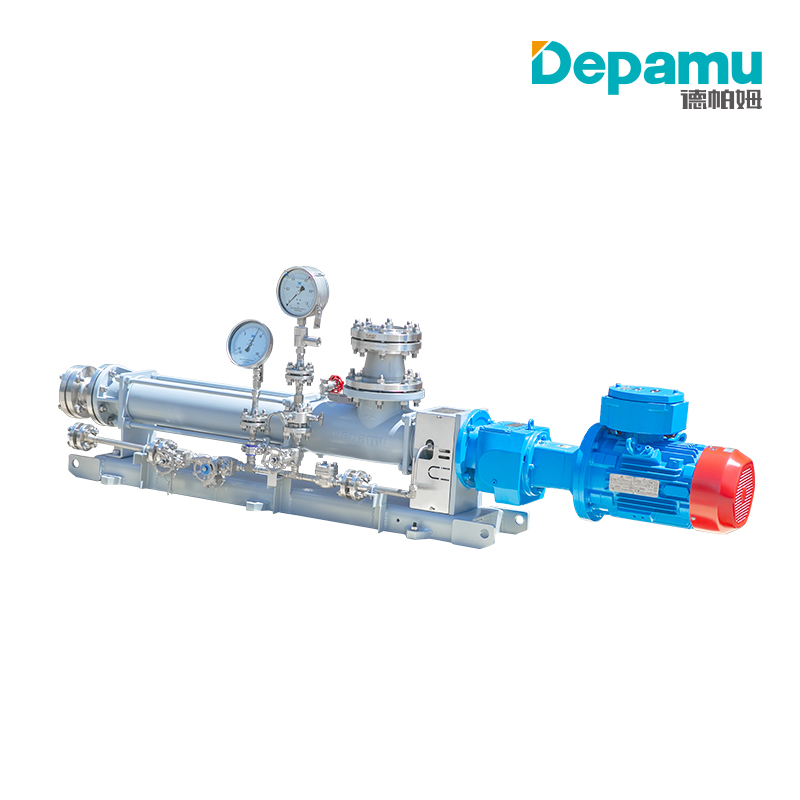
Operational Principle and Design
The functionality of the Depamu progressive cavity pump is rooted in a design that has proven effective for over nine decades. The pump consists of two primary components: a single external-thread helical rotor, typically made of metal, and a double internal-thread stator, usually manufactured from an elastomer such as natural rubber (NR), nitrile (NBR), or fluorocarbon (FPM). The rotor turns eccentrically within the stator, creating a continuous, interference-fit seal. This action forms a series of sealed, discrete cavities that progress linearly from the suction to the discharge port as the rotor rotates.
This mechanism defines the pump's key advantages. The cavities move the fluid without significant compression or turbulence, resulting in a smooth, virtually pulsation-free flow. This low-shear characteristic is vital for handling shear-sensitive fluids, such as polymer solutions, where mechanical degradation would compromise the chemical's effectiveness. Furthermore, the positive displacement nature of the design allows for consistent volumetric flow, which is directly proportional to the rotational speed, making it an inherently suitable platform for precise metering and dosing applications.
Engineering and Performance Specifications
Depamu manufactures its progressive-cavity pumps following rigorous industrial quality requirements for reliable real-world industrial service. The company's product line demonstrates a significant capacity for handling difficult media. According to Depamu specifications, their pumps can handle fluids with a viscosity up to 2 million centipoise (cP) and slurries with a solid content of up to 60%. This capability places them firmly in the realm required for demanding sludge transfer duties.
The flow rate range is extensive, spanning from 0.1 to 3000 m³/h, with a maximum discharge pressure reaching 1.5 MPa for standard configurations. For applications requiring higher pressures, a multistage design can achieve up to 3.0 MPa. A notable feature of Depamu's design is the double support structure, which enhances rotor stability and contributes to higher achievable pressures and a longer operational lifespan. The pumps also boast excellent self-priming capabilities, with a maximum suction lift of up to 9 meters, a feature that simplifies installation and operation.
Application: Sewage Sludge Transfer
Sewage sludge is a notoriously challenging medium. Typically defined as sludge with a solids content ranging from 1% to 12%, it is an abrasive, viscous, and non-uniform fluid that may contain grit and fibrous material. Moving this material from primary and secondary clarifiers to digesters, thickeners, and dewatering equipment requires a pump capable of handling high solids content while maintaining efficiency under harsh conditions.
Depamu progressive cavity pumps are well-suited to this application. Their metal rotor and elastomer stator construction is inherently designed to withstand the passage of abrasive particles. The pump is capable of conveying incompressible materials up to 80 mm in diameter, which significantly reduces the risk of clogging—a common problem with other pump types. Additionally, because flow rate is related to rotational speed, operators can control wear caused by abrasive materials by reducing pump speed, a key operational strategy for extending the service life of rotor and stator components. The pumps are available with specialized stator materials such as nitrile rubber (NBR) and fluorocarbon (FPM), ensuring compatibility with the chemical and thermal characteristics of the sludge being handled.
In wastewater treatment plants, progressive cavity pumps are frequently deployed as sludge feed pumps to dewatering equipment such as belt filter presses, centrifuges, and screw presses. The pump's ability to deliver a consistent, non-pulsating flow ensures stable operation of downstream dewatering processes, which in turn improves cake dryness and reduces polymer consumption.
Application: Polymer Chemical Dosing
Polymer dosing is another critical unit operation in wastewater treatment, where polyelectrolytes (flocculants) are added to sludge to promote agglomeration of fine particles and facilitate dewatering. The accuracy and reliability of this dosing process directly affect both treatment performance and operational costs, as polymer chemicals represent a significant expense in sludge treatment.
The progressive cavity pump's positive displacement design makes it an excellent platform for polymer dosing applications. Because the volumetric flow rate is directly proportional to rotational speed, precise and repeatable dosing can be achieved by adjusting pump speed via a variable frequency drive (VFD) or similar control mechanism. This precision is essential for maintaining the correct polymer-to-sludge ratio, as under-dosing leads to poor dewatering performance and over-dosing wastes costly chemicals.
One of the most significant advantages of the Depamu progressive cavity pump in polymer dosing is its low-shear pumping action. Polymer solutions are shear-sensitive: excessive mechanical agitation or turbulence during transfer can degrade the long-chain molecular structure of the polymer, reducing its flocculation effectiveness. The progressive cavity design moves the fluid through sealed cavities with minimal turbulence, preserving the molecular integrity of the polymer solution.
Design Considerations for Polymer Dosing Systems
In a typical polymer dosing system for sludge dewatering, polymer is prepared in a make-up unit, diluted to the desired concentration, and then transferred via progressive cavity Dosing Pumps to injection points in the sludge feed line or directly into the dewatering equipment. The dosing pump must deliver the polymer solution at a rate that can be precisely controlled and, ideally, proportionally paced to the sludge feed rate. Progressive cavity dosing pumps are commonly used for this purpose because they provide a consistent, pulsation-free flow that ensures uniform mixing with the sludge stream.
Depamu offers a range of pump configurations suitable for polymer dosing, from compact units for small treatment plants to larger systems for high-capacity municipal facilities. The pumps can be equipped with various stator elastomers to ensure compatibility with the specific polymer chemistry being dosed, whether the polymer is in concentrated or dilute form. For optimal performance, polymer dosing pumps should be equipped with dry-run protection and overpressure protection to prevent damage during operation.
Material Selection and Customization
The selection of appropriate materials for the rotor and stator is critical for pump longevity and performance, particularly in the challenging environments of sludge transfer and polymer dosing. Rotors are typically manufactured from alloy steel or stainless steel with a wear-resistant coating such as hard chrome plating. The stator is formed from an elastomer injected into a metal tube and chemically bonded to it. Depamu offers stator materials including natural rubber (NR), nitrile rubber (NBR), and fluorocarbon rubber (FPM) to accommodate different chemical and thermal conditions.
For sludge applications, nitrile rubber is commonly specified due to its good resistance to abrasion and moderate chemical resistance. Fluorocarbon rubber is preferred where the sludge contains aggressive chemicals or is processed at elevated temperatures. The correct selection of rotor coating and stator elastomer has a direct impact on pump service life and should be carefully matched to the specific medium being pumped.
Maintenance and Operational Reliability
Progressive cavity pumps are known for their robust construction and ability to operate for extended periods without major service intervention. However, certain maintenance practices contribute to maximizing service life and minimizing downtime. The most common cause of wear in progressive cavity pumps is abrasion of the rotor and stator due to high grit content in the pumped medium or operation under dry-run conditions.
To mitigate abrasive wear in sludge applications, regular inspection of the rotor and stator is recommended. When pump efficiency begins to decline, stator life can be extended by up to 50% simply by reversing the stator. In polymer dosing applications, maintaining proper pump speed and ensuring that the polymer solution remains within the specified viscosity range are key to preventing premature wear. Depamu's double support structure, mentioned earlier, contributes to improved rotor stability and longer operational lifespan, reducing the frequency of maintenance interventions.
Proper filtration of the pumped medium to remove oversized abrasive particles before they enter the pump can significantly reduce wear rates. Additionally, controlling operating conditions—maintaining optimal pressure, temperature, and flow rates—reduces stress on pump components and contributes to overall system reliability.
Comparative Advantages Over Alternative Pump Technologies
Centrifugal pumps, while efficient for clean, low-viscosity liquids, are fundamentally unsuited to the challenges presented by sludge and polymer solutions. When viscosity exceeds approximately 300 cSt, centrifugal pump efficiency declines sharply, with documented head losses of 8 meters or more and efficiency reductions of 20% at viscosities approaching 800–1000 cP. Above this threshold, positive displacement pumps become the preferred solution, and among PD pump technologies, the progressive cavity pump has emerged as the reference technology for viscous, solids-laden, and shear-sensitive fluids.
Compared to diaphragm metering pumps, which are also used for chemical dosing, progressive cavity pumps offer the advantage of handling higher viscosity fluids and higher solids content without the risk of valve fouling or blockage. Diaphragm Pumps are limited by the check valves that control flow, which can become clogged or worn when handling slurries or viscous polymer solutions. The progressive cavity pump has no valves in the flow path, eliminating this failure mode entirely.
Compared to peristaltic pumps, which also offer low-shear pumping and are used for polymer dosing, progressive cavity pumps generally provide higher flow rates and discharge pressures, making them suitable for larger-scale municipal and industrial applications. Peristaltic pumps are typically limited to lower flow rates and require frequent replacement of the flexible tubing, which can be a significant ongoing operating cost.
Conclusion
The Depamu progressive cavity single screw pump represents a mature and highly capable solution for the two most demanding fluid handling challenges in wastewater treatment: sewage sludge transfer and polymer chemical dosing. Its positive displacement, low-shear operating principle makes it uniquely suited to handling viscous, abrasive, and shear-sensitive media that would degrade or clog other pump types. With the ability to handle viscosities up to 2 million cP, solids content up to 60%, flow rates from 0.1 to 3000 m³/h, and discharge pressures up to 3.0 MPa, Depamu's pump range covers the full spectrum of municipal and industrial wastewater treatment requirements.
For sludge transfer, the pump's robust construction and solids-handling capability ensure reliable operation in the most abrasive conditions. For polymer dosing, its precise volumetric metering and gentle, low-shear pumping action preserve polymer effectiveness while enabling accurate chemical consumption control. With proper material selection, appropriate maintenance practices, and careful attention to operating conditions, Depamu progressive cavity pumps can deliver long, reliable service life and contribute to the overall efficiency and cost-effectiveness of wastewater treatment operations. As municipalities and industries continue to face tightening environmental regulations and rising operational costs, the selection of reliable, efficient pumping equipment has never been more important—and the progressive cavity pump, exemplified by Depamu's engineering, remains a proven and trusted choice for these critical applications.