

Depamu Triple Screw Pumps: Engineering Precision for Efficient Fuel and Oil Transfer
Introduction
In the sprawling ecosystems of oil refineries, marine engine rooms, power plants, and hydraulic power units, the reliable transfer of lubricating and fuel fluids is not merely a logistical concern; it is the lifeline of operational continuity. Among the diverse array of pumping technologies available, the triple screw pump has earned a distinguished reputation for its unique ability to combine high pressure with quiet, pulse-free flow, particularly when handling viscous, lubricating liquids. Depamu (Hangzhou) Pumps Technology Co., Ltd., a high-tech enterprise with over two decades of engineering pedigree and technology rooted in advanced German engineering principles, has refined this technology to meet the rigorous demands of modern fluid handling. This article provides a comprehensive technical analysis of Depamu's Triple Screw Pumps, focusing on their application in fuel and oil transfer. It explores their mechanical architecture, operational physics, performance specifications, and the intrinsic advantages that make them a preferred solution over alternative positive displacement and centrifugal pumps in the petrochemical, marine, and power generation sectors.
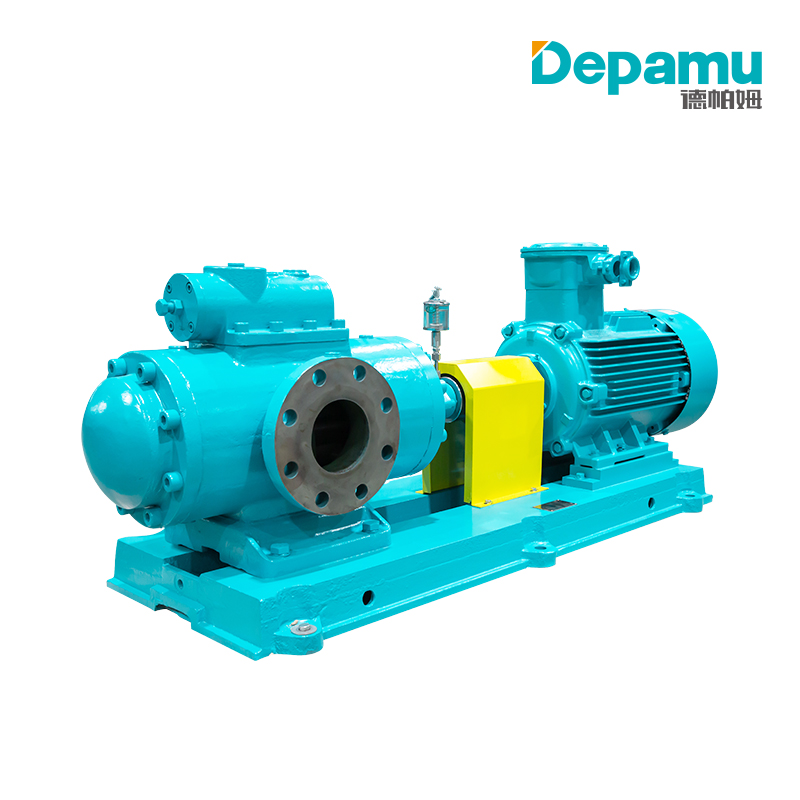
Fundamental Architecture and the "Fluid Seal" Principle
The Depamu triple screw pump, available in the DPSN and DP3G series, operates on a hydrodynamic principle fundamentally different from centrifugal pumps that rely on high-speed impellers or gear pumps that use meshing teeth. The core of the pump consists of three rotors: one central power rotor (the drive screw) and two idler rotors (the sealing screws), all intermeshing within a precision-machined liner or housing. As the drive screw rotates, typically driven directly by an electric motor, the two flanking idler screws rotate in the opposite direction. A defining characteristic of this design is that, under normal operating conditions, there is no metal-to-metal contact between the driving and driven screws.
The engineering brilliance of the triple screw pump lies in the "fluid seal" concept. The clearances between the screws and the housing are meticulously calculated. The pumped liquid itself—whether heavy fuel oil (HFO), diesel, or hydraulic fluid—fills these gaps, creating a dynamic hydraulic seal. This means the pump is self-lubricating, provided the fluid viscosity is within the operational range. The pressurized liquid drives the slave screws to rotate around their axes, resulting in almost negligible mechanical friction and drastically extending the pump's lifespan. Depamu has developed mature technologies to prevent wear issues during startup and shutdown, when the screws may momentarily come into direct contact, using screws with superior strength, surface hardness, and processing precision to withstand such transient conditions.
Operational Physics: Laminar Flow and Pulse-Free Delivery
To understand why the Depamu triple screw pump is specified for critical applications like diesel loading or hydraulic supply, one must analyze the physical behavior of the fluid as it passes through the pump. The geometry of the screws creates a series of distinct, sealed cavities. As the screws rotate, these cavities move axially from the suction port to the discharge port. Crucially, the fluid does not rotate or churn inside the pump; it moves in a straight line. This axial laminar flow eliminates turbulence, foam, and emulsification.
This operational physics yields two decisive advantages. First, for hydraulic oil systems, where air entrainment leads to spongy control responses and component cavitation, the gentle, non-churning action is a significant advantage over gear pumps. Second, the triple screw pump produces a continuous, uniform flow rate. As the screw threads progressively mesh, they displace fluid smoothly without the trapping and releasing action that causes pressure spikes in piston pumps. This quasi-pulse-free flow reduces stress on downstream piping, valves, and instrumentation, making these pumps ideal for precise burner supply in boilers or servo-valve feed in hydraulic systems. Furthermore, Depamu designs its triple screw pumps with a high suction lift capability, often reaching up to 8 meters, eliminating the need for expensive vacuum priming systems or bottom foot valves and simplifying installation.
Performance Specifications and Model Variants
Depamu offers two primary series of triple screw pumps, the DPSN series and the DP3G series, both sharing impressive performance specifications. They deliver a maximum flow rate of 575 m³/h (9,583 L/min) and a maximum differential pressure of 25 bar. The pumps can operate at speeds up to 2,900 r/min and handle fluids with a viscosity range of 3 to 760 cSt and temperatures up to 300°C.
The DPSN series is characterized by a robust design suitable for land-based industrial applications, often allowing for direct coupling to standard electric motors without a gear reducer. The DP3G series emphasizes structural simplicity for maintenance. In smaller flow models (0.2–6.5 m³/h), the pump body and liner are integrated into a single unit with mechanical seals. For medium to large flows, the liner is a separate component fixed within the pump body. This series is particularly prevalent in marine applications, offered in both horizontal and vertical mounting configurations to suit the tight spatial constraints of engine rooms. Depamu also customizes shaft seals based on the medium: mechanical seals are standard for diesel and light hydraulic oils, while gland packing is used for high-temperature fuel oils where mechanical seals might fail due to coking or thermal expansion.
Efficiency in Fuel and Oil Transfer: A Comparative Advantage
The efficiency of a pump is a critical economic and operational metric. Depamu triple screw pumps demonstrate remarkable operating efficiencies versus centrifugal pumps when handling viscous liquids such as heavy crude oil, bunker or residual fuel oils, and low-sulfur fuels. The high-efficiency performance of multiple screw pumps is a clear advantage over centrifugal pumps where liquid viscosity exceeds approximately 20 centistokes (cSt). Centrifugal pumps have a Best Efficiency Point (BEP) that can be difficult to maintain under varying viscosity and flow conditions, whereas screw pumps do not share this limitation. Their low Net Positive Suction Head required (NPSHr) compared to centrifugal pumps makes them particularly useful in installations with limited available NPSH.
When compared to other positive displacement pumps, such as gear pumps, the triple screw pump offers superior efficiency and longevity. Gear pumps suffer from mechanical contact between teeth, leading to wear and performance degradation over time. Depamu's triple screw pump, conversely, offers a "semi-permanent" life regarding the screw assembly due to its non-contact, oil-film-protected operation. The hydrodynamic lubrication principle, combined with high-precision manufacturing, results in a service life that significantly exceeds that of gear pumps or Rotor Pumps. The absence of mechanical contact between screws during normal operation minimizes wear, and the constant clearance between the screws ensures that even at high rotational speeds, slip loss is minimized. This results in high volumetric efficiency and consistent actuator speeds in hydraulic applications.
Application in Fuel Oil and Diesel Transfer
The Depamu triple screw pump is not a "one-size-fits-all" device but a versatile platform optimized for specific fluids within its viscosity and temperature ranges. In power plants and marine bunkering stations, the transfer of Heavy Fuel Oil (HFO) and Marine Diesel Oil (MDO) presents challenges such as high viscosity requiring heating and the risk of solid particulate contamination. Depamu triple screw pumps exhibit a high tolerance for entrained gases and solid particles. In diesel loading scenarios, the pump's ability to handle air-vapor mixtures prevents "vapor lock"—a condition common in centrifugal pumps where vapor pockets stop fluid flow entirely. The robust construction also allows for the integration of safety valves in medium to large flow models. If the discharge line is blocked or pressure exceeds the pre-set limit (max 25 bar differential pressure), the valve re-circulates fluid back to the inlet side, protecting the motor and pipes from overpressure damage.
For diesel fuel, which has a lower viscosity than lubricating oils, Depamu offers pumps capable of handling viscosities as low as 0.5 cSt, ensuring reliable operation even with lighter fuel grades. The positive displacement nature of the triple screw pump ensures that the flow rate remains stable regardless of back-pressure variations—a critical characteristic for fuel injection systems where precise fuel metering is essential. The pumps' ability to handle fluids without agitation means that diesel fuel maintains its integrity during transfer, without the formation of foam or emulsions that could impair combustion efficiency. In marine applications, these pumps are employed in diesel fuel supply systems for sea and river vessels, as well as in ship boiler installations for fuel supply, delivering consistent flow without pressure pulsation to ensure proper atomization and combustion.
For heavy fuel oils (HFO) and residual fuels, the pumps' robust construction and ability to handle high-viscosity fluids come to the forefront. Depamu offers specialized heavy fuel oil pump variants, such as the LQ3G series, designed specifically for heat-preserving bitumen and heavy fuel oil transfer. In oil and gas industry applications, triple screw pumps serve as transfer, circulating, blending, or export pumps for clean, lubricating fluids of varying viscosities, including crude oils, fuel oils, bitumen, grease, and paraffin. The pumps' non-pulsating flow and low shear characteristics are particularly valued in applications where the fluid's chemical or physical properties must be preserved during transfer.
Application in Lubricating Oil and Hydraulic Systems
Lubricating oil transfer represents one of the most demanding and widespread applications for Depamu's triple screw pumps. The pumps are extensively used in industrial settings as lubrication pumps, in hydraulic systems as Hydraulic Pumps, and in various oil delivery systems as transfer and refueling pumps. High-shear pumps can break down the long-chain polymers in multi-grade lubricating oils, reducing their viscosity index and protective capabilities. Because the Depamu triple screw pump moves fluid via laminar flow rather than high-shear agitation, it transfers lube oil without degrading the fluid's properties. The hydrodynamic oil film that forms between the screws not only protects the pump components but also ensures that the lubricating oil itself is transferred without foaming or turbulence, which is critical because aerated or turbulent oil can compromise lubrication effectiveness in downstream equipment such as turbines, compressors, and large machinery bearings.
In the marine industry, triple screw pumps are the preferred choice for main engine lube oil circulation, providing stable pressure and flow output that adapt to varying viscosity and temperature conditions. They are also used as main, auxiliary, and emergency lubrication pumps in marine diesel engines, steam turbines, and industrial gearboxes. For hydraulic oil service, hydraulic systems require instantaneous response and high volumetric efficiency. Depamu's triple screw pumps offer volumetric efficiencies that significantly outperform gear pumps. The constant clearance between the screws ensures that even at high rotational speeds, slip loss is minimized, resulting in consistent actuator speeds and predictable pressure rise, which is critical for machine tools, plastic injection molding machines, and marine steering gear.
Robustness, Reliability, and Manufacturing Quality
Depamu's engineering philosophy emphasizes durability and reliability. The triple screw pump's ability to handle high-viscosity and high-temperature fluids is complemented by its compact structure, small size, light weight, and high-speed capability. The pump is not overly sensitive to gases or pollutants and allows for direct driving by a motor or other prime mover. It can transport highly viscous and high-temperature fluids without generating foam or turbulence in the pumped fluid. The durable structure also facilitates easy mounting and maintenance.
The company's commitment to quality is evident in its manufacturing credentials. Depamu holds over 100 technical patents and has participated in drafting Chinese pump industry standards. Its facility in the Hangzhou Qiantang Area is certified under CE (Europe), ISO 9001, ISO 14001, and ISO 45001. This certification matrix is crucial for international buyers, particularly in the oil and gas sector, where conformance to stringent standards is mandatory. The company's ability to export to markets such as the USA, UK, and France indicates compliance with rigorous environmental and efficiency regulations. To ensure maximum mean time between repairs, Depamu emphasizes operational best practices, including attention to viscosity sensitivity during startup and the avoidance of running the pump completely dry for extended periods, as the fluid film is essential for cooling and lubricating the screw set.
Conclusion
The Depamu triple screw pump represents a convergence of precision engineering, robust industrial design, and a deep understanding of fluid dynamics. By leveraging the hydrodynamic principle of a self-lubricating fluid film and the physics of axial laminar flow, these pumps deliver efficient, pulse-free, and low-shear transfer of fuel oils, diesel, lubricating oils, and hydraulic fluids. Their high volumetric efficiency, strong self-priming capability, and exceptional service life—described as "semi-permanent"—make them a compelling alternative to centrifugal, gear, and piston pumps in critical applications. From the engine rooms of marine vessels to the fuel supply systems of power plants and the hydraulic circuits of precision machinery, Depamu's triple screw pumps provide a reliable and efficient solution for the most demanding fuel and oil transfer challenges. In an era where operational continuity and energy efficiency are paramount, the engineering precision embedded in every Depamu triple screw pump ensures that fluids are moved not just with power, but with intelligence and integrity.