

Depamu Chemical Dosing Unit Skid Mounted for Environmental Engineering
Introduction: The Case for System Integration
Chemical dosing is the quiet, continuous discipline that makes modern environmental engineering possible. Whether the objective is coagulating colloidal solids, precipitating phosphorus, disinfecting effluent, or conditioning sludge, the outcome depends less on the sophistication of the chemistry than on the reliability and precision with which reagents are delivered. A coagulant dosed at the wrong rate will either fail to destabilise particles or leave a residual that burdens downstream processes; a disinfectant applied without stable control can create disinfection by-products as readily as it destroys pathogens. The engineering challenge, therefore, is not the chemistry itself but the coherence of the delivery system.
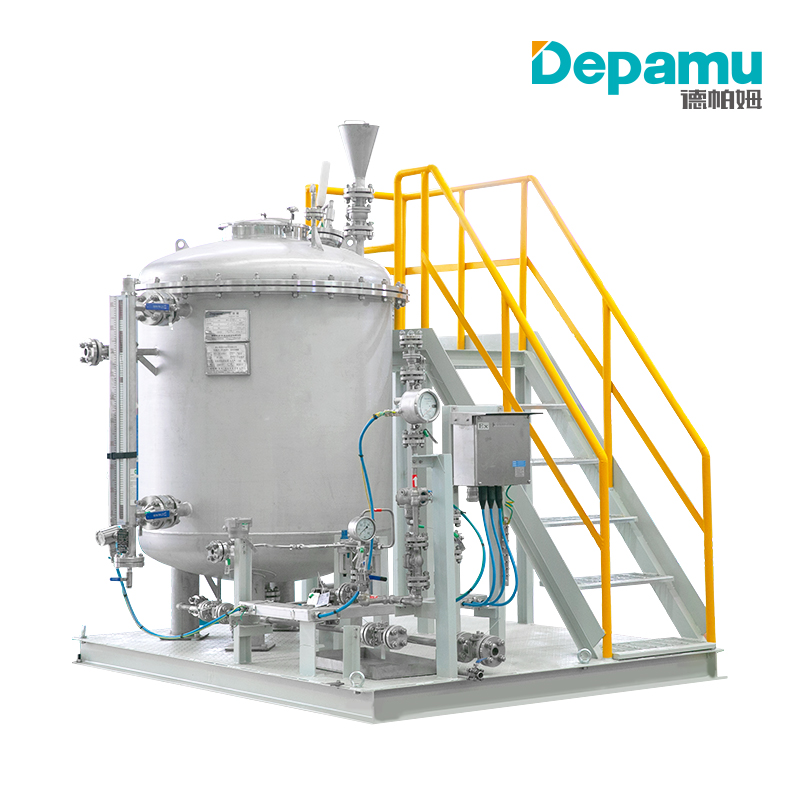
Traditionally, environmental engineers assembled dosing systems from separately procured components—pumps from one vendor, tanks from another, controls from a third—and reconciled their incompatibilities on site. Depamu (Hangzhou) Pumps Technology Co., Ltd. approaches the problem from the opposite direction. Its DPJY-series chemical dosing skids are factory-assembled, pre-piped, pre-wired, and wet-tested as integrated systems, with the Metering Pump’s hydraulic behaviour matched at the engineering stage to the chemical’s properties and the piping network’s pressure profile. For environmental engineering, where treatment trains are increasingly expected to meet stringent nutrient and residual limits under variable hydraulic and load conditions, this systemic logic is not a convenience. It is a precondition for performance.
The Engineering Logic of the Skid as a Coherent System
The fundamental argument for a skid-mounted package over a field-erected “stick-built” installation is systemic coherence. When pumps, tanks, and controls are procured separately, mismatches in hydraulic characteristics, viscosity handling, and suction/discharge dynamics introduce bottlenecks that only surface during commissioning. Depamu’s design philosophy eliminates this failure mode by treating the skid as a single engineered artefact. The package arrives as a complete unit, collapsing installation risk and commissioning time. Industry data on pre-engineered chemical feed systems corroborate the operational value of this approach: installation labour can be reduced by 30–50%, maintenance labour by 20–30%, and chemical efficiency improved by 5–15%, because the integrated design removes the leaks, mismatches, and control-loop conflicts that plague piecemeal assembly.
At the heart of the Depamu skid sits the metering pump, and it is here that the environmental engineering significance of the package becomes clearest. Depamu’s hydraulic diaphragm series spans flow rates from 15 L/H to 5,400 L/H and discharge pressures from 0.4 MPa to 72 MPa, with metering accuracy of ±0.5% and stepless stroke adjustment from 0% to 100%. The hydraulic diaphragm design provides zero leakage to atmosphere—a non-negotiable characteristic when the injected fluid is a corrosive coagulant, a volatile disinfectant, or a polymer solution whose molecular chains are sensitive to shear. The pump is not simply mounted on a frame; its behaviour is selected to match the duty. This distinction matters because environmental reagents are not interchangeable fluids. A polyaluminium chloride solution, a ferric chloride coagulant, a sodium hypochlorite disinfectant, and a high-molecular-weight polyacrylamide flocculant each impose different demands on wetted materials, shear tolerance, and control responsiveness. A system designed as a whole can place dissolution, dilution, and dosing stages in a sequence that protects the reagent from preparation through injection; a system assembled from parts cannot guarantee that protection.
Applications Across the Environmental Engineering Treatment Train
The environmental engineering value of the Depamu skid is best understood by following its deployment across the treatment train, where each stage imposes a distinct chemical duty.
Coagulation and Flocculation. Coagulation and flocculation sit at the hydraulic and chemical heart of most surface-water and wastewater treatment trains. Coagulants—aluminium sulphate, ferric chloride, polyaluminium chloride—destabilise the electrostatic charges that keep colloidal particles in suspension; flocculants, typically high-molecular-weight polyacrylamides, bridge those destabilised particles into settleable floc. The engineering difficulty lies in delivering two chemically incompatible reagents, at two different mixing energies, into a flow whose quality can change hourly, without shearing the delicate polymer chains that make flocculation work. Depamu’s automatic dissolving and dosing devices are specified for flocculation treatment of municipal or industrial wastewater and for flocculation in sludge dewatering, precisely because the integrated skid protects the polymer from unnecessary valves, elbows, or improperly sized pump heads that would break its molecular chains. The material flexibility of the skid—solution tanks available in 304/316L stainless steel, fibre-reinforced plastic, and polyethylene—allows material selection to follow the corrosivity of the reagent rather than forcing the reagent to accommodate a single metallurgy.
Nutrient Removal. Regulatory pressure to prevent eutrophication has made chemical phosphorus precipitation a standard complement to biological nutrient removal. Chemical dosing skids deliver accurate, responsive dosing of ferric salts, alum, or alternative precipitants to achieve low phosphorus limits, often alongside nitrogen control in combined nutrient dosing configurations. The precision of the metering pump becomes a compliance instrument here: overdosing wastes coagulant and consumes alkalinity, while underdosing risks exceeding discharge consents. A skid whose dosing accuracy is held to ±0.5% and whose flow can be paced to the plant’s hydraulic signal transforms nutrient removal from a manual judgement into a controlled unit operation.
Disinfection. Disinfection skids integrate dosing, contact, and residual analysis to maintain the required concentration–time relationship for pathogen inactivation. Sodium hypochlorite dosing requires attention to degassing, material compatibility, and stable residual control; a pre-engineered skid incorporates calibration columns, pump risers for degassing, and integrated residual analysers as part of the package rather than as afterthoughts. The same systemic logic that protects a polymer from shear protects a disinfectant from dose excursions that could produce by-products or leave a residual incompatible with receiving waters.
Sludge Conditioning and Dewatering. Polymer dosing for sludge conditioning is among the most unforgiving dosing duties in environmental engineering. The polymer must be made down, aged, and dosed without mechanical degradation, and the dose must track changes in sludge characteristics. Skid-mounted polymer make-up and dosing systems integrate mixing, dilution, and dosing so that the activated polymer is delivered uniformly to the dewatering device. Depamu’s skid architecture supports this sequence, allowing the polymer preparation and injection stages to be designed as a continuous, protected path rather than as a series of independently optimised components.
Materials, Standards, and the Compliance Environment
Environmental engineering skids operate in a regulatory environment that extends beyond treatment performance to material traceability, safety, and environmental protection. The DPJY series is engineered with reference to recognised standards for metering pumps and packaged systems, including API 675 for controlled-volume metering pumps, ASME requirements for tank and pressure-component fabrication, and ISO 9001:2015 quality-controlled manufacturing. Where skids are deployed in hazardous or corrosive service, ATEX or IECEx certification and NACE MR0175 compliance for sour service may be specified. The practical significance for environmental engineers is that a factory-tested, documented skid reduces the compliance burden: the package arrives with traceable components, hydrostatic test records, and a control philosophy that can be audited as a system rather than reconstructed from a folder of separate submittals.
Conclusion: The Skid as an Environmental Engineering Instrument
The Depamu chemical dosing skid is not merely a convenient packaging of pumps and tanks. It represents a shift in the way environmental engineering thinks about chemical delivery: from a collection of separately specified components to an integrated instrument whose hydraulic, material, and control characteristics are designed as a coherent whole. In coagulation and flocculation, nutrient removal, disinfection, and sludge conditioning, the performance of the treatment process depends on the dosing system behaving predictably across the full range of hydraulic and chemical variability. A skid-mounted, factory-tested, modularly extensible package—supported by metering accuracy in the ±0.5% range, zero-leakage hydraulic Diaphragm Pumping, and material selection that follows reagent corrosivity—provides that predictability as an engineered outcome rather than an operational hope. As environmental standards tighten and treatment trains are asked to achieve more with less chemical waste and shorter installation windows, the integrated dosing skid is less a product category than a structural response to the demands of the field. Depamu’s DPJY series, developed from hydraulic diaphragm metering technology and refined into a modular, system-level architecture, exemplifies that response. For the environmental engineer, the skid is ultimately an instrument of control: it turns a catalogue of reactive chemicals into a precisely dosed, auditable, and reproducible environmental intervention.