

Depamu Industry: Plunger, Hydraulic Diaphragm, and Mechanical Diaphragm Metering Pumps for Acid and Chemical Dosing
Introduction
In chemical processing, the metering pump is a deceptively modest component. It is rarely the most expensive piece of equipment on a skid, yet its failure—whether through leakage, loss of accuracy, or corrosion—can halt production, endanger personnel, and create environmental liabilities. For aggressive acids, the stakes are particularly high. Nitric acid, sulfuric acid, hydrochloric acid, and their mixtures attack most common metals, while many of the elastomers used in conventional pump seals degrade rapidly under oxidizing conditions. The metering pump must therefore satisfy a demanding set of requirements simultaneously: chemical compatibility across a wide range of concentrations and temperatures, repeatable accuracy at small dose rates, and containment integrity that does not depend on a dynamic seal.
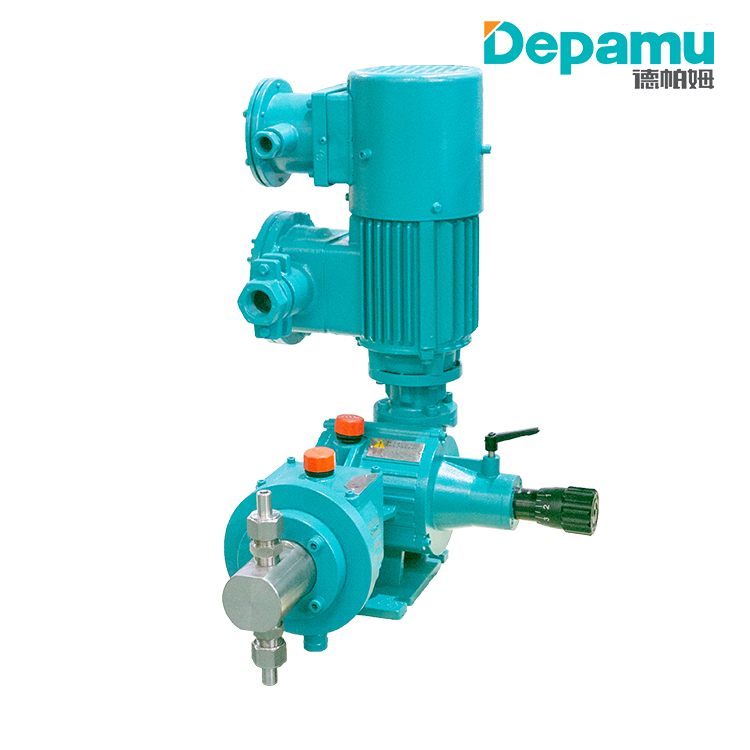
Depamu (Hangzhou) Pumps Technology Co., Ltd. has built its product portfolio around this challenge. The company’s origins trace to the early 1990s, when it introduced Hydraulic Diaphragm Metering Pump technology and scientific management systems from Germany into its Hangzhou manufacturing base. Over the following decades, Depamu expanded into a family of positive displacement metering technologies—packed plunger pumps, hydraulically actuated Diaphragm Pumps, and mechanically actuated diaphragm pumps—each occupying a distinct position on the trade-off curve between pressure capability, containment integrity, and cost. Understanding how these three architectures differ, and where each is best applied, is essential for specifying acid and chemical dosing systems that remain reliable over the long service life expected in process plants.
The Plunger Pump: Direct Displacement and High Pressure
The packed Plunger Metering Pump is the most straightforward of the three architectures. A precision-machined plunger reciprocates within a cylinder, and its forward stroke directly displaces a volume of process fluid through a discharge check valve. On the return stroke, the plunger retracts, creating a vacuum that draws fresh fluid through the suction check valve. There is no intermediate barrier between the plunger and the process fluid. This directness confers a fundamental advantage: the pump can generate very high pressures with a mechanically simple liquid end. Depamu’s DP(M)ZA series, for example, reaches discharge pressures up to 228 MPa and single-pump-head flow rates as high as 12,100 L/h.
The absence of a diaphragm also means that the plunger pump’s metering accuracy is not compromised by the compliance or fatigue characteristics of an elastomer or polymer membrane. Depamu specifies a metering accuracy of ±0.5% across a 10–100% stroke-length adjustment range for its plunger metering pumps, a level of precision that is particularly important in nitration reactions and other acid-dosing duties where stoichiometric control directly affects product quality and process safety. The drive train contributes to this precision. Depamu employs a patented integrated sleeve adjustable eccentric mechanism that allows true stepless stroke adjustment while the pump is running or stationary, driven through a worm gear pair that reduces noise and maintains mechanical efficiency.
The limitation of the packed plunger design lies in its sealing interface. The dynamic seal between the reciprocating plunger and the stationary packing is the primary site for potential leakage, and in acid service even a slow weep can be unacceptable. Depamu addresses this with high-performance plunger materials and engineered packing, and offers ceramic plunger options in the DP(M)DA series for enhanced corrosion and wear resistance. Nevertheless, the packed plunger remains a design in which the process fluid is in direct contact with a moving seal. For toxic, fuming, or environmentally sensitive acids, this characteristic may make the plunger pump less attractive than a diaphragm alternative, even though its pressure capability and accuracy are difficult to match.
The Hydraulic Diaphragm Pump: Plunger Pressure, Zero Leakage
The hydraulically actuated diaphragm pump resolves the packed plunger’s sealing dilemma by inserting a flexible diaphragm between the process fluid and the hydraulic drive. A plunger, operating in a closed hydraulic reservoir, displaces oil rather than process fluid. The oil pressure is transmitted across the diaphragm, which flexes to draw in and discharge the chemical through check valves. The diaphragm periphery is clamped and stationary; only its central region deflects, and the hydraulic fluid on the drive side maintains essentially equal pressure on both faces of the membrane. The result is a liquid end with no dynamic seal in contact with the process fluid. The static seal at the diaphragm’s clamped edge replaces the sliding plunger packing, and the pumped chemical remains fully isolated from the mechanical drive components.
This architecture occupies a distinctive position in the metering pump spectrum: it combines the high-pressure capability of a plunger drive with the containment integrity of a diaphragm barrier. Depamu’s hydraulic diaphragm metering pumps are offered with internal safety valves and compensation valves that perform two critical functions automatically. The compensation valve replenishes hydraulic oil lost through minor seepage and vents accumulated air from the hydraulic chamber, while the internal safety valve protects the diaphragm from over-pressure if the discharge line becomes blocked or a valve is closed against the pump’s stroke. Oil-immersion lubrication of the transmission mechanism further supports long-term reliability.
In acid service, the hydraulic diaphragm’s zero-leakage characteristic is its principal advantage. For nitric acid, which is both strongly oxidizing and highly corrosive, the elimination of a dynamic process-fluid seal removes a chronic failure mode. Depamu specifies metering accuracy of ±0.5% for its hydraulic diaphragm metering pumps, matching the precision of its plunger pumps while offering superior sealing performance. The trade-off is mechanical complexity: the hydraulic system requires a reservoir, replenishment valve, and safety valve, and the diaphragm itself must be selected for chemical compatibility and fatigue resistance. Depamu’s design addresses diaphragm durability through uniformly ground single or double diaphragm constructions, with double PTFE diaphragms available for aggressive acids and a diaphragm status monitoring system that can signal a rupture and allow continued operation until a planned replacement.
The Mechanical Diaphragm Pump: Simplicity and Cost-Effective Containment
The mechanically actuated diaphragm pump simplifies the diaphragm drive by eliminating the hydraulic circuit entirely. A mechanical link—typically a slide bar or eccentric mechanism—drives the diaphragm directly. The diaphragm still provides a static seal between the process fluid and the atmosphere, so the pump retains the leak-free character of a diaphragm design, but the transmission is mechanically simpler and generally less expensive than a hydraulic system. Depamu’s mechanical diaphragm pumps use a patented design that ensures stable flow output, with stepless adjustment available through a fine-tuning knob whether the pump is running or shut down.
The simplification comes at a cost. Without the hydraulic pressure-equalization layer, the diaphragm in a mechanically actuated pump experiences higher localized stresses and is more susceptible to fatigue. The metering accuracy is also typically lower than that of hydraulic or plunger designs. Depamu’s DP-Series mechanical diaphragm pumps specify a steady-state accuracy of ±2% with a 10:1 turndown ratio, and maximum discharge pressures are limited compared with the hydraulic and plunger ranges. For many water-treatment, pH-adjustment, and lower-pressure chemical-feed duties, this level of accuracy and pressure capability is entirely adequate, and the mechanical diaphragm pump offers an economical route to leak-free dosing of corrosive or hazardous chemicals.
Materials, Configuration, and the Acid-Service Decision
Regardless of drive architecture, the wetted materials determine whether a metering pump survives in acid service. Depamu’s pump heads can be supplied in 304, 316, and 316L stainless steels, 904 super-austenitic stainless steel, Hastelloy C, and high-polymer materials such as PTFE and PVDF. The correct selection depends on the specific acid, concentration, temperature, and impurity profile. For nitric acid, 304L stainless steel can be suitable in many environments where it forms a protective passive film, but more aggressive conditions call for 904L or Hastelloy C, particularly at elevated temperatures or in the presence of chlorides. PTFE diaphragms and gaskets are widely used for acid containment, while ceramic plungers in the DP(M)DA series provide corrosion immunity and thermal resistance up to 1000°C at the dynamic seal interface of a plunger pump.
Configuration flexibility further extends the applicability of Depamu metering pumps in chemical processes. Multiple pump heads—up to twelve in a single assembly—can be arranged in parallel either to reduce discharge pulsation by phasing the strokes or to proportion different chemicals with independent flow adjustment on each head. In mixed-acid pickling or nitration processes, this capability allows nitric acid and a co-reactant to be dosed in precise ratio from a single drive frame. Flow adjustment can be manual, electric, pneumatic, or frequency-conversion based, with remote automatic control available through an electric actuator.
The choice among plunger, hydraulic diaphragm, and mechanical diaphragm is therefore not a matter of one technology being universally superior. A packed plunger pump is often the right choice for high-pressure, high-accuracy dosing of a clean or only moderately aggressive acid where a controlled dynamic seal is acceptable and the pressure demands exceed the practical range of diaphragm designs. A hydraulic diaphragm pump becomes preferable when the acid is toxic, fuming, or environmentally sensitive and zero leakage is non-negotiable, while high pressure and ±0.5% accuracy are still required. A mechanical diaphragm pump is appropriate for lower-pressure, lower-cost acid dosing where ±2% accuracy is sufficient and the simplicity of a direct mechanical drive is valued over the hydraulic system’s additional components.
Conclusion
Depamu’s product range reflects a practical recognition that acid and chemical dosing cannot be reduced to a single “best” pump architecture. The packed plunger delivers direct displacement and very high pressure; the hydraulic diaphragm adds a pressure-equalized barrier that eliminates the dynamic process-fluid seal without sacrificing precision; the mechanical diaphragm simplifies the diaphragm drive for cost-sensitive, lower-pressure duties. Across all three, Depamu’s engineering emphasis falls on the details that determine service life in corrosive environments: stepless stroke adjustment, precision check valves, oil-immersion lubrication of the transmission, and a broad wetted-material portfolio that can be matched to the specific acid chemistry. For the process engineer specifying a dosing system, the value of this portfolio lies less in any single model than in the ability to select the architecture that matches the pressure, accuracy, and containment requirements of each acid stream—and to avoid paying for capabilities the application does not need, or accepting compromises it cannot tolerate.