

Depamu high-pressure pump Technology for Feeding Fecal Sludge–Rice Husk Mixtures: Engineering a Path Through the “Unpumpable”
Abstract
The combined handling of fecal sludge (FS) and rice husk (RH) represents one of the more perverse fluid-handling problems in waste-to-energy and sanitation engineering. Fecal sludge is a yield-stress, shear-thinning non-Newtonian paste that stiffens on standing; rice husk is a fibrous, low-bulk-density lignocellulosic residue that wraps around impellers and bridges across narrow passages. Together, they form a heterogeneous, abrasive, and intermittently cohesive feed stream that defeats centrifugal pumps and challenges even purpose-built positive displacement machines. This article examines how Depamu’s high-pressure piston and Screw Pump platforms can be configured to feed such mixtures reliably, and why the correct answer is less a single “magic pump” than an engineered pump–process train. Drawing on Depamu’s DP(M)DA/XAA piston pump and single-screw pump portfolios, the discussion covers rheological constraints, solids-handling limits, wear and materials selection, and the system-level architecture required to turn an “unpumpable” blend into a controlled feed stream.
1. Introduction: A Mixture That Refuses to Behave
Fecal sludge and rice husk are increasingly paired not by accident but by design. In co-hydrothermal liquefaction (co-HTL), rice husk serves simultaneously as a lignocellulosic co-feedstock and as a total-solids regulator, enabling biocrude yields approaching 60 wt% at a 1:1 FS:RH ratio and 15.5 wt% total solids. In co-pelletization and briquetting, rice husk powder is blended with fecal sludge charcoal to improve mechanical strength and thermal properties. In co-digestion and composting studies, rice husk is evaluated as a bulking agent and carbon source for fecal sludge stabilization.
Each of these pathways begins with the same mundane but formidable step: getting the mixture into the reactor, pelletizer, or digester at a controlled rate and pressure. This is where the engineering difficulty concentrates. Fecal sludge at the solids concentrations relevant to these processes behaves as a Bingham plastic or a yield-pseudoplastic material with a pronounced yield stress; it does not flow until a threshold pressure is exceeded, and its apparent viscosity falls sharply under shear but recovers when agitation stops. Rice husk introduces a second, orthogonal problem: its fibrous structure and low bulk density make it prone to bridging, wrapping, and “roping” in conventional pump passages. A pump that handles one component well may fail on the mixture, because the failure modes interact—the fibrous fraction creates nuclei for arching, while the sludge’s yield stress prevents the arch from collapsing under its own weight.
Centrifugal pumps are, almost without exception, the wrong tool. They depend on imparting kinetic energy through an impeller, and a high-yield-stress feed with large fibrous particles does not form the continuous, aerated stream that a centrifugal impeller requires. Depamu’s own engineering literature acknowledges this directly: conventional centrifugal pumps “often falter when confronted with slurries containing large particles, dewatered sludge, or paste-like tailings”. Positive displacement (PD) pumping is therefore not a preference but a necessity. The question becomes which PD architecture, and how it should be integrated with the upstream and downstream process.
2. The Depamu Piston Pump: Pressure, Precision, and Solids Tolerance
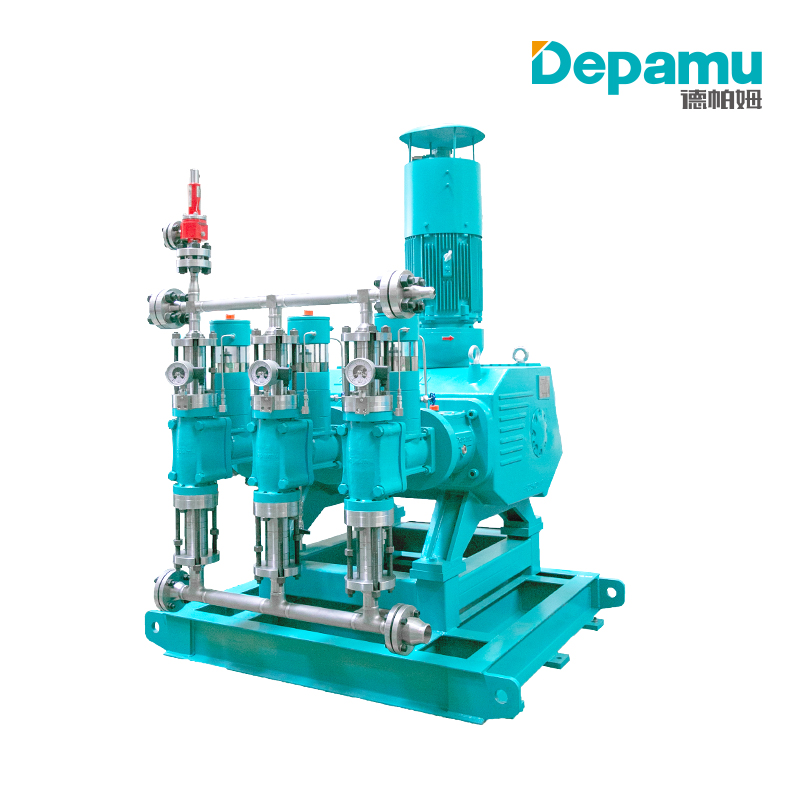
Depamu’s DP(M)DA and DP(M)XAA single-head piston/plunger pumps are the company’s most direct answer to high-solids, high-pressure duty. The plunger contacts the medium directly; its reciprocating motion changes the working-chamber volume cyclically, drawing the medium through the inlet check valve and discharging it through the outlet check valve. This direct-displacement mechanism does not rely on impeller velocity to energize the fluid. Instead, the plunger physically pushes the medium, which means pressure generation is largely decoupled from the fluid’s rheology—a critical advantage when the feed is a paste rather than a liquid.
The performance envelope is substantial: single-head flows up to 12,100 L/h and pressures up to 228 MPa (approximately 33,000 psi), with metering accuracy as fine as ±0.5% across a 10–100% adjustment range. For larger-volume duties, the HD3E(M) and HD3M(M) reciprocating series extend flows to 94.61 m³/h and pressures to 160.3 MPa, with the HD3M(M) engineered under the API 674 framework for severe service and available with a process diaphragm for zero-leakage containment of abrasive or hazardous media.
For a fecal-sludge–rice-husk feed, the piston pump’s relevance lies in two features. First, the positive-displacement, valve-based architecture is inherently tolerant of high solids and large particles, provided the particles can pass the valve seats and the suction chamber is force-fed. Second, the pump’s high pressure capability is not merely about overcoming pipeline friction; it provides the hydraulic authority to inject the mixture into a pressurized reactor or through a downstream restriction (a die, a heat exchanger, or a let-down valve) without flow collapse. In co-HTL service, for example, the feed must be brought to reactor pressure while remaining homogeneous; a pulsating, low-pressure feed would allow the fibrous fraction to segregate and the sludge to stiffen in the line.
The piston pump is not, however, a self-feeding machine in the hopper sense. It requires a flooded or force-fed suction condition, and its check valves are sensitive to fibrous material that can bridge across the seat. The rice husk fraction therefore cannot be allowed to arrive at the pump inlet as loose, long fibers. Some form of upstream size reduction and intimate mixing—a macerator, a twin-shaft grinder, or a high-shear inline homogenizer—is a functional prerequisite, not an optional refinement. The pump can then meter and pressurize the conditioned mixture, but it cannot be expected to do the comminution itself.
3. The Depamu Screw Pump: The Low-Shear, Fibre-Tolerant Alternative
Depamu’s progressive cavity (single-screw) platform occupies a complementary position in the pump-selection space. Its operating principle is geometric: a single-helix metallic rotor rotates eccentrically within a double-helix elastomeric stator, forming sealed cavities that progress axially from suction to discharge. There are no reciprocating check valves and no narrow clearances through which the entire flow must pass. This geometry confers three properties directly relevant to FS–RH feeding. First, the pump passes non-compressible solids up to 80 mm in diameter and handles solids concentrations up to 60%, with viscosity tolerance extending to 100,000 cP. Second, the gentle, low-shear, laminar-like displacement preserves the structure of shear-sensitive flocs and polymers, which matters if the downstream process depends on sludge conditioning or if a flocculant is dosed upstream. Third, the absence of valves and the open cavity geometry reduce—though do not eliminate—the risk of fibrous bridging.
The screw pump’s limitation is pressure. Standard single-screw discharge pressures reach approximately 1.5 MPa, with multi-stage configurations extending to 3.0 MPa. This is adequate for tank feeding, digester charging, and low-pressure pipeline transfer, but it is an order of magnitude or more below the piston pump’s capability. The screw pump is therefore best understood as a feeding and homogenizing machine, not a high-pressure injection machine. It can receive a blended FS–RH stream from a hopper or premix tank, gently convey it without segregation, and deliver it at a stable, pulsation-free rate to a downstream high-pressure piston pump or directly to a low-pressure process.
Depamu also offers single-screw pumps with loading hoppers and forced-feed augers, which are particularly relevant for dewatered sludge and semi-solid biomass. The open hopper allows the mixture to be charged by a conveyor or grab, while the auger bridges the transition from “solid-like” to “pumpable” by continuously presenting material to the rotor–stator element. This configuration is closer to the practical reality of FS–RH handling than a bare inline pump, because the mixture at the point of generation is often too stiff to flow into a suction pipe on its own.
4. Why Neither Pump Alone Is Sufficient: The Architecture of a Feed Train
The central engineering insight for FS–RH feeding is that the mixture’s rheology changes as a function of composition, moisture, shear history, and residence time. A 1:1 FS:RH blend at 15.5 wt% total solids is not the same material as a 3:1 blend at 25 wt% solids, nor is a freshly mixed batch the same as a batch that has stood for two hours. A single pump specification cannot be robust across this entire space. The practical solution is a feed train with distinct unit operations, each matched to a specific transformation in the material’s flow behavior.
Stage 1: Receiving and pre-conditioning. The rice husk must be reduced in particle size and blended with the sludge to a target total-solids content. A macerator or twin-shaft grinder reduces the fibrous fraction below the critical passage dimension of the downstream pump and disrupts the tendency of the husk to form continuous fiber networks. Simultaneous mixing with sludge coats the husk particles, reducing their springiness and increasing the bulk density of the feed. The output of this stage is not a “fluid” in the Newtonian sense, but it is a cohesive, conveyable paste with a consistent, reduced particle-size distribution.
Stage 2: Buffering and force-feeding. A hopper-equipped progressive cavity pump, or a screw feeder with an open hopper and auger, receives the conditioned paste and delivers it at low pressure to the high-pressure pump’s suction. This stage performs two functions: it isolates the high-pressure piston pump from upstream variability, and it imposes a preliminary shear history that temporarily lowers the mixture’s apparent viscosity through thixotropic breakdown. Depamu’s hopper-fed screw pump configurations are designed for precisely this duty—handling media with high solids content and variable consistency without requiring the material to be self-leveling in a tank.
Stage 3: High-pressure injection. The piston pump takes the now-consistent, de-aerated, particle-size-controlled paste and raises it to process pressure. The check valves see a conditioned feed rather than raw husk, and the plunger displaces a material whose rheology has been temporarily stabilized by the upstream shear. The piston pump’s multi-head configuration (up to twelve heads in a single assembly) offers an additional system-level benefit: multiple heads can be operated in parallel to reduce discharge pulsation, or configured as a proportional pump to inject a co-feed (for example, a pH adjuster or a viscosity modifier) simultaneously with the main feed.
Stage 4: Optional pressure let-down or downstream conditioning. If the process requires the feed to pass through a heat exchanger or a restrictive nozzle before the reactor, the piston pump’s pressure authority provides the driving force. If the downstream process is pressure-tolerant but shear-sensitive, a screw pump may be used after the piston pump’s discharge to smooth pulsations, provided the pressure rating of the screw stage is compatible.
This staged architecture is more complex than a single pump, but it reflects the physical reality that no positive displacement machine can simultaneously optimize for hopper reception of a semi-solid, low-shear conveyance of a fibrous paste, and high-pressure injection of a high-solids slurry. Depamu’s portfolio covers each stage, but the integration—the selection of particle-size targets, hopper geometry, shear history, and pressure staging—is where the engineering value lies.
5. Materials, Wear, and the Abrasion Question
Fecal sludge carries grit—sand, silt, and undigested mineral matter—that is abrasive to pump wetted parts. Rice husk, despite its low density, contains biogenic silica (phytoliths) that is also abrasive, particularly when the husk is dry or has been thermally altered. The mixture is therefore not merely “high solids”; it is abrasive at the very surfaces where clearances are tightest.
Depamu addresses this through material selection rather than a single universal specification. Pump heads for the piston series can be supplied in 304, 316, and 316L stainless steels, 904 duplex stainless steel, Hastelloy C, and high-polymer materials; the HD3M(M) series extends wetted-material options to alloy steel, dual-phase steel, and titanium. Plungers use high-performance designs with dedicated stuffing and sealing components, and the check valves are high-precision inlet/outlet valves intended to maintain metering accuracy while resisting clogging in solids-laden service. For the screw pump platform, stators are available in NBR, EPDM, FKM, and PTFE-lined variants, while rotors are typically 316L stainless steel with optional 2205 duplex or hard-chrome-plated variants for abrasive duty. The elastic stator chamber also absorbs particle impacts, which reduces wear relative to rigid-wall machines in high-solids service.
The practical implication for FS–RH service is that material selection must be driven by a abrasion test or at least by the silica and grit content of the specific sludge and husk sources, not by a generic “stainless steel” default. In continuous duty, the rotor–stator fit and the plunger–packing interface are the likely wear leaders; specifying hard-chrome or duplex rotors and a correctly sized stator interference is more consequential than upgrading the pump casing.
6. Control, Pulsation, and Process Integration
A feed pump is only as good as its ability to respond to the process it serves. Depamu’s piston pumps offer stepless stroke adjustment from 0% to 100% through an integrated sleeve adjustable eccentric transmission, with flow control achievable manually, electrically, pneumatically, or via frequency conversion. Electric actuation enables remote automatic control, which is essential when the pump is one element in a reactor feed loop that must track temperature, pressure, or level. The multi-head configuration also provides a passive hydraulic means of pulsation reduction: heads arranged in parallel with appropriate phase offsets produce a discharge flow that is significantly smoother than a single-head machine, without the need for a separate pulsation dampener.
The screw pump stage, by contrast, is naturally low-pulsation because its flow is proportional to rotational speed and independent of discharge pressure. This makes the screw pump an excellent master controller for the feed train: it can set the bulk flow rate, while the piston pump’s stroke or speed trims the final injection pressure. If the downstream process is sensitive to flow transients, the screw pump can be operated at constant speed and the piston pump’s suction pressure held constant by a small buffer tank between the stages, decoupling the two control loops.
7. Conclusion
Feeding a mixture of fecal sludge and rice husk is not a problem that yields to a single pump selection. The sludge contributes a yield stress and a shear-dependent viscosity that demand positive displacement; the husk contributes a fibrous network that demands open passages, size reduction, and a geometry that resists wrapping. Depamu’s piston pumps provide the pressure authority and metering precision required for high-pressure injection, with a performance envelope reaching 228 MPa and flow capacities to 12,100 L/h per head. Depamu’s screw pumps provide the low-shear, fibre-tolerant, hopper-fed conveyance that conditions the mixture and delivers it to the high-pressure stage without segregation or clogging.
The correct engineering answer is therefore a staged feed train: preconditioning and size reduction, hopper-fed low-pressure conveyance, and high-pressure positive-displacement injection, with materials selected for the abrasive silica and grit load and controls integrated across the stages. This architecture does not make the mixture “easy” to pump—no architecture can. It makes the mixture manageable by ensuring that each pump sees a feed stream for which its mechanism is suited, and by accepting that the rheological and fibrous challenges must be resolved upstream of the machine that generates the pressure. In the growing field of fecal-sludge–rice-husk valorization, that distinction between pumping the mixture and engineering the feed stream is the difference between a pump that runs and a process that works.