

Depamu Screw Pumps: A Dual-Domain Engineering Solution for Sewage Treatment and Oil Transport
Abstract
The reliable transfer of complex fluids remains one of the most persistent engineering challenges across the environmental and energy sectors. In municipal and industrial wastewater treatment, operators must move abrasive, heterogeneous sludge and precisely dose shear-sensitive polymer flocculants. In oil transport, the fluid stream may range from conventional crude to extra-heavy bitumen laden with sand, gas, and water. Depamu (Hangzhou) Pumps Technology Co., Ltd., a Chinese manufacturer with over two decades of specialized experience and more than 100 technical patents, has positioned its progressive cavity (single screw) pump platform as a versatile answer to both domains. This article examines the engineering principles, design features, and application-specific performance of Depamu Screw Pumps in sewage treatment and oil transport, demonstrating how a single positive displacement architecture—when properly adapted—can deliver low-shear handling, solids tolerance, and metering precision across radically different industrial environments.
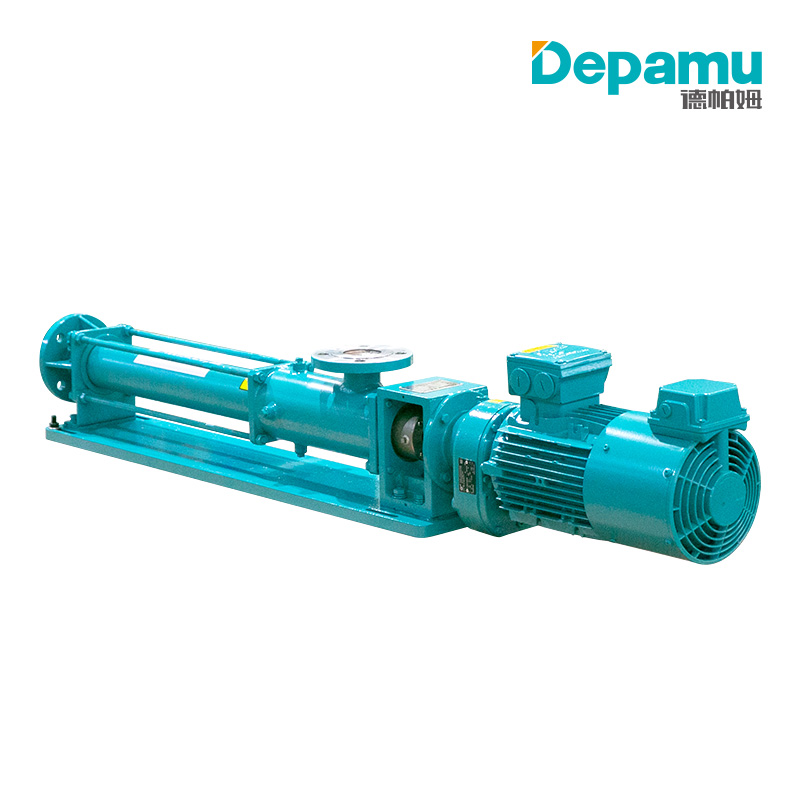
1. Introduction: The Common Thread of Difficult Fluids
Sewage sludge and heavy crude oil appear, at first glance, to belong to entirely separate engineering universes. One is a biological and chemical byproduct of urban water management; the other is a hydrocarbon resource extracted from geological formations. Yet both share a set of fluid-dynamic characteristics that confound conventional pumping equipment. Both are frequently viscous, abrasive, multiphase, and variable in composition. Both punish centrifugal pumps with efficiency losses, clogging, and excessive wear. And both demand a pumping solution that can move the medium gently, continuously, and without pulsation.
The progressive cavity (PC) pump, also known as the single screw pump, has emerged as a reference technology for precisely these conditions. Depamu, founded in 2003 and headquartered in Hangzhou’s Qiantang District, has developed a comprehensive single screw pump portfolio that leverages advanced German engineering principles and holds ISO 9001, ISO 14001, ISO 45001, and CE certifications. The company’s pumps are engineered to handle viscosities up to 100,000 cP, solids concentrations up to 60%, and flow rates spanning from 0.1 to 3,000 m³/h, with standard discharge pressures reaching 1.5 MPa and multi-stage configurations extending to 3.0 MPa. These capabilities form the technical foundation for the pump’s dual suitability in sewage treatment and oil transport.
2. The Progressive Cavity Principle: Why Geometry Matters
The operational heart of every Depamu single screw pump is a deceptively simple geometric pairing: a single-helix metallic rotor rotating eccentrically within a double-helix elastomeric stator. As the rotor turns, sealed cavities form at the suction port and progress axially toward the discharge end, carrying a fixed volume of fluid with each rotation. Because the sealing line between rotor and stator is maintained under both static and dynamic conditions, the pump generates differential pressure without check valves or reciprocating mechanisms.
This positive displacement action confers several advantages that are directly relevant to both sewage and oil service. First, flow rate is directly proportional to rotational speed and independent of discharge pressure, enabling precise flow control through variable frequency drive (VFD) adjustment. Second, the gentle, low-shear pumping action preserves the molecular structure of shear-sensitive media—a critical requirement for polymer flocculants in wastewater treatment and for emulsion control in crude oil transport. Third, the absence of valves and narrow clearances allows the pump to pass solid particles and fibrous material without clogging. Fourth, the pump is inherently self-priming, with suction lift capabilities of up to 8–9 meters of water column, simplifying installation and tank-stripping operations.
Depamu’s design also incorporates a double-support structure that enhances rotor stability, contributing to higher achievable pressures and extended operating life. The stator is available in a range of elastomeric compounds—including NBR, EPDM, FKM, and PTFE-lined variants—allowing the pump to be tailored to the chemical and thermal properties of the specific medium. Rotors are typically machined from 316L stainless steel, with optional 2205 duplex or hard-chrome-plated variants for abrasive service.
3. Sewage Treatment: Sludge Transfer and Polymer Dosing
Municipal and industrial wastewater treatment presents two distinct pumping challenges that Depamu’s progressive cavity platform addresses with a single core architecture.
3.1 Sludge Transfer
Sewage sludge is defined by solids concentrations typically ranging from 1% to 12%, and it is abrasive, viscous, and heterogeneous, often containing sand grains and fibrous material. The medium must be moved through primary and secondary clarifiers, digesters, thickeners, and dewatering equipment—each stage imposing its own demands on pressure, flow stability, and wear resistance. Depamu’s PC pumps are engineered to pass non-compressible solids up to 80 mm in diameter, minimizing the clogging risk that frequently afflicts other pump types. Because flow rate depends on rotational speed, operators can reduce pump speed to manage abrasive wear and extend the service life of rotor and stator components—a critical operational strategy in sludge service. The elastic stator chamber also absorbs the impact of abrasive particles, reducing wear when conveying high-solids media.
3.2 Polymer Chemical Dosing
In water and wastewater treatment, polymer flocculants are indispensable for enhancing solids separation and dewatering performance. The effectiveness of these high-molecular-weight polymers depends critically on maintaining their molecular chain structure. High shear forces and turbulence—such as those generated by centrifugal pumps—can cleave these chains, reducing polymer efficacy and increasing chemical costs. The progressive cavity pump’s inherently low-shear, laminar flow through sealed cavities preserves the polymer’s molecular integrity. Depamu highlights the pump’s low pulsation as a key advantage, ensuring consistent and uniform chemical delivery without the need for complex damping systems. The same precision extends to the dosing of coagulants, lime slurry, and other treatment chemicals. For dedicated chemical injection duties, Depamu also offers mechanically driven diaphragm Metering Pumps with flow ranges of 100–850 L/h and discharge pressures up to 2.5 MPa, complementing the PC pump portfolio in integrated dosing systems.
4. Oil Transport: Heavy Crude, Multiphase Flow, and Artificial Lift
The extraction and transportation of crude oil—particularly heavy and extra-heavy grades—impose a different but equally demanding set of requirements. These fluids exhibit high viscosity, high solids content (including sand and abrasive particles), multiphase compositions of oil, water, and gas, and often challenging downhole conditions. Centrifugal pumps, which dominate many fluid transfer applications, become fundamentally unsuited when viscosity exceeds approximately 300 cSt, with documented efficiency reductions of 20% at viscosities approaching 800–1,000 cP. Above this threshold, positive displacement pumps become the preferred solution, and the single screw pump has emerged as the reference technology for viscous, solids-laden, and shear-sensitive petrochemical fluids.
Depamu single screw pumps are designed to handle fluids with solids content up to 60%, operating across the full pH range (0–14) and at temperatures from −12°C to +150°C. For exceptionally high-temperature applications, all-metal stator options are available. The pumps’ multiphase capability allows them to handle oil–water–gas mixtures without requiring separate phase separation equipment—a significant advantage in both surface transfer and downhole artificial lift. In downhole applications, progressive cavity pumps serve as artificial lift systems for wells that cannot produce naturally, with volumetric efficiencies typically ranging from 75% to 95%—significantly higher than conventional pump systems.
A critical concern in crude oil handling is the formation of emulsions, which complicate downstream separation and increase chemical treatment costs. The single screw pump’s low-turbulence, low-shear operation preserves the fluid’s molecular structure and prevents emulsion formation in oil–water mixtures, simplifying surface separation and reducing operating expenditure. Field applications of all-metal progressive cavity pumps have demonstrated average daily power consumption reductions of up to 66.6% compared to conventional pumping units, underscoring the energy-efficiency benefits of the positive displacement principle.
For higher-volume, higher-pressure oil and gas duties, Depamu also manufactures twin-screw multiphase pumps capable of handling gas volume fractions from 0% to 100%, with over 600 installed references globally for twin-screw multiphase technology. The company has established long-term strategic partnerships with China’s national oil companies—CNPC, SINOPEC, and CNOOC—and exports to more than 50 countries, including the United States, the United Kingdom, and France.
5. Material Selection and Application-Specific Engineering
The versatility of the Depamu screw pump platform rests on a modular approach to materials and configuration. For sewage sludge service, stator elastomers such as NBR and FKM are selected to match the chemical and thermal characteristics of the sludge being processed. For petrochemical slurry transfer, wetted components are available in AISI 316L stainless steel, providing superior resistance to pitting and crevice corrosion compared with standard 304 stainless steel—an important consideration where chlorides, sulfides, and organic acids are present. The “sanitary” designation of Depamu’s stainless steel single screw pumps extends beyond food and pharmaceutical applications: polished product-contact surfaces, the absence of dead spaces, and compliance with FDA and EU 1935/2004 regulations translate into reduced cross-contamination risk and easier cleaning in petrochemical service.
The choice of elastomer is particularly critical in crude oil service, where aromatics content, hydrogen sulfide (H₂S), and carbon dioxide (CO₂) levels affect material compatibility. Depamu offers various elastomer compounds to address these chemical challenges, ensuring performance across diverse crude oil types. For abrasive heavy oil production with high sand content, the industry has responded with innovations such as all-metal conical progressive cavity pumps, which use a clearance fit between stator and rotor rather than an interference fit, allowing bidirectional clearance adjustment and demonstrating superior performance in thermal recovery wells. Advanced seal technologies, including DiamondFace-treated silicon carbide seal faces, have shown remarkable durability in extra-heavy crude applications, withstanding solids content up to 20%, gas content of 30–90%, and water content up to 80%.
6. Operational Advantages Across Both Domains
Several operational characteristics unite the sewage and oil-transport applications of Depamu screw pumps.
Low shear and product integrity. Whether the medium is a polymer flocculant whose molecular chains must remain intact or a crude oil emulsion that should not be further stabilized, the PC pump’s gentle, cavity-based conveyance preserves the fluid’s native structure.
Pulsation-free flow and metering precision. The volumetric nature of the pumping action yields a uniform, continuous discharge that is free of the pulsation characteristic of Reciprocating Pumps and the turbulence of centrifugal machines. This precision makes the pump suitable for both transfer and dosing duties, eliminating the need for separate flow-control valves and their associated pressure drop and maintenance burden.
Self-priming and installation flexibility. Suction lift capabilities of 8–9 meters simplify tank stripping, pipeline drainage, and suction-lift installations where the pump must operate under variable suction conditions. Modular structural combinations and flexible mounting options further reduce engineering complexity.
Wear management through speed control. Because flow is proportional to rotational speed, operators can slow the pump to reduce abrasive wear when handling sand-laden sludge or heavy oil, extending the service life of rotor and stator components.
7. Conclusion
Depamu screw pumps demonstrate that a well-engineered positive displacement architecture can transcend the conventional boundaries between environmental and energy applications. In sewage treatment, the progressive cavity design delivers the solids tolerance, low-shear handling, and metering precision required for both abrasive sludge transfer and delicate polymer dosing. In oil transport, the same platform—adapted through material selection, elastomer compounding, and configuration—handles heavy crude, multiphase well streams, and downhole artificial lift duties with high volumetric efficiency and low energy consumption. With over 100 technical patents, a broad material portfolio spanning NBR, EPDM, FKM, PTFE, 316L stainless steel, and duplex alloys, and a flow range from 0.1 to 3,000 m³/h, Depamu has built a screw pump family that is as much a testament to modular engineering as it is to application-specific refinement. As wastewater treatment operators confront increasingly stringent effluent standards and oil producers turn to heavier, more challenging reservoirs, the demand for pumping solutions that combine gentleness, durability, and precision will only intensify. The Depamu screw pump platform is positioned to meet that demand across both domains.