

Depamu Long-Life Reciprocating Pumps for Steam Boiler Applications: Engineering Endurance in the Most Demanding Feed Service
Abstract
Steam boiler feed service is among the most unforgiving duties in industrial pumping. The feed pump must operate continuously whenever the boiler is in service, discharge against pressures that can substantially exceed the boiler’s own operating pressure, and track evaporation rate closely enough to protect drum water level. In high-pressure and ultra-high-pressure regimes, the centrifugal pump—long the default choice for medium-pressure duty—encounters diminishing returns: efficiency falls as pressure rises, multistage architectures multiply sealing complexity, and cavitation margins narrow when handling hot feedwater. Depamu’s API 674-compliant reciprocating pumps, particularly the HD series, address this regime through positive displacement, stable volumetric efficiency, and a design philosophy oriented explicitly toward extended service life. This article examines the technical basis for that orientation, the mechanisms through which long life is achieved, and the operational and economic consequences for steam boiler operators.
1. The Feed Pump as a Reliability-Critical Component
The boiler feed pump occupies a position of singular importance in any steam generation system. It is the component that connects water supply to steam production, and its failure carries consequences ranging from lost productivity to catastrophic equipment damage. Regulatory practice universally requires at least two independent means of feeding water to a boiler, a recognition that feedwater supply is not merely an efficiency variable but a fundamental safety function.
The hydraulic requirements are demanding in themselves. The pump must generate discharge pressure sufficient to overcome boiler steam pressure and piping resistance, typically at approximately 1.1 to 1.5 times boiler pressure. It must deliver flow that tracks evaporation rate, because drum water level control is directly coupled to feedwater delivery. And it must do so with suction performance that avoids cavitation when handling hot feedwater, whose vapour pressure margin is inherently narrow.
These requirements become more severe as boiler pressure increases. In subcritical and supercritical steam boilers, feed pressure requirements can exceed the practical limits of single-stage centrifugal pumps, and even multistage centrifugal arrangements encounter diminishing returns. The efficiency of centrifugal impellers decreases under high-pressure conditions, and cavitation risk increases when the pressure differential becomes excessive. Multistage configurations, while necessary to achieve high discharge pressures, introduce complexity in shaft sealing and increase the physical footprint of the pumping equipment.
Reciprocating pumps, by contrast, operate on a principle structurally better suited to this regime. Flow output depends primarily on plunger stroke volume and reciprocating frequency rather than on discharge pressure. The pump continues to deliver the required feedwater volume even as boiler pressure rises, rather than drifting to a lower flow point on a curve. This characteristic, combined with documented efficiencies of 80% to 95% in boiler feed service, explains why reciprocating technology retains a defensible position in high-pressure and ultra-high-pressure feed duties.
2. What “Long Life” Must Mean in Boiler Feed Service
A claim of long service life is meaningful only when it is specified against the operating realities of the application. In boiler feed service, three conditions define the endurance challenge.
Continuous duty. The feed pump must operate whenever the boiler is in service, discharging at a rate equal to the boiler’s rated capacity. Unlike batch or intermittent process pumps, boiler feed pumps accumulate operating hours rapidly, and every design compromise in bearings, seals, or lubrication is magnified by the sheer duration of running time.
Pressure-induced stress. High discharge pressure is not merely a performance requirement; it is a mechanical load borne by the plunger, packing, valves, and drive train on every stroke. At pressures in the tens of megapascals, the margin between normal wear and accelerated degradation is narrow.
Feedwater quality. Boiler feedwater often contains dissolved oxygen, chemical additives, and corrosion inhibitors that can attack pump components. In mining and remote industrial settings, feedwater may carry dissolved minerals, suspended particles, and acidic compounds that corrode or foul pump components, necessitating robust, wear-resistant designs.
A long-life pump, therefore, is not simply one built from thicker materials. It is one whose wear surfaces, drive mechanism, and hydraulic end are engineered as an integrated system for sustained operation under these combined loads.
3. Depamu’s Design Architecture for Extended Service Life
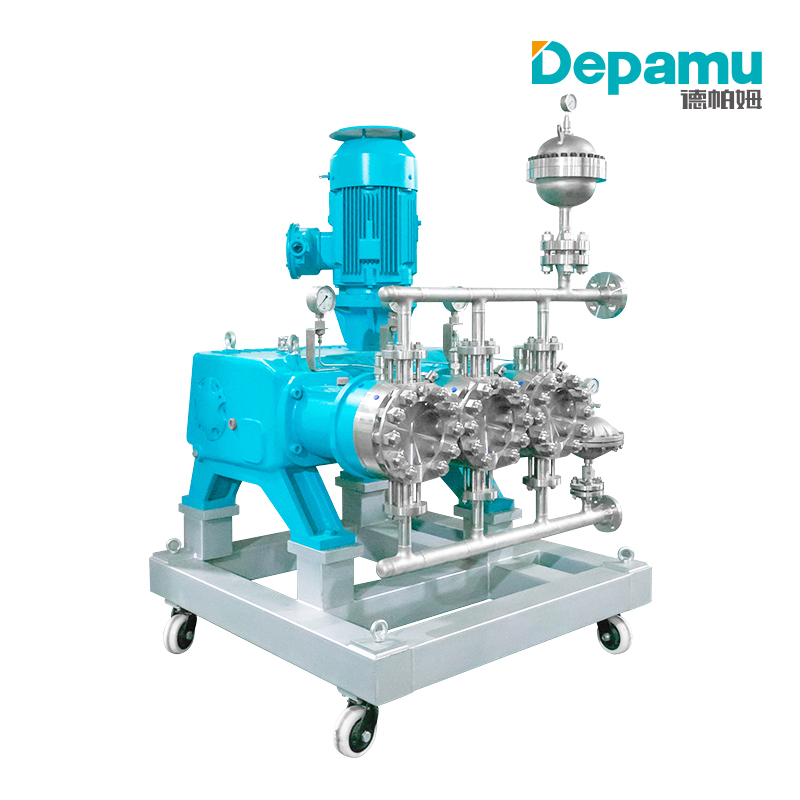
Depamu, a Hangzhou-based pump manufacturer, has positioned its API 674-compliant reciprocating pumps—most notably the HD series—as a focused response to the technical demands of high-pressure boiler feed. The HD series includes models such as the HD3E(M), HD3H(M), HD3M(M), and HD5J(M), with performance envelopes that span the typical requirements of industrial steam boilers. Long service life in these pumps is not attributed to a single feature but to a set of design decisions that converge on the same objective.
3.1 Plunger and Hydraulic End
The plunger is the component in direct contact with the pumped medium and the first line of defence against wear. Depamu employs a plunger with a hard-material spraying layer, producing high surface hardness and good finish. The result is reduced running wear, lower resistance, and extended service life. The hydraulic end is also designed to accommodate elevated temperatures without material limitation, an important consideration when feedwater temperature and thermal cycling are part of normal operation. For applications where the feedwater is abrasive or corrosive, Depamu offers process diaphragm configurations that interpose a hermetic barrier between the process fluid and the pump’s mechanical components. This eliminates the leakage pathways inherent in packed plunger designs and extends the life of components that would otherwise be exposed to attack.
3.2 Drive End and Lubrication
The drive mechanism of a reciprocating pump is where continuous operation exacts a cumulative toll. Depamu addresses this through a low-speed, high-load connecting rod design that uses roller bearings rather than conventional bushing connections. The distinction is consequential. Under sliding friction, an oil film cannot form adequately at low pump speeds even with active lubrication, making normal operation difficult. Roller bearings maintain effective lubrication regardless of pump speed, reducing friction coefficient and heat generation. This is particularly relevant in high-pressure applications where pump speed is deliberately reduced to minimise component stress. Oil-immersion lubrication of the transmission mechanism further supports reliable long-term operation of the crank, connecting rod, and bearing assemblies. A forced lubrication system in the power end ensures stable operation over extended intervals between maintenance windows.
The transmission architecture reinforces these endurance characteristics. An integrated worm gear pair and adjustable eccentric mechanism enable stepless stroke adjustment from 0% to 100% for precise flow control. Internal-meshing double helical gears and reducer configurations provide stable transmission with low noise and minimal friction losses, contributing directly to overall efficiency and reducing the cumulative wear that continuous duty would otherwise impose.
4. Performance Envelope and Efficiency in Feed Service
The HD series illustrates how these design principles are implemented across a commercial product family. The HD3E(M) model delivers flow rates from 0.76 to 10.74 m³/h at discharge pressures from 3.1 to 50.9 MPa, while the HD3H(M) covers 2.74 to 32.14 m³/h at pressures from 2.2 to 41.6 MPa. The broader HD series extends to flow ranges up to 94.61 m³/h and pressure ranges up to 160.3 MPa depending on configuration. These envelopes encompass the typical requirements of industrial steam boilers across mining, power, and process applications, including high-pressure and ultra-high-pressure duties where centrifugal staging would otherwise be required.
Efficiency in boiler feed pumping is not a single number but a composite of volumetric, mechanical, and control-related performance. The HD series achieves volumetric efficiencies exceeding 95% and mechanical efficiencies of 90%, surpassing API standards, with this high efficiency maintained across the operating range rather than only at a single design point. The volumetric advantage is structural: because the plunger directly displaces the fluid, there are fewer pathways for internal leakage to develop as pressure rises. The mechanical advantage stems from the low-speed, roller-bearing drive architecture and the precision of the transmission gearing. For the boiler operator, this translates into a feed system whose energy consumption remains predictable and whose flow delivery remains tightly coupled to drum level demand, regardless of fluctuations in boiler pressure.
5. Operational and Economic Consequences of Long Life
The design life of comparable API 674-compliant Depamu models is cited at 20 years, with the reduction in total cost of ownership arising from minimised replacement frequency and associated downtime. In boiler feed service, where the pump is a continuously operating safety-critical component, this longevity has consequences that extend beyond the pump itself.
First, the reliability of water level control is preserved over time. A pump whose volumetric efficiency remains stable as components wear provides a consistent control variable for the drum level control loop, reducing the risk of trips or unsafe water level excursions. Second, the maintenance burden is shifted from frequent replacement of wear parts to planned, condition-based intervention. The use of roller bearings, forced lubrication, and hard-surfaced plungers means that the degradation of critical components is slowed and made more predictable. Third, the elimination of the multistage centrifugal architecture removes the sealing complexity and footprint associated with high-head centrifugal arrangements, simplifying the balance-of-plant requirements around the feed system.
These advantages are amplified in remote or harsh industrial environments. In mining operations, for example, the remote locations of many sites make maintenance access difficult and equipment replacement time-consuming, while atmospheric conditions characterised by high dust concentrations, extreme temperatures, and corrosive elements place additional stress on mechanical equipment. Mine water often contains dissolved minerals, suspended particles, and acidic compounds that can corrode or foul pump components. A pump engineered for long life under these combined conditions—with a hydraulic end resistant to wear and a drive end that maintains lubrication integrity at low speed—reduces the frequency with which maintenance crews must intervene and the likelihood that a feedwater interruption will halt thermal operations.
6. Conclusion
The boiler feed pump is not a commodity component. It is the hydraulic link between water supply and steam production, and its design must reflect the continuous duty, pressure-induced stress, and feedwater quality challenges that define the application. Depamu’s HD series reciprocating pumps respond to these challenges not through a single oversized feature but through an integrated design architecture: hard-surfaced plungers and temperature-tolerant hydraulic ends; roller-bearing connecting rods and forced lubrication in the power end; precision gearing and stepless stroke adjustment for efficient, controllable flow delivery. The result is a feed pump whose long service life is not a claim but a consequence of engineering decisions oriented toward sustained operation. For steam boiler operators facing high-pressure or ultra-high-pressure feed duties—particularly in remote or demanding environments—this orientation translates into predictable efficiency, reduced maintenance frequency, and a lower total cost of ownership over the life of the boiler system.