

Depamu High-Efficiency Reciprocating Pumps for Steam Boiler Feed Applications
Abstract
Steam boiler feed service demands a pump that can overcome high system backpressure, deliver flow precisely matched to evaporation rate, and operate continuously with minimal maintenance intervention. While multistage centrifugal pumps have historically dominated high-flow, medium-pressure boiler feed applications, their efficiency deteriorates sharply under ultra-high-pressure conditions, and their multistage architecture introduces sealing complexity and a substantial physical footprint. Depamu’s API 674-compliant reciprocating pumps, particularly the HD series, offer a technologically differentiated alternative for high-pressure and ultra-high-pressure boiler feed duties where positive displacement, stable efficiency, and precise flow control are decisive. This article examines the technical basis of that alternative, the performance envelope of the HD series, and the operational and economic arguments for reciprocating technology in modern steam generation systems.
1. Introduction: The Boiler Feed Pump as a Critical Link
In any industrial steam generation system, the boiler feed pump occupies a position of singular operational importance: it is the component that connects water supply to steam production, and its failure carries consequences ranging from lost productivity to catastrophic equipment damage. The feed pump must operate whenever the boiler is in service, discharging at a rate equal to the boiler’s rated capacity, and it must do so against discharge pressures that, in high-pressure and ultra-high-pressure systems, can reach several tens of megapascals. Regulatory practice universally requires at least two independent means of feeding water to a boiler, a recognition that feedwater supply is not merely an efficiency variable but a fundamental safety function.
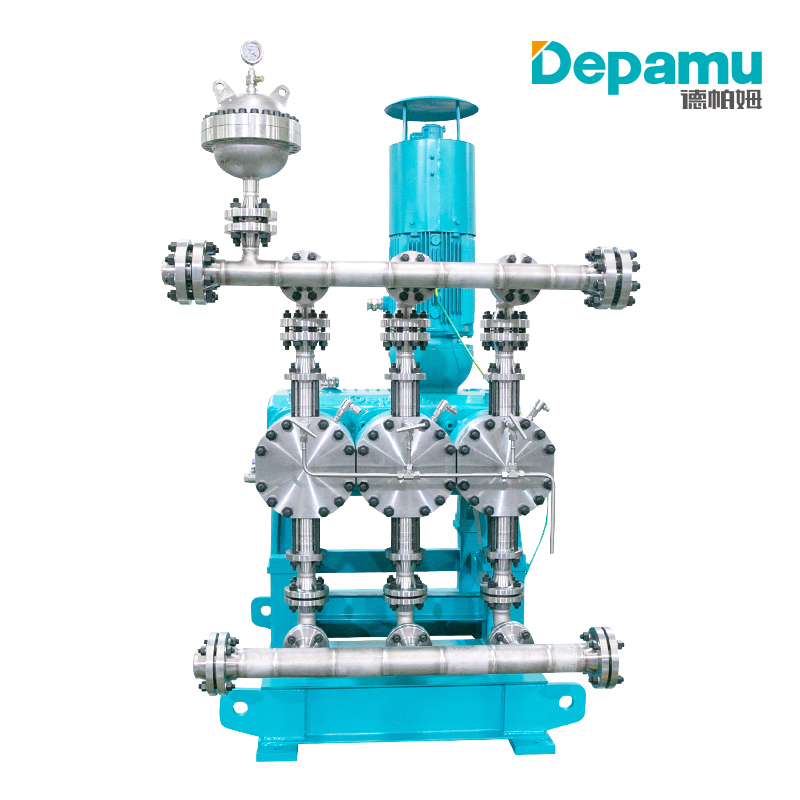
The historical preference for reciprocating positive-displacement pumps in boiler feed service is not incidental. Reciprocating pumps are inherently high-pressure devices, and their flow output depends primarily on plunger stroke volume and reciprocating frequency rather than on discharge pressure. This characteristic stands in contrast to centrifugal behavior, where flow falls as system pressure rises, and where multistage configurations become necessary to achieve high heads at the cost of sealing complexity and footprint. Depamu, a Hangzhou-based pump manufacturer founded in 2003, has positioned its API 674-compliant High-Pressure Reciprocating Pumps—most notably the HD series—as a focused response to this technical gap, supported by a portfolio that includes plunger, diaphragm, and hose diaphragm configurations and a manufacturing base of 35,000 square meters employing over 200 people.
2. Understanding Boiler Feed Pump Requirements
Boiler feed service imposes a combination of hydraulic, thermal, and reliability requirements that few pump types satisfy simultaneously. The pump must generate discharge pressure sufficient to overcome boiler steam pressure and piping resistance, typically at a level above boiler pressure; engineering guidance commonly places the required discharge pressure at approximately 1.1 to 1.5 times boiler pressure. It must deliver flow that tracks evaporation rate, because drum water level control is directly coupled to feedwater delivery. And it must do so with a suction performance that avoids cavitation when handling hot feedwater, whose vapor pressure margin is inherently narrow.
These requirements become more severe as boiler pressure increases. In subcritical and supercritical steam boilers, feed pressure requirements can exceed the practical limits of single-stage centrifugal pumps, and even multistage centrifugal arrangements encounter diminishing returns as pressure rises. The efficiency of centrifugal impellers decreases under high-pressure, high-viscosity, or low-temperature conditions, and cavitation risk increases when the pressure differential becomes excessive. Reciprocating pumps address this regime differently: because flow is governed by displacement rather than by a pressure-dependent head–flow curve, the pump can maintain essentially constant flow as boiler pressure fluctuates with steam demand, and volumetric efficiency remains largely unaffected by viscosity or pressure variation.
3. The Reciprocating Principle in Boiler Feed Service
The defining hydraulic distinction between reciprocating and centrifugal machines is the relationship between flow and pressure. A centrifugal pump converts impeller velocity into pressure head, and its delivered flow falls along a characteristic curve as system resistance increases. A reciprocating pump displaces a fixed volume per stroke; its theoretical flow is the product of plunger area, stroke length, and strokes per unit time, and is independent of discharge pressure. In boiler feed service, this means that the pump continues to deliver the required feedwater volume even as boiler pressure rises, rather than drifting to a lower flow point on a curve.
This principle translates into two operational advantages that are particularly relevant to steam boilers. First, reciprocating pumps in boiler feed service have been documented at efficiencies of 80% to 95%, a range that substantially exceeds the typical performance of alternative pump types in comparable applications. Second, the positive-displacement action provides excellent priming characteristics and tolerance of elevated fluid temperatures without the cavitation problems that afflict centrifugal pumps under similar suction conditions. These are not marginal differences; they affect both the energy balance of the feed system and the reliability of water level control.
4. Depamu HD Series: Performance Envelope and Design Architecture
Depamu’s HD series illustrates how these principles are implemented in a commercial product family. The HD3E(M) model delivers flow rates from 0.76 to 10.74 m³/h at discharge pressures from 3.1 to 50.9 MPa, while the HD3H(M) covers 2.74 to 32.14 m³/h at 2.2 to 41.6 MPa; the broader HD series extends to flow ranges up to 94.61 m³/h and pressure ranges up to 160.3 MPa depending on configuration. These envelopes encompass the typical requirements of industrial steam boilers across mining, power, and process applications, including high-pressure and ultra-high-pressure duties where centrifugal staging would otherwise be required.
The design architecture behind these ratings reflects attention to the specific demands of continuous feed service. Depamu’s reciprocating pumps employ an integrated worm gear pair and adjustable eccentric transmission mechanism, enabling stepless stroke adjustment from 0% to 100% for precise flow control. Internal-meshing double helical gears and reducer configurations provide stable transmission with low noise and minimal friction losses, contributing directly to overall efficiency. The power end uses a low-speed, high-load connecting rod design with roller bearings rather than bushing connections, maintaining effective lubrication even at low speeds and reducing heat generation during extended continuous operation—a meaningful distinction in boiler feed service, where pumps may run for long intervals between maintenance windows.
5. Efficiency Analysis: Volumetric, Mechanical, and System-Level
Efficiency in boiler feed pumping is not a single number but a composite of volumetric, mechanical, and control-related performance. The HD series achieves volumetric efficiencies exceeding 95% and mechanical efficiencies of 90%, surpassing API standards, with this high efficiency maintained across the operating range rather than only at a single design point. The volumetric advantage is structural: because the plunger directly compresses the fluid, there are fewer energy-transfer steps than in a centrifugal system, and a greater proportion of drive power is converted into useful hydraulic work.
Flow control contributes a further efficiency dimension that is often overlooked in pump selection. Depamu’s reciprocating pumps offer a flow adjustment range of 10% to 100% with a metering accuracy of ±0.5%, achieved by directly altering plunger stroke length or adjusting crankshaft speed. This regulation mechanism responds quickly and with high repeatability, allowing the feed pump to maintain the precise drum water level required for stable boiler operation without dissipating excess energy across a throttling valve. In installations that experience variable steam demand—combined heat and power plants, industrial facilities with batch process steam loads, and mining operations with fluctuating thermal requirements—this combination of stable volumetric efficiency and wide, accurate turndown produces cumulative energy savings that a single-point efficiency rating would not reveal.
6. Reliability, Materials, and Maintenance in Continuous Service
Boiler feed pumps are judged not only by performance at the design point but by their ability to remain in service with minimal intervention. Depamu’s design approach addresses several failure modes that are specific to this duty. The modular construction separates the plunger, cylinder liner, and valve assembly into independent modules, permitting on-site disassembly and reassembly without specialized lifting equipment—a practical contrast to multistage centrifugal pumps, whose impellers, guide vanes, and precision sealing systems demand more elaborate maintenance procedures. Check valves incorporate a self-cleaning structure, and high-performance plungers and packing are specified for extended service intervals.
Feedwater chemistry is a persistent reliability variable. Boiler feed water may contain dissolved oxygen, chemical additives, corrosion inhibitors, residual oils, or suspended solids that attack pump components or alter lubrication conditions. Depamu offers wetted parts in alloy steel, stainless steel, dual-phase steel, titanium, and Hastelloy, allowing the pump to be matched to the corrosivity of the specific feedwater rather than accepting a single default metallurgy. For abrasive or contaminated feedwater, the process diaphragm configuration introduces a diaphragm barrier between the pumped fluid and the pump head, with a diaphragm rupture alarm providing real-time monitoring and ensuring no leakage even when handling hazardous fluids. This layered approach to containment is particularly relevant where feedwater upset conditions or treatment system failures can introduce particulate matter into the feed stream.
7. Application Scenarios and Selection Logic
The case for Depamu reciprocating pumps is strongest in three boiler feed scenarios. The first is high-pressure and ultra-high-pressure service, where the positive-displacement principle allows a single pump stage to achieve discharge pressures that would require multiple centrifugal stages in series, reducing both capital cost and maintenance complexity. The second is variable-load operation, where the wide turndown and pressure-independent flow of a reciprocating pump maintain stable feedwater delivery at low flow rates where centrifugal pumps may operate inefficiently or unstably. The third is feedwater with elevated viscosity, residual oil content, or particulate loading, where the volumetric efficiency of reciprocating pumps is less affected by these variables than centrifugal impeller efficiency.
These scenarios are not mutually exclusive. A mining steam plant, for example, may combine remote location, variable steam demand, and feedwater of inconsistent quality; the operational experience of a mining company in Guangxi, China, with boiler feedwater pumps reported stabilized pressure meeting design standards, no leaks, no noticeable vibrations, and a significantly reduced failure rate approaching maintenance-free continuous operation. While such reports are illustrative rather than statistically exhaustive, they are consistent with the design priorities evident in the HD series: reliability under continuous duty, tolerance of off-design feedwater conditions, and maintenance procedures that do not require specialized heavy equipment.
8. Installation and Maintenance Considerations
Successful application of reciprocating boiler feed pumps depends on installation practices that recognize the machine’s suction-side sensitivity. The pump should be positioned to provide adequate net positive suction head, particularly when handling hot feedwater, and piping should be designed with adequate support and expansion provisions so that mechanical stresses are not transmitted to the pump casing. Acceleration head losses in the suction line must be accounted for in NPSH calculations, a consideration that is more pronounced in reciprocating than in centrifugal service. Depamu pumps can be configured with electric motor, diesel engine, or solar drive, and in horizontal, vertical, stationary, or mobile arrangements, allowing integration into both permanent installations and temporary or remote boiler feed systems. Modern systems can also be equipped with PLC and DCS monitoring for real-time fault warning, enabling predictive rather than reactive maintenance—a meaningful capability where unplanned boiler downtime carries significant operational cost.
9. Conclusion
The selection of a boiler feed pump is an engineering decision with consequences that extend well beyond the pump itself: it affects boiler safety, water level stability, energy consumption, and the maintenance burden borne by plant operators. Depamu’s high-efficiency reciprocating pumps, designed to API 674 and embodied in the HD series, offer a coherent technical response to the specific demands of high-pressure and ultra-high-pressure boiler feed service. Their positive-displacement principle delivers flow that is substantially independent of discharge pressure; their volumetric and mechanical efficiencies exceed 95% and 90% respectively, with stable performance across the operating range; and their modular construction, material flexibility, and containment options address the reliability and feedwater-quality realities of continuous industrial service. For applications where centrifugal technology encounters its practical limits—ultra-high pressure, wide turndown, viscous or contaminated feedwater, and remote or maintenance-constrained installations—the reciprocating alternative is not a legacy choice but a technically grounded one.