

Abstract
Steam boiler feed service is among the most unforgiving duties in industrial pumping. The feed pump must operate continuously whenever the boiler is in service, discharge against pressures that can exceed the boiler’s own operating pressure by a substantial margin, and track evaporation rate closely enough to protect drum water level. In high-pressure and ultra-high-pressure regimes, the centrifugal pump—long the default choice for medium-pressure feed duty—encounters diminishing returns: efficiency falls as pressure rises, multistage architectures multiply sealing complexity, and cavitation margins narrow when handling hot feedwater. Depamu’s API 674-compliant Reciprocating Pumps, particularly the HD series, address this regime through positive displacement, stable volumetric efficiency, and a design philosophy oriented explicitly toward extended service life. This article examines the technical basis for that orientation, the mechanisms through which long life is achieved, and the operational and economic consequences for steam boiler operators.
1. The Feed Pump as a Reliability-Critical Component
The boiler feed pump occupies a position of singular importance in any steam generation system. It is the component that connects water supply to steam production, and its failure carries consequences ranging from lost productivity to catastrophic equipment damage. Regulatory practice universally requires at least two independent means of feeding water to a boiler, a recognition that feedwater supply is not merely an efficiency variable but a fundamental safety function.
The hydraulic requirements are demanding in themselves. The pump must generate discharge pressure sufficient to overcome boiler steam pressure and piping resistance, typically at approximately 1.1 to 1.5 times boiler pressure. It must deliver flow that tracks evaporation rate, because drum water level control is directly coupled to feedwater delivery. And it must do so with suction performance that avoids cavitation when handling hot feedwater, whose vapour pressure margin is inherently narrow.
These requirements become more severe as boiler pressure increases. In subcritical and supercritical steam boilers, feed pressure requirements can exceed the practical limits of single-stage centrifugal pumps, and even multistage centrifugal arrangements encounter diminishing returns as pressure rises. The efficiency of centrifugal impellers decreases under high-pressure, high-viscosity, or low-temperature conditions, and cavitation risk increases when the pressure differential becomes excessive. Multistage configurations, while necessary to achieve high discharge pressures, introduce complexity in shaft sealing and increase the physical footprint of the pumping equipment.
Reciprocating pumps, by contrast, operate on a principle that is structurally better suited to this regime. Flow output depends primarily on plunger stroke volume and reciprocating frequency rather than on discharge pressure. The pump continues to deliver the required feedwater volume even as boiler pressure rises, rather than drifting to a lower flow point on a curve. This characteristic, combined with documented efficiencies of 80% to 95% in boiler feed service, explains why reciprocating technology retains a defensible position in high-pressure and ultra-high-pressure feed duties.
2. What “Long Life” Must Mean in Boiler Feed Service
A claim of long service life is meaningful only when it is specified against the operating realities of the application. In boiler feed service, three conditions define the endurance challenge.
Continuous duty. The feed pump must operate whenever the boiler is in service, discharging at a rate equal to the boiler’s rated capacity. Unlike batch or intermittent process pumps, boiler feed pumps accumulate operating hours rapidly, and every design compromise in bearings, seals, or lubrication is magnified by the sheer duration of running time.
Pressure-induced stress. High discharge pressure is not merely a performance requirement; it is a mechanical load borne by the plunger, packing, valves, and drive train on every stroke. At pressures in the tens of megapascals, the margin between normal wear and accelerated degradation is narrow.
Feedwater quality. Boiler feedwater often contains dissolved oxygen, chemical additives, and corrosion inhibitors that can attack pump components. In mining and remote industrial settings, feedwater may carry dissolved minerals, suspended particles, and acidic compounds that corrode or foul pump components, necessitating robust, wear-resistant designs.
A long-life pump, therefore, is not simply one built from thicker materials. It is one whose wear surfaces, drive mechanism, and hydraulic end are engineered as an integrated system for sustained operation under these combined loads.
3. Depamu’s Design Architecture for Extended Service Life
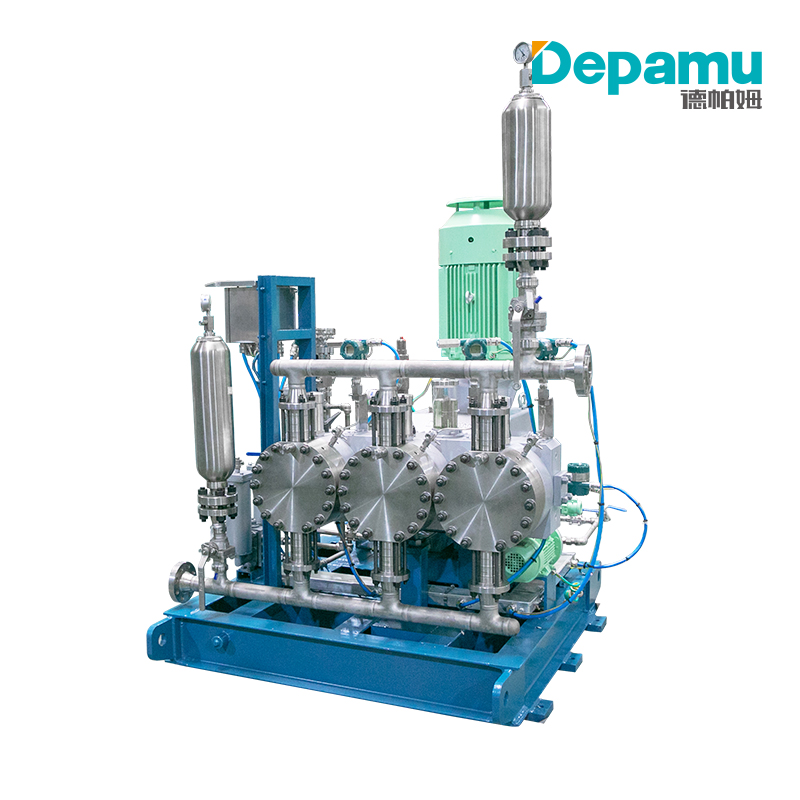
Depamu, a Hangzhou-based pump manufacturer, has positioned its API 674-compliant reciprocating pumps—most notably the HD series—as a focused response to the technical demands of high-pressure boiler feed. The HD series includes models such as the HD3E(M), HD3H(M), HD3M(M), and HD5J(M), with performance envelopes that span the typical requirements of industrial steam boilers. The HD3E(M), for instance, delivers flow rates from 0.76 to 10.74 m³/h at discharge pressures from 3.1 to 50.9 MPa, while the HD3H(M) covers 2.74 to 32.14 m³/h at pressures from 2.2 to 41.6 MPa. The broader HD series extends to flow ranges up to 94.61 m³/h and pressure ranges up to 160.3 MPa depending on configuration.
Long service life in these pumps is not attributed to a single feature but to a set of design decisions that converge on the same objective.
3.1 Plunger and Hydraulic End
The plunger is the component in direct contact with the pumped medium and the first line of defence against wear. Depamu employs a plunger with a hard-material spraying layer, producing high surface hardness and good finish. The result is reduced running wear, lower resistance, and extended service life. The hydraulic end is also designed to accommodate elevated temperatures without material limitation, an important consideration when feedwater temperature and thermal cycling are part of normal operation.
For applications where the feedwater is abrasive or corrosive, Depamu offers process diaphragm configurations that interpose a hermetic barrier between the process fluid and the pump’s mechanical components. This eliminates the leakage pathways inherent in packed plunger designs and extends the life of components that would otherwise be exposed to attack.
3.2 Drive End and Lubrication
The drive mechanism of a reciprocating pump is where continuous operation exacts a cumulative toll. Depamu addresses this through a low-speed, high-load connecting rod design that uses roller bearings rather than conventional bushing connections. The distinction is consequential. Under sliding friction, an oil film cannot form adequately at low pump speeds even with active lubrication, making normal operation difficult. Roller bearings maintain effective lubrication regardless of pump speed, reducing friction coefficient and heat generation. This is particularly relevant in high-pressure applications where pump speed is deliberately reduced to minimise component stress.
Oil-immersion lubrication of the transmission mechanism further supports reliable long-term operation of the crank, connecting rod, and bearing assemblies. A forced lubrication system in the power end ensures stable operation even at very low speeds, a configuration that is directly aligned with the extended maintenance intervals often required in remote or demanding installations.
3.3 Flow Control and Volumetric Stability
Long life is also a function of how the pump is controlled. Depamu’s reciprocating pumps employ an integrated worm gear pair and adjustable eccentric transmission mechanism, enabling stepless stroke adjustment from 0% to 100%. The flow adjustment range of 10% to 100% with a metering accuracy of ±0.5% is achieved by directly altering plunger stroke length or adjusting crankshaft speed. This control architecture responds quickly and with high repeatability, allowing the feed pump to maintain the precise water level required for stable boiler operation without the inefficiencies and instability that centrifugal pumps may exhibit at low flow rates.
Volumetric efficiency in the HD series exceeds 95%, with mechanical efficiencies of 90%, and this high efficiency is maintained across the operating range rather than only at a single design point. From a life-cycle perspective, stable efficiency means that the pump does not progressively lose hydraulic performance as internal clearances wear—a characteristic that prolongs the interval between overhauls.
4. From Service Life to Total Cost of Ownership
The economic case for a long-life reciprocating pump rests on more than the purchase price of replacement parts. For comparable API 674-compliant models, Depamu cites a design life of 20 years, with the reduction in total cost of ownership arising from minimised replacement frequency and associated downtime.
In boiler feed service, downtime carries a dual penalty. The immediate cost is the lost steam production, which propagates through any process that depends on that steam. The secondary cost is the risk of boiler damage if feedwater supply is interrupted or degraded. A pump designed for extended intervals between overhauls reduces both the direct maintenance expenditure and the operational exposure to unplanned outages.
Maintenance accessibility reinforces this advantage. The core components of Depamu’s reciprocating pumps—plunger, cylinder liner, and valve assembly—are designed as independent modules, allowing for on-site disassembly and reassembly without specialised lifting equipment. This contrasts with multistage centrifugal pumps, whose complex impellers, guide vanes, and precision sealing systems demand more elaborate maintenance procedures. In remote mining or industrial locations where maintenance access is difficult and equipment replacement is time-consuming, modular serviceability is not a convenience; it is a determinant of availability.
5. Application Fit and Selection Considerations
The long-life characteristics of Depamu reciprocating pumps translate into specific advantages across boiler feed scenarios.
High-pressure and ultra-high-pressure boilers. Where feed pressure requirements exceed the practical limits of single-stage centrifugal pumps, the positive displacement principle allows a single pump stage to achieve discharge pressures that would require multiple centrifugal stages in series, reducing both capital cost and maintenance complexity.
Variable-load and wide-turndown operation. Boiler systems that experience significant load fluctuations benefit from the wide turndown ratio of reciprocating pumps. Depamu pumps maintain stable flow output across a broad range of operating conditions, whereas centrifugal pumps may operate inefficiently or unstably at low flow rates.
Challenging feedwater. For feedwater containing residual oils, suspended solids, or chemical treatment agents that increase viscosity or introduce abrasive particles, the diaphragm configuration provides an additional barrier between the process fluid and the pump’s mechanical components. In mining environments, where mine water often carries dissolved minerals and acidic compounds, this robustness is a direct contributor to service life.
6. Conclusion
The steam boiler feed pump is not a component that can be selected solely on the basis of a performance curve at a single design point. It operates continuously, against high and fluctuating pressures, often in environments where maintenance is difficult and downtime is costly. Long service life, in this context, is the cumulative result of plunger wear resistance, drive-end lubrication strategy, flow-control precision, and maintenance-oriented architecture working in concert.
Depamu’s HD series embodies this integrated approach. Its API 674 compliance provides a recognised baseline of engineering rigor, while the specific design choices—hard-sprayed plungers, roller-bearing connecting rods, forced lubrication, stepless stroke adjustment, and modular hydraulic-end construction—address the wear mechanisms and operational stresses that determine how long a boiler feed pump actually lasts. For operators of high-pressure and ultra-high-pressure steam systems, particularly in remote or demanding industrial settings, the practical question is not whether a reciprocating pump can meet the hydraulic duty, but whether it can sustain that duty over years of continuous operation. The design architecture of the Depamu HD series is a direct answer to that question.