

Depamu Chemical Injection Package for No-Leak Water Treatment: Engineering Zero-Leakage into Every Drop
Abstract
In an era of tightening environmental regulation and escalating industrial demand for precise chemical management, the safe and accurate injection of treatment chemicals has become a critical operational imperative. Chemical leakage in water treatment and industrial processes wastes costly reagents, jeopardizes worker safety, and poses severe risks to surrounding ecosystems. Depamu (Hangzhou) Pumps Technology Co., Ltd., a leading Chinese manufacturer of Metering Pumps and packaged chemical injection systems, has developed a comprehensive line of zero-leak Chemical Injection Packages engineered to address these challenges. Grounded in advanced hydraulic diaphragm technology introduced from Germany in the early 1990s, Depamu’s zero-leak injection packages integrate chemical dissolving, preparation, metering, and injection into a single skid-mounted automated platform. This article examines the technical foundations, product architecture, automation logic, and practical applications of Depamu’s zero-leak chemical injection packages, with particular emphasis on their role in boiler water treatment, circulating water systems, raw water pretreatment, and wastewater treatment.
1. Introduction: The Operational Imperative for Zero-Leak Chemical Injection
Industrial water treatment is fundamentally a discipline of precision. Whether the objective is pH adjustment, scale inhibition, corrosion prevention, oxygen scavenging, or disinfection, the accurate delivery of treatment chemicals determines the efficacy of the entire process. Inaccurate dosing produces two equally undesirable outcomes: under-dosing invites scale formation, corrosion, and microbial proliferation, while over-dosing wastes reagents, inflates operating costs, and can create secondary water quality problems.
Yet precision alone is insufficient. The chemicals themselves—ammonia, hydrazine, phosphate, biocides, concentrated acids, and alkalis—are frequently toxic, corrosive, or volatile. A leak at a pump seal, a flange, or a valve is not merely a maintenance inconvenience; it is a safety incident, an environmental liability, and a regulatory violation. Traditional approaches to chemical injection, in which pumps, tanks, and control systems are procured separately and assembled on site, frequently suffer from compatibility issues, performance inconsistencies, and elevated maintenance burdens—all of which compound the risk of leakage.
Depamu’s response to this challenge is systemic rather than component-level. By treating the entire injection process as an integrated engineering problem, Depamu has developed a family of skid-mounted packages that embed zero-leak design at every interface: from the diaphragm that separates the hydraulic fluid from the process medium, to the static seals that replace dynamic plunger seals, to the real-time monitoring that detects diaphragm integrity before any environmental release occurs.
2. Technical Foundation: Hydraulic Diaphragm and Static Sealing
The zero-leak concept in chemical injection begins at the pump level. Depamu’s Hydraulic Diaphragm Metering Pumps employ a design philosophy fundamentally different from traditional plunger-type pumps. In a conventional plunger pump, a reciprocating plunger must pass through a dynamic seal. This seal is subject to continuous friction and wear, and eventually permits fluid to escape along the moving shaft. Depamu’s diaphragm metering pumps eliminate this weakness entirely. The static seal of the diaphragm at the hydraulic end replaces the dynamic seal of the plunger, meaning that the medium being transported never comes into contact with a moving shaft seal. As a result, no medium leakage occurs under any operating condition.
This principle is reinforced in the company’s process Diaphragm Pumps, which are specifically designed to guarantee leak-free transport of toxic, flammable, or abrasive media under demanding conditions. For the most aggressive chemical applications, Depamu offers a PTFE double-diaphragm configuration that provides exceptional corrosion resistance and leak-prevention capability. Some models go further still, integrating a diaphragm leak alarm pump with a diaphragm failure alarm function. This allows operators to detect and respond to diaphragm health issues before any environmental release occurs.
The hydraulic diaphragm pump combines the leak-free containment of a diaphragm with the pressure capability and hydraulic stability of a plunger system. This combination makes it suitable not only for water treatment but also for oil and gas operations, where zero leakage is paramount on offshore platforms and in environmentally sensitive production areas for injecting corrosion inhibitors, demulsifiers, and other production chemicals. The hierarchical containment approach—static sealing, material selection, and real-time monitoring—forms the foundation of the zero-leak guarantee.
3. DPJY Series: Integrated Skid-Mounted Architecture
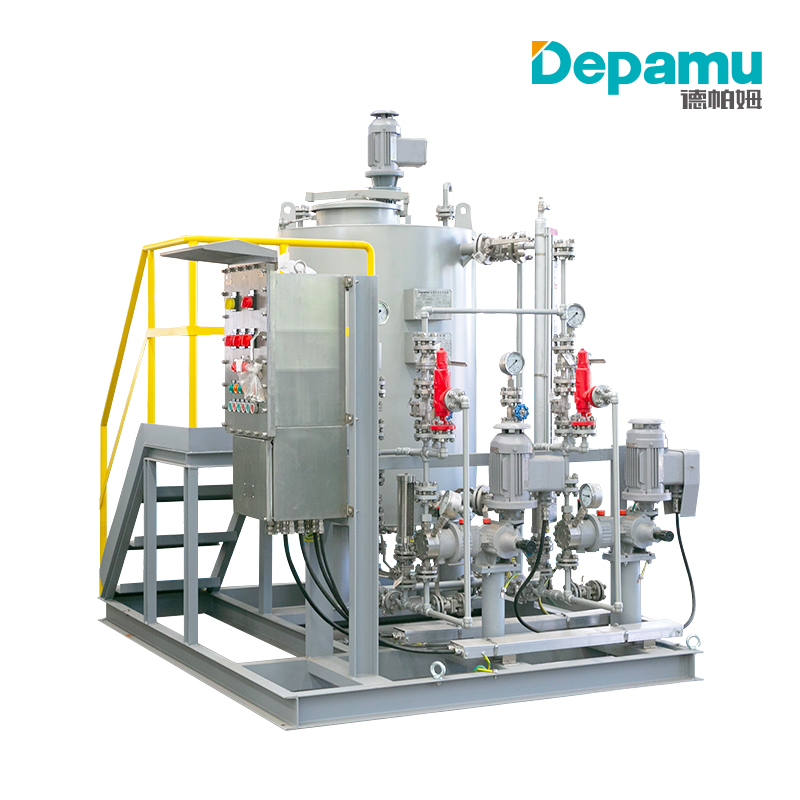
Depamu’s zero-leak philosophy extends beyond individual pumps to fully integrated chemical injection packages. The company’s flagship DPJY series injection packages are complete sets of equipment that consolidate the entire injection process into a single skid-mounted unit. Each package comprises a solution tank, one or more metering pumps, a level gauge, a safety valve, a pressure gauge, a pulsation damper, various valves and piping, and an electrical control cabinet, all mounted on a common steel base. This integrated combination achieves the functions of chemical dissolving, preparation, metering, and injection in a compact structure that is easy to transport and install.
The modular design philosophy underlying these packages offers significant operational advantages. The metering pumps within a unit can be randomly assigned as duty or standby pumps. Where two or more solution tanks are provided, they can be operated alternately or simultaneously through valve switching. This flexibility guarantees continuous operation during maintenance or unexpected equipment failure—a critical requirement for municipal water plants and industrial facilities where dosing interruption is not an option.
Material selection in the DPJY series reflects a deep understanding of the corrosivity of treatment chemicals. Depending on specific anti-corrosion requirements, solution tanks can be manufactured from 316 or 304 stainless steel, carbon steel, rubber- or plastic-lined carbon steel, fiberglass-reinforced plastic, polyethylene, or PVC. Wetted parts are similarly selected from a range of materials to match the chemical compatibility requirements of each application. This customization capability ensures that the zero-leak design is not undermined by material degradation over time.
The basic parameters of the DPJY series demonstrate its adaptability across water treatment domains. For boiler water injection packages, solution tank volumes range from 0.5 to 2.5 cubic meters, with metering pump capacities of 20 to 70 liters per hour and discharge pressures from 0.5 to 32 megapascals, depending on the reagent. For circulating water injection packages, tank volumes increase to 1 to 4 cubic meters, with pump capacities of 50 to 1,500 liters per hour and discharge pressures of 0.3 to 2.0 megapascals. Wastewater injection packages accommodate tank volumes of 0.5 to 2.5 cubic meters and pump capacities of 50 to 850 liters per hour.
4. Automation and Control Intelligence
The modern chemical injection package is not merely a mechanical assembly; it is an intelligent process node. Depamu’s packages can be controlled locally and manually or automatically. Automatic control is realized through frequency converters that receive signals for flow rate, pH value, electrical conductivity, turbidity, and other process parameters.
At the heart of the automated package is a programmable logic controller (PLC) that functions as a host controller interfacing with the plant’s distributed control system (DCS). The PLC receives real-time signals from online analytical instruments—flow meters, pH sensors, conductivity meters, dissolved oxygen analyzers, turbidity meters, and phosphate analyzers—processes these signals, and calculates the optimal chemical injection rate. The control logic then adjusts the rotational speed or stroke length of the metering pump through variable-frequency drives, achieving a flow adjustment range of 0 to 100 percent.
The automated control system supports multiple control strategies tailored to different water treatment processes. Feedback control measures outcomes such as residual chemical concentration, pH, and turbidity, and adjusts dosing to correct deviations from setpoints. While reliable, this approach is reactive—it responds after a change has occurred. Feedforward control measures disturbances such as raw water flow rate and influent quality, and adjusts dosing proactively based on a mathematical model. This mode is fast but model-dependent. Cascade control combines the two, using feedforward control to provide a rough dosing estimate and feedback control to trim the final dosage.
Under automatic control, the system can automatically adjust the rotation speed and stroke of the metering pump, and all signals for metering pump and mixer status and faults can be transmitted to the DCS or host computer, enabling remote start or stop of the injection pump as required. The speed control input signal of the frequency converter is a standard 4–20 mA signal, consistent with the feedback signal.
5. Applications Across the Water Treatment Spectrum
Depamu’s zero-leak chemical injection packages serve a broad spectrum of water treatment processes, including boiler feedwater treatment, circulating water systems, raw water pretreatment, and wastewater treatment. Each application imposes distinct chemical, pressure, and control requirements, and the modular architecture of the DPJY series accommodates this diversity.
In boiler water treatment, the packages are deployed for the injection of ammonia, hydrazine, acetoxime, and phosphate. Ammonia injection adjusts pH and prevents corrosion. Hydrazine injection scavenges dissolved oxygen and prevents pitting corrosion. Phosphate injection controls scaling by reacting with calcium ions to form basic calcium phosphate, which is then removed through blowdown. Phosphate injection is the most widely used method for controlling scale formation in boiler water, and automatic control is achieved through continuous monitoring of feedwater flow rate, pH value, and phosphate radical concentration. The zero-leak design is particularly critical for hydrazine, a toxic oxygen scavenger that demands careful handling; the diaphragm sealing mechanism ensures that hydrazine cannot escape into the operating environment.
For circulating water systems, Depamu offers injection packages configured for scale inhibitors, corrosion inhibitors, and bactericides. These systems feature larger solution tanks (1 to 4 cubic meters) and higher pump capacities to meet the continuous chemical injection needs of cooling water circuits. The packages can also be configured for PAC (polyaluminum chloride) injection, PAM (polyacrylamide) injection, concentrated sulfuric acid injection, and sodium hypochlorite injection, depending on the treatment objective.
In raw water pretreatment and wastewater treatment, the packages handle flocculants, dispersants, acids, and alkalis. For dry powder chemicals, Depamu offers automatic dissolving and injection packages applicable to flocculation treatment for municipal or industrial wastewater, flocculation treatment during sludge dewatering, drinking water purification, and wastewater treatment in the chemical, paper, and metallurgy industries. These systems automatically and continuously prepare liquid media in different concentrations from dry powder and granular chemicals, which are then accurately injected into the process system by a metering pump. A scientific servo mechanism and a unique powder transport system avoid powder heating, caking, or sticking, securing high injection precision.
6. Proven Reliability in Extreme Environments: The Yamal LNG Case
The credibility of a zero-leak claim is best tested under conditions that push equipment to its limits. Depamu’s chemical injection packages have been deployed in the Yamal LNG project, one of the most demanding industrial environments on earth. Operation under extreme climatic conditions, with temperatures well below freezing, demands equipment that can maintain structural integrity, sealing performance, and precise dosing despite thermal contraction, ice formation, and logistical constraints.
The selection of Depamu packages for Yamal LNG underscores the maturity of the company’s hydraulic diaphragm technology and the robustness of its skid-mounted architecture. The packages ensure operational integrity through precise chemical management, delivering corrosion inhibitors, methanol, and other critical treatment chemicals in an environment where equipment failure carries consequences that extend far beyond the plant boundary. This reference installation demonstrates that the zero-leak design is not a fair-weather promise but an engineered capability validated in the harshest operating conditions.
7. Standards, Certifications, and Quality Assurance
Depamu’s products adhere to the API 675 standard of the American Petroleum Institute for metering pumps and API 674 for positive displacement Reciprocating Pumps. The company has also passed certifications of international authorities including DNV, ISO 9001:2000 Quality Management System, ISO 14001, ISO 45001, and CE European Community Certification. These certifications are not merely badges of compliance; they represent independent verification that the design, manufacturing, and testing processes meet internationally recognized benchmarks for precision, safety, and environmental performance.
The DPJY-series injection packages are manufactured strictly following process specifications, combining advanced production processes and technologies from America and Germany with practical engineering adaptations. This synthesis of imported core components and localized engineering has enabled Depamu to produce packages that compete on the global stage while remaining adaptable to the specific requirements of Chinese and international water treatment plants.
8. Conclusion: Zero-Leak as an Engineering Philosophy
The phrase “no-leak water treatment” is sometimes treated as an aspirational goal, a specification to be approached but never fully achieved. Depamu’s contribution to the field is to demonstrate that zero leakage is achievable when it is designed in at every level rather than bolted on as an afterthought. The static diaphragm seal eliminates the fundamental wear mechanism of the plunger pump. The PTFE double-diaphragm configuration provides a second barrier against aggressive media. The diaphragm failure alarm detects incipient failure before release occurs. The skid-mounted architecture integrates pumps, tanks, valves, and controls into a coherent system with redundant capacity and material compatibility. The PLC-based automation ensures that precision dosing is maintained dynamically as process conditions change. And the validation of these principles in extreme environments such as Yamal LNG confirms that the zero-leak guarantee is not a laboratory abstraction but a field-proven reality.
As environmental regulations tighten and industries confront the dual pressures of operational cost reduction and ecological responsibility, the chemical injection package will increasingly be judged not only by its dosing accuracy but by its containment integrity. Depamu’s zero-leak packages offer a compelling engineering answer to that judgment: a system in which every drop of treatment chemical reaches its intended destination, and none reaches the environment unintended.