

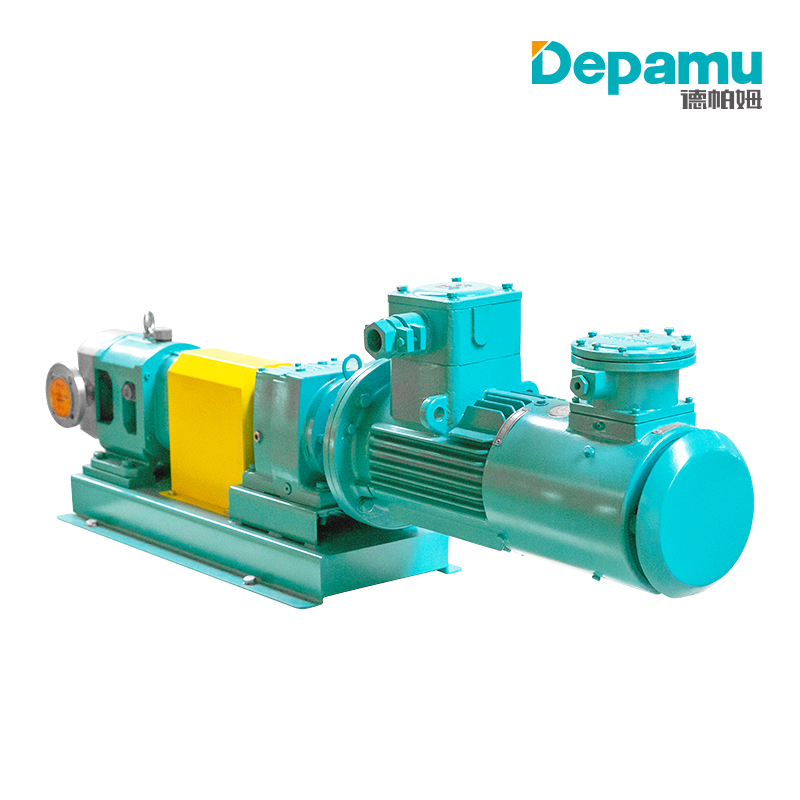
Depamu Metal Rotor Pump for High-Viscosity Fluids Like Honey and Ointments in the Food and Pharmaceutical Industry
Abstract
The transfer of high-viscosity, shear-sensitive fluids such as honey and pharmaceutical ointments presents a convergence of engineering challenges that conventional centrifugal pumps cannot resolve. This article examines how Depamu metal rotor pumps—positive displacement rotary lobe pumps engineered to API 676 standards—address these challenges through low-speed operation, non-contacting rotor geometry, and hygienic construction. Drawing on published technical specifications and comparative pump literature, the discussion positions the Depamu Rotor Pump not as a universal solution but as a precisely targeted technology for viscous, delicate, and hygiene-critical duties in food and pharmaceutical processing.
1. Introduction: Why High-Viscosity Fluids Defy Conventional Pumping
Honey at ambient temperature may range from roughly 2,000 to 10,000 cP, rising by an order of magnitude at lower temperatures; pharmaceutical ointments and pastes can sit at the upper end of the processable spectrum, approaching or exceeding 100,000 cP. These are not merely “thick” liquids. Many are non-Newtonian, exhibiting shear-thinning behaviour in which apparent viscosity changes with shear rate, making flow prediction unreliable for pumps designed around Newtonian assumptions. Honey is additionally shear-sensitive: excessive mechanical agitation can incorporate micro-bubbles, compromising clarity and commercial grade, while high shear and localized heating can degrade natural enzymes and promote unwanted crystallization. Ointments and pharmaceutical emulsions present a parallel but distinct set of constraints: their formulation integrity depends on minimal shear exposure, and any pump in the product path must be fully drainable, cleanable, and traceable to avoid cross-contamination between batches.
Centrifugal pumps, the default choice for low-viscosity liquids, lose efficiency drastically as viscosity rises. The impeller churns viscous media without generating useful pressure, creating conditions for cavitation and mechanical damage while subjecting the product to turbulence and shear that can irreversibly alter texture or structure. Positive displacement (PD) pumps, which trap a fixed volume of fluid and mechanically force it through the discharge, are the established alternative. Within the PD category, however, not all architectures perform equally across the viscosity–shear–hygiene triangle. The rotary lobe pump—the technology embodied in Depamu’s metal rotor pump line—occupies a distinctive position: it offers the gentle, low-shear handling of a non-contacting rotary design, combined with the hygienic configurability required by food and pharmaceutical processors.
2. The Depamu Metal Rotor Pump: Operating Principle and Engineering Logic
Depamu (Hangzhou) Pumps Technology Co., Ltd., established in 2003 and leveraging German pump technologies introduced in 2007, has developed a portfolio that includes stainless steel food-grade rotary lobe pumps designed in accordance with API 676. The operating principle is elegantly simple. Two synchronised rotors—typically bi-lobe or tri-lobe in configuration—rotate within a stationary casing without making direct contact with each other or with the casing walls. As the rotors turn, a low-pressure zone forms at the suction port, drawing fluid into the expanding cavities between the lobes and the casing. The fluid is transported around the periphery of the pump chamber, and on the discharge side the diminishing volume between the lobes and the casing forces the fluid out under pressure in a smooth, continuous flow.
The critical design parameter is the clearance between the rotors and between the rotors and the pump body, typically maintained in the range of 0.05 to 0.3 millimetres depending on fluid viscosity and characteristics. Because there is no metal-to-metal contact within the pumping chamber, wear is eliminated and operational lifespan is extended. The fluid itself acts as a lubricant and sealant, with its surface tension helping to minimise slip through the clearances. Low rotational speeds—10 to 650 revolutions per minute—further reduce shear exposure, making the pump suitable for fluids sensitive to agitation, emulsification, or structural degradation.
This architecture produces a set of performance characteristics directly relevant to honey and ointments. The Depamu food-grade rotor pump is rated for viscosities up to 2,000,000 cP, with some product literature citing the broader rotor pump range as capable of handling media up to the same ceiling. Self-priming capability extends to a maximum suction lift of up to nine metres, eliminating the need for auxiliary priming devices when drawing viscous product from tanks or vessels. Discharge pressures reach up to 1.5 MPa in standard single-stage sanitary configurations, rising to 2.0 MPa across the broader lobe series and up to 3.0 MPa in multi-stage arrangements. Temperature tolerance spans −40 °C to 280 °C, accommodating both chilled dairy operations and the handling of melted chocolate or hot sugar masses.
3. Hygienic Construction: The Non-Negotiable Foundation
For food and pharmaceutical duty, hydraulic performance is necessary but not sufficient. All product-contact components of the Depamu food-grade rotor pump are manufactured from AISI 316L stainless steel, selected for corrosion resistance against chlorides, cleaning chemicals, and the acidic nature of many food products. Internal surface finishes are engineered to roughness values typically below 0.8 micrometres Ra, creating a non-porous surface that inhibits residue adhesion and bacterial biofilm formation. This finish facilitates effective Clean-in-Place procedures without time-consuming manual dismantling. Gaskets and seals use FDA-compliant elastomeric materials, commonly EPDM, with deformation limiters to prevent dead legs where product could stagnate. The mechanical seal—typically a single or double sanitary design with silicon carbide or carbon faces—is internally assembled and accessible from the front of the pump without disconnecting the casing or pipework, simplifying maintenance and reducing downtime.
Depamu’s hygienic design philosophy extends to regulatory alignment. The pumps are positioned for compliance with FDA requirements and EU regulation 1935/2004 on materials intended to come into contact with food, and the company’s manufacturing is supported by ISO 9001, ISO 14001, ISO 45001, API, and CE certifications alongside more than 100 technical patents. For pharmaceutical processors, this framework provides a defensible basis for equipment qualification and audit response. The availability of metal rotors with replaceable tips, and rubber rotors for applications requiring extremely low shear or handling of larger solid particles, allows the pump to be configured to the specific sensitivity profile of the product.
4. Application in Focus: Honey Processing
Honey is a deceptively demanding test case. Its viscosity is high and strongly temperature-dependent; a 30 °C temperature increase can reduce viscosity by more than 80%, meaning a pump must perform across a rapidly shifting operating envelope. It is abrasive due to pollen and crystals, and it is shear-sensitive in ways that directly affect commercial value: high-speed agitation can incorporate micro-bubbles that compromise transparency, while excessive shear and localized heat can degrade enzymes and accelerate crystallization. A pump that merely “moves” honey is not enough; it must move honey without exacting a quality penalty.
The Depamu rotor pump’s low-speed, large-cavity conveying action addresses these constraints. Because the lobes do not contact each other or the casing, the fluid is displaced by volumetric expansion and contraction rather than by crushing or high-velocity impingement. Comparative analysis of lobe versus gear-type positive displacement pumps for honey transfer identifies the lobe principle as superior for premium honey applications precisely because the non-contacting action preserves crystal clarity and limits heat generation. Depamu’s jacketed pump head option allows honey to be heated in the pump itself, reducing viscosity from the 10,000 cP range to a more manageable 500 cP without introducing hot spots that can darken colour or degrade heat-sensitive components. The nine-metre suction lift is particularly valuable in bulk honey handling, where product may be drawn from drums or storage tanks with significant vertical separation from the pump.
The same characteristics translate to adjacent food categories. Chocolate and confectionery transfer benefits from the low-shear action that preserves temper and texture and prevents undesirable fat crystal formation; fruit preserves and purees containing particulate matter pass through the large, unobstructed flow passages without damage. The pump is not a specialist for honey alone but a platform technology whose value scales across the viscous, shear-sensitive spectrum of food processing.
5. Application in Focus: Pharmaceutical Ointments and Emulsions
Pharmaceutical ointments, creams, and emulsions impose a hygiene and integrity burden that exceeds even the most rigorous food standards. The pump must handle high-viscosity, often non-Newtonian formulations without imparting shear that could alter droplet size distribution, destabilize an emulsion, or degrade a active ingredient. It must be fully cleanable and, where required, sterilizable in place, with no dead zones or retention areas that could harbour residues between batches. Regulatory expectations under GMP frameworks demand traceability of materials, surface finishes compatible with cleaning validation, and designs that minimize the risk of contamination from wear particles or external ingress.
The Depamu rotor pump’s hygienic configuration maps onto these requirements with unusual coherence. The absence of metal-to-metal contact in the pumping chamber eliminates a primary source of particulate contamination, a point explicitly recognized in pharmaceutical pump selection literature as a sanitary advantage of non-contacting rotary designs. The 316L stainless steel wetted path and sub-0.8 µm Ra surface finish support cleaning validation and reduce the risk of biofilm formation. The pump’s ability to handle viscosities up to 2,000,000 cP covers the full practical range of ointment bases, from low-viscosity lotions to stiff hydrocarbon gels, while the low-speed operation minimizes the shear history to which the formulation is subjected. For emulsions and suspensions, the gentle volumetric displacement avoids the turbulent churning that can cause phase separation or particle attrition.
It is important to be precise about the pump’s place in the pharmaceutical process. The Depamu metal rotor pump is a transfer and dosing pump, not a high-pressure homogenizer or a sterile filling needle. Its role is to move formulated product from mixing vessel to holding tank or from holding tank to filling line without degrading what the formulation team has engineered. In this role, the combination of high-viscosity capability, low shear, and cleanable hygienic construction is directly aligned with the operational realities of ointment and cream manufacturing.
6. Comparative Positioning: Where the Rotor Pump Fits
A candid assessment of the Depamu rotor pump requires acknowledging what it is not. In the broader landscape of positive displacement technologies, progressive cavity pumps are often cited as the most versatile choice for extremely high-viscosity media and are capable of handling well above 1,000,000 cP, while twin Screw Pumps offer excellent performance for highly viscous and shear-sensitive pharmaceutical fluids. Rotary lobe pumps are characterized in comparative literature as “good” for viscous fluids and “case by case” for highly viscous fluids, with particular strength in gentle product handling, hygienic applications, and particulate-laden products.
The nuance is important. The Depamu metal rotor pump is not positioned as the equal of a progressive cavity pump for the most extreme, abrasive, or solids-heavy viscous slurries. Its differentiators lie elsewhere: in the combination of low-shear handling, high sanitary finish, CIP compatibility, and the mechanical simplicity of a non-contacting rotary design. Where a progressive cavity pump’s elastomeric stator may present compatibility or cleaning challenges in certain pharmaceutical formulations, and where a twin screw pump’s cost and complexity may exceed the needs of a given duty, the rotary lobe architecture offers a balanced engineering compromise. The Depamu pump’s nine-metre suction lift and reverse-rotation clearing capability add operational flexibility that is valued in batch food and pharmaceutical plants where pump positioning is constrained by vessel geometry and piping layouts.
The practical implication is that pump selection for honey and ointments should proceed from the fluid and process first, not from a generic hierarchy of technologies. For a premium honey bottling line where crystal clarity and enzyme preservation are paramount, the low-shear lobe principle is well matched. For an ointment transfer duty where cleanability and non-contacting operation are decisive, the Depamu sanitary rotor pump presents a coherent solution. For a raw molasses offloading application requiring maximum suction and tolerance of abrasive solids, a different configuration may be more appropriate. The value of the Depamu platform lies in occupying a well-defined and technically defensible position within this decision space.
7. Conclusion
The transfer of honey and pharmaceutical ointments demands more than a pump that can generate pressure against a viscous resistance. It requires a device that respects the rheology, shear sensitivity, and hygienic status of the product while delivering reliable, cleanable, and controllable flow. The Depamu metal rotor pump addresses this requirement through a coherent set of design choices: non-contacting bi-lobe or tri-lobe rotors operating at low speed, precise clearances that exploit the fluid’s own lubricity, 316L stainless steel construction with sub-0.8 µm surface finishes, and a hygienic architecture compatible with CIP and the documentation expectations of food and pharmaceutical regulators. Its viscosity ceiling of 2,000,000 cP, suction lift of up to nine metres, and discharge pressure capability to 1.5 MPa in sanitary configurations define a performance envelope that comfortably encompasses the practical range of honey and ointment processing. What the pump offers is not universal supremacy across all viscous-fluid duties, but a carefully engineered balance—gentle enough for shear-sensitive products, viscous-capable enough for pastes and syrups, and hygienic enough for the most audit-sensitive processing environments. In an industry where product integrity is inseparable from equipment performance, that balance is the relevant measure of engineering value.