

Depamu Specialty Sanitary & High Pressure AODD & EODD Pumps: Engineering Excellence for Demanding Fluid Handling Applications
Introduction
In the complex landscape of industrial fluid handling, few challenges demand more from pumping equipment than the simultaneous requirements of sanitary integrity and high-pressure performance. Whether transferring sensitive pharmaceutical ingredients under strict hygienic protocols or injecting corrosive chemicals at pressures approaching 100 MPa, the pump becomes a critical control point where process safety, product quality, and operational reliability converge. Depamu (Hangzhou) Pumps Technology Co., Ltd., established in 2003 and headquartered in the Qiantang Area of Hangzhou, China, has emerged as a significant player in this specialized domain. The company manufactures a comprehensive portfolio that includes Metering Pumps, high-pressure Reciprocating Pumps, air-operated double diaphragm (AODD) pumps, electric-operated double diaphragm (EODD) pumps, and complete chemical dosing systems, supported by ISO 9001, ISO 14001, ISO 45001, API, and CE certifications, along with over 100 technical patents.
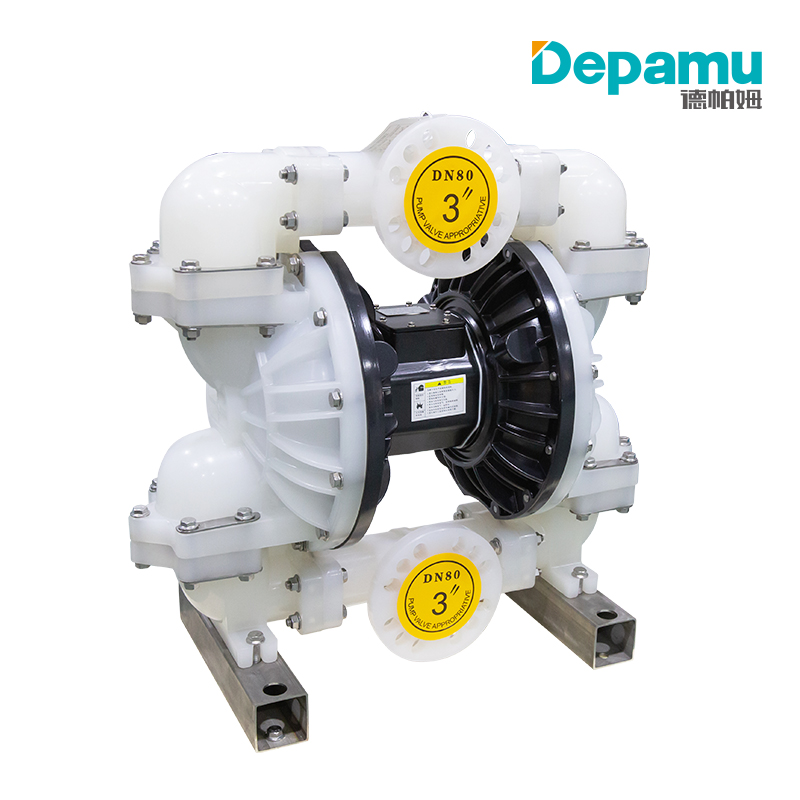
This article examines Depamu's specialty sanitary and high-pressure AODD and EODD pump technologies, exploring how the company's engineering philosophy addresses the distinct—and often conflicting—demands of hygienic processing and extreme-pressure applications.
The AODD and EODD Technology Framework
The fundamental architecture of double Diaphragm Pumps represents one of the most versatile solutions in positive displacement pumping. Unlike centrifugal or plunger pumps that rely on mechanical seals and close-tolerance rotating or reciprocating components, double diaphragm pumps employ a pair of flexible membranes driven by either compressed air (AODD) or an electric motor (EODD) to displace fluid through alternating pumping chambers. This design yields several operational advantages that are particularly valuable in demanding environments.
AODD pumps are inherently self-priming and can run dry without damage. On offshore platforms or in batch processing operations where tank emptying requires the pump to continue operating after the liquid level drops, this capability prevents the catastrophic failures that would otherwise occur with seal-dependent pumps. The pumps can also operate against closed discharge valves for extended periods without causing damage to the pump or the surrounding environment.
Depamu's EODD technology represents a significant evolution in this pump category. Unlike air-operated double diaphragm pumps that rely on compressed air, EODD pumps utilize an electric motor-driven mechanism to actuate diaphragms, offering distinct advantages in precision, energy efficiency, and operational consistency. This distinction is particularly consequential in applications where precise flow control and repeatable dosing are critical—characteristics that align closely with both sanitary processing and high-pressure chemical injection requirements.
Sanitary Applications: Hygiene as an Engineering Discipline
Depamu's sanitary pump solutions address industries where product purity and contamination prevention are non-negotiable. The company's product portfolio explicitly targets pharmaceutical, food, and extraction sectors with specialized offerings including sanitary transfer systems, supercritical CO₂ extraction lines, and Rotor Pumps designed for hygienic fluid handling.
The "sanitary" designation in Depamu's product line extends beyond surface-level considerations. For food and pharmaceutical applications, pumps must satisfy regulatory frameworks including FDA compliance and EU 1935/2004 regulations for materials in contact with process fluids. Depamu's sanitary lobe pumps employ FDA-compliant elastomeric materials for gaskets and seals, and the pumps are designed according to API 676 standards, which specify requirements for positive displacement rotary pumps in general refinery service and have been adapted for hygienic applications.
The practical demands of sanitary pumping are illustrated by applications such as chocolate and syrup transfer, where viscosity, temperature sensitivity, and the need for gentle handling without shearing or aeration all influence pump selection. Depamu's food-grade rotary lobe pumps address these requirements through precision engineering and material selection that prioritizes both performance and regulatory compliance.
In pharmaceutical and food extraction processes, the challenges intensify. Supercritical CO₂ extraction, a technology increasingly favored for its solvent-free processing capabilities, requires pumps that can handle the unique properties of supercritical fluids—high diffusivity, low viscosity, and extreme sensitivity to pressure and temperature fluctuations. Depamu's rotor pumps and complete supercritical extraction systems are engineered specifically for these applications, where any contamination or pressure instability can compromise both product quality and process safety.
High-Pressure Capabilities: Engineering Against Extremes
While sanitary applications emphasize hygiene and material compatibility, high-pressure pump applications prioritize structural integrity, sealing reliability, and resistance to aggressive chemical attack. Depamu's high-pressure diaphragm pump portfolio spans an impressive operational envelope, with discharge pressures reaching up to 95 MPa and flow rates of up to 12,100 liters per hour.
The company's reciprocating pumps are designed according to American Petroleum Institute standard API 674, which specifies requirements for positive displacement reciprocating pumps used in the petroleum, petrochemical, and natural gas industries. This design standard ensures that pumps meet the highest requirements for reliability, safety, and performance under extreme operating conditions.
The fundamental advantage of diaphragm pump technology in high-pressure service lies in its hydraulic separation between the power end and the process fluid. Unlike plunger or piston pumps, where the moving element is in direct contact with the pumped media, a diaphragm pump employs a flexible membrane—typically fabricated from PTFE, metallic alloys, or composite materials—that isolates the fluid completely. For hazardous or corrosive media, this design is not merely a convenience; it is a safety imperative.
Depamu's high-pressure diaphragm pumps find application in demanding services including liquid carbon dioxide injection, monoamine phosphate transfer, oilfield water injection, polymer injection, and chemical fertilizer processing. The company's product range includes models specifically engineered for transporting fluids with high pressure, high temperature, or strong corrosion characteristics, as well as fluids that are easy to volatilize or crystallize.
The Convergence: Sanitary High-Pressure Pump Applications
Perhaps the most technically demanding applications occur at the intersection of sanitary requirements and high-pressure operation. Depamu's EODD pump technology, in particular, demonstrates how electric drive systems can bridge these seemingly contradictory demands.
Consider the case of sodium hypochlorite (NaOCl) handling—a chemical that is simultaneously a corrosive oxidizing agent, prone to gas evolution and crystallization, and extensively used in water treatment, pulp and paper processing, and sanitation industries. Sodium hypochlorite's high alkalinity (pH typically 11–13) and tendency to decompose and release oxygen gas, particularly under increased temperature or pressure conditions, create specific challenges including vapor lock, cavitation damage, and seal degradation.
Depamu's EODD pumps address these challenges through a combination of material selection and design innovation. The pumps employ stainless steel 316 and 316L components for superior corrosion resistance against hypochlorite solutions, along with PTFE diaphragms that feature good mechanical performance and resistance to corrosion by strong acids, bases, and solvents. The electric drive mechanism provides more consistent diaphragm actuation than air-operated alternatives, which can vary with compressed air supply fluctuations—a factor that directly influences both dosing accuracy and diaphragm life.
Offshore and Marine Applications: A Test of Engineering Endurance
Depamu's AODD pump technology has demonstrated particular resilience in offshore marine environments, where equipment must withstand high temperatures, high humidity, intense salt spray, and the constant risk of explosive atmospheres. The company has successfully deployed AODD pumps and chemical injection skids on CNOOC (China National Offshore Oil Corporation) platforms in the South China Sea and Bohai Bay.
The AODD pump's pneumatic drive mechanism inherently eliminates the risk of electrical sparks, making it a natural fit for hazardous zones classified under IEC and ATEX directives. The seal-less design virtually eliminates the risk of process fluid leakage—a critical consideration when pumped fluids may include toxic corrosion inhibitors, flammable methanol, or environmentally harmful chemicals.
Depamu's DP series AODD pumps, including the 2DPMFXAA model, offer maximum flow rates up to 3,200 liters per hour per pump head and maximum discharge pressures of 0.6 MPa. For applications requiring higher pressures, the company's broader portfolio includes models capable of discharge pressures up to 95 MPa and flow rates of 12,100 liters per hour.
Quality Assurance and Certification
Depamu's engineering claims are substantiated by a comprehensive certification framework. The company holds ISO 9001 (quality management), ISO 14001 (environmental management), and ISO 45001 (occupational health and safety) certifications, along with API standards compliance and CE marking for European market access. The company's products are designed in accordance with API 674 (reciprocating pumps) and API 675 (controlled volume pumps) standards, and have passed certifications from international authorities including DNV (Det Norske Veritas).
This certification portfolio reflects a systematic approach to quality that extends beyond product performance to encompass manufacturing consistency, environmental responsibility, and worker safety. For customers in regulated industries—pharmaceutical, food, oil and gas, nuclear power—these certifications provide the assurance that Depamu pumps will meet not only performance specifications but also the documentation and traceability requirements that regulatory compliance demands.
Conclusion
Depamu's specialty sanitary and high-pressure AODD and EODD pump technologies represent a coherent engineering response to some of the most demanding fluid handling challenges in modern industry. By combining the inherent advantages of double diaphragm pump architecture—seal-less design, dry-run capability, self-priming operation—with advanced material selection, precision manufacturing, and application-specific engineering, Depamu has developed a portfolio that serves industries ranging from pharmaceutical manufacturing to offshore oil production.
The convergence of sanitary and high-pressure requirements, while technically challenging, is increasingly common as industries demand greater process flexibility, higher product purity, and more reliable performance under extreme conditions. Depamu's ability to address both domains—whether through FDA-compliant sanitary lobe pumps for food processing, API 674-compliant High-Pressure Reciprocating Pumps for oilfield service, or EODD pumps that combine electric drive precision with chemical-resistant construction—positions the company as a versatile partner for fluid handling applications that tolerate no compromise.