

Depamu Chemical Dosing Skid Package: Integrated Design for Water Treatment Applications
Abstract
Precise chemical dosing is a cornerstone of modern water treatment, directly influencing operational safety, process efficiency, and regulatory compliance. Traditional approaches that involve purchasing pumps, tanks, and controllers separately and assembling them on-site suffer from compatibility issues, performance inconsistencies, and high maintenance burdens. Depamu’s chemical dosing skid package addresses these challenges through a systematic, factory-assembled, skid-mounted solution that integrates chemical dissolution, preparation, metering, and injection into a single automated platform. This article provides a comprehensive technical overview of the Depamu dosing skid, examining its integrated design philosophy, core component architecture, PLC-based automation logic, and versatile applications across boiler water treatment, cooling systems, wastewater processing, and oil and gas operations. Particular attention is given to the system’s proven reliability in demanding environments, including its deployment in the Yamal LNG project.
1. Introduction
In industrial water treatment, the precise dosing of treatment chemicals—whether for pH adjustment, scale inhibition, corrosion prevention, or disinfection—determines the overall efficiency of the process. Inaccurate dosing produces two equally undesirable outcomes: underdosing leads to scale formation, corrosion, or microbial proliferation, while overdosing results in chemical waste, increased operating costs, and secondary water quality degradation. The conventional practice of procuring pumps, tanks, and control devices separately and assembling them in the field introduces compatibility problems, performance mismatches, and elevated maintenance demands. Depamu’s integrated dosing skid package resolves these issues by treating the entire dosing process as a unified engineering problem rather than a collection of individual equipment items.
2. Design Philosophy and Modular Skid Architecture
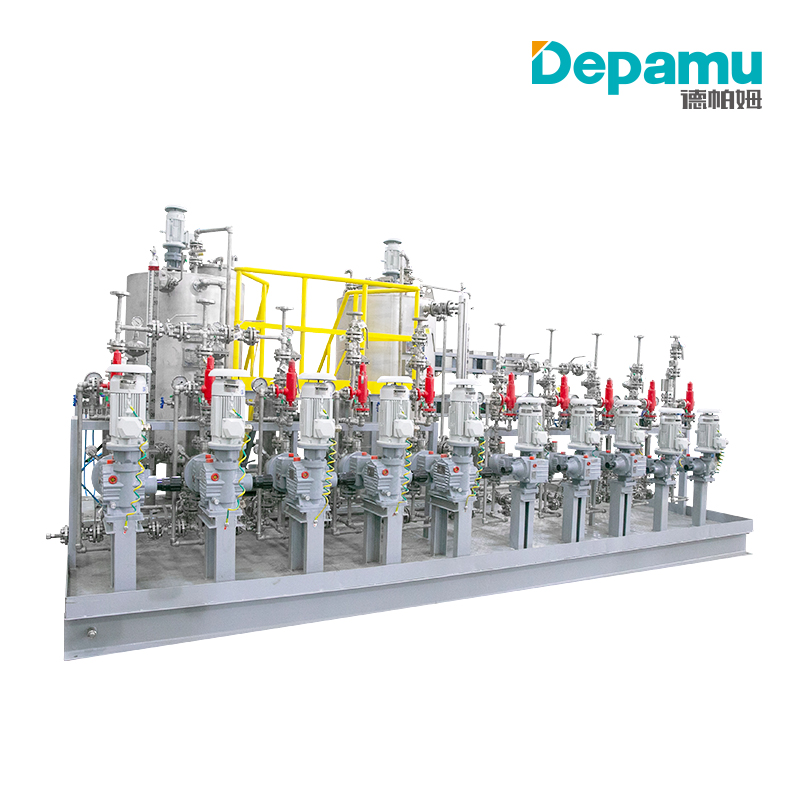
The Depamu dosing package is a factory-assembled, skid-mounted unit that integrates all necessary components onto a common steel base frame. This modular approach fundamentally differs from conventional fragmented configurations. By adopting a “systematic design” philosophy, Depamu ensures that every component—pumps, storage tanks, piping, valves, instruments, and controls—operates in harmonious coordination, thereby eliminating the performance inconsistencies that arise from partial integration. The result is a package that offers a compact footprint, simplified installation, and convenient transportation, making it equally suitable for new construction and retrofit projects.
A notable innovation in Depamu’s skid design is the abandonment of single-layer layouts in favor of a three-tier skid configuration that vertically integrates IBC totes and other components. This vertical integration reduces equipment footprint by 40 to 50 percent compared with conventional designs while using height differentials to minimize pump cavitation risk and extend service life. Such spatial efficiency is particularly valuable in offshore platforms, municipal treatment plants, and other space-constrained installations where floor area commands a premium.
3. Core Components and Integrated Functionality
The Depamu dosing skid comprises several core functional units that work in seamless integration.
3.1 Solution Storage Tanks
The solution storage tank serves as the vessel for storing and mixing prepared chemical solutions. Depending on the specific chemical and corrosion-resistance requirements, tanks are fabricated from 304 or 316 stainless steel, carbon steel with rubber or plastic lining, fiberglass-reinforced plastic (FRP), polyethylene (PE), or PVC. Tank capacities range from 0.5 m³ to 2.5 m³ for boiler water applications, with larger capacities available for other industrial uses. Level gauges provide continuous monitoring of solution inventory, and low-level detection prevents dry running of the Metering Pumps.
3.2 Metering Pumps
The metering pump is the heart of the Injection Package, delivering chemical solutions with high precision. For boiler water injection, pumps typically provide flow rates of 20 to 70 liters per hour at discharge pressures up to 2.5 MPa for ammonia and hydrazine injection, and up to 5–32 MPa for phosphate injection. Flow rate is steplessly adjustable from 0% to 100% of rated capacity. The pump’s wetted parts are constructed from corrosion-resistant materials such as 316/304 stainless steel or UPVC to ensure durability. Pumps can be configured in multiple combinations—such as one tank with two pumps, or two tanks with four pumps—typically with one pump serving as a standby to ensure uninterrupted operation.
3.3 Pulsation Dampeners and Safety Valves
The reciprocating motion of metering pumps generates flow pulsation that can affect downstream processes and piping integrity. Pulsation dampeners mitigate these fluctuations to ensure steady injection, while safety valves provide overpressure protection by automatically releasing excess pressure to protect system components.
3.4 Piping, Valves, and Electrical Control Cabinet
A comprehensive network of pipes, valves, and fittings connects all components, enabling flexible flow control, isolation for maintenance, switching between multiple tanks, or parallel pump operation. The electrical control cabinet governs the entire package, supporting operating modes ranging from local manual control to semi-automatic operation and fully automatic control integrated with the plant’s distributed control system (DCS). Auxiliary components, including safety valves, pulsation dampeners, level gauges, and pressure gauges, further ensure safe and stable operation.
4. Automation and Control Architecture
4.1 PLC-Based Control Logic
The intelligence of the Depamu dosing package resides in its programmable logic controller (PLC), which functions as a host controller interfacing with the plant’s DCS. The PLC receives real-time signals from online analytical instruments—including flow meters, pH sensors, conductivity meters, dissolved oxygen analyzers, turbidity meters, and phosphate analyzers—and calculates the optimal chemical injection rate. The control logic adjusts the rotational speed or stroke length of the metering pump via variable frequency drives (VFDs), achieving a flow regulation range of 0% to 100%.
4.2 Control Strategies
The automatic control system supports multiple control strategies tailored to different water treatment processes. Feedback control corrects deviations from setpoints based on measured values of residual chemical concentration, pH, or turbidity. Feedforward control measures disturbance factors and proactively adjusts dosing based on a mathematical model, enabling rapid response. Cascade control combines the two approaches: feedforward control provides the bulk of the dosing rate, while feedback control fine-tunes it for accuracy, achieving both rapid response and precise regulation. In practice, PID (proportional-integral-derivative) algorithms embedded in the PLC calculate correction amounts based on the deviation between measured values and target setpoints. For highly nonlinear pH neutralization loops, gain scheduling may be required; for residual chlorine control with long dead times, conservative tuning ensures stable operation.
4.3 Operating Modes
The system supports three operating modes. First, local manual control allows operators to adjust pump settings directly at the control cabinet. Second, semi-automatic mode executes pre-programmed dosing sequences under operator supervision. Third, fully automatic control delegates all aspects of dosing to the PLC or DCS based on real-time sensor inputs. This flexibility enables the system to adapt to plants with varying levels of automation infrastructure.
5. Applications in Water Treatment
5.1 Boiler Feedwater Treatment
In thermal power plants and industrial steam generation facilities, boiler feedwater quality is critical to equipment longevity and thermal efficiency. Depamu provides specialized injection packages for ammonia injection (for pH adjustment and corrosion prevention), hydrazine injection (for dissolved oxygen removal and pitting prevention), and phosphate injection (for scale control). In phosphate injection, trisodium phosphate reacts with calcium ions to form basic calcium phosphate—a soft precipitate that does not adhere to heat transfer surfaces and is easily removed through blowdown. The automatic control system continuously adjusts injection rates based on real-time water quality parameters, ensuring stable protection of the steam generation system.
5.2 Cooling Water Treatment
In cooling water systems, scale, corrosion, and microbial growth pose continuous threats to heat exchange equipment. Depamu systems are designed to inject scale inhibitors, corrosion inhibitors, and biocides to protect heat transfer surfaces and maintain system efficiency. The systems can be customized for specific chemicals such as polyaluminum chloride (PAC), polyacrylamide (PAM), and concentrated sulfuric acid, demonstrating their adaptability. Depamu’s circulating water injection package employs a “blowdown and makeup” control logic, in which a conductivity controller signals the skid to discharge concentrated water, thereby maintaining cycles of concentration within optimal limits.
5.3 Wastewater and Raw Water Treatment
For municipal and industrial wastewater treatment, flocculation is a critical process for solid removal. Depamu systems automatically prepare and inject dry powder flocculants and coagulants with high precision. The systems also control the dosing of dispersants, acids, and bases at various treatment stages to regulate pH, making them applicable to both wastewater flocculation and drinking water purification. Automatic dry powder injection packages can continuously prepare liquid media at different concentrations from a wide range of dry powder and granular chemicals.
5.4 Oil and Gas Operations
Oil and natural gas extraction requires the injection of demulsifiers, corrosion inhibitors, oxygen scavengers, and methanol (for hydrate inhibition). These applications typically demand higher-pressure pumps and larger storage tanks, highlighting the system’s robustness and ability to handle diverse chemical properties. The DPJY series injection packages are specifically targeted at clients in petroleum, chemical, natural gas, and oil refining industries with production automation requirements.
6. Operational and Logistical Advantages
The skid-mounted configuration offers significant logistical and operational advantages over stick-built systems. Because the entire package is factory-assembled and tested before shipment, on-site commissioning time is dramatically reduced and the risk of field integration errors is minimized. The compact, modular structure facilitates convenient maintenance and transportation. Depamu’s injection packages are characterized by high automation, ease of operation and maintenance, and the ability to satisfy the demands of different operating conditions. Users can select equipment and parts from famous domestic and foreign brands in various materials, and multiple control modes—manual and automatic—can be selected to meet diverse control requirements. The modular design also allows for convenient extension in terms of capacity and function, enabling the system to grow with evolving process requirements.
7. Reliability and Proven Performance
The reliability of Depamu dosing packages has been validated in demanding environments. The Depamu reagent dosing unit employed in the Yamal LNG facility serves as a critical component ensuring operational integrity through precise chemical management. For critical services at Yamal LNG, multiple pump configurations—including duty and standby arrangements—are typically specified, with hydraulically actuated diaphragm metering pumps incorporating multi-diaphragm configurations with alarm functions. The selection of Depamu packages for this project underscores the system’s capacity for DCS integration and its proven reliability in harsh, remote environments where uninterrupted operation is essential.
8. Conclusion
The Depamu chemical dosing skid package represents a significant advancement in integrated water treatment chemical delivery. By combining robust mechanical components with intelligent automation—centered on a PLC that interfaces seamlessly with plant-wide DCS architecture—Depamu delivers a solution that is precise, reliable, and highly adaptable across diverse industrial applications. The skid-mounted modular design simplifies installation, reduces footprint, and lowers the engineering challenges associated with traditional fragmented systems. From protecting boilers and cooling towers to enabling clean water production and supporting critical oil and gas operations, the Depamu dosing skid has become an indispensable component for ensuring efficiency, safety, and environmental compliance in modern industrial water management.