

Depamu Corrosion Inhibitor Injection Package for Chemical Industry
Abstract
Corrosion represents one of the most persistent and costly challenges facing the chemical industry, with direct economic losses estimated at approximately 3% of GDP in industrialized nations. In chemical plants, petrochemical refineries, and related processing facilities, the integrity of carbon steel pipelines, reactor vessels, and heat exchangers is continuously threatened by corrosive media containing dissolved oxygen, hydrogen sulfide, carbon dioxide, and various ionic species. Corrosion inhibitor injection has emerged as one of the most cost-effective strategies for mitigating internal corrosion, with most inhibitors formulated to function effectively at concentrations of 10–20 ppm. The Depamu Corrosion Inhibitor Injection Package, a factory-assembled, skid-mounted modular system, integrates storage, metering, control, and injection functions into a single pre-commissioned unit. This article provides a comprehensive technical analysis of the Depamu injection package, examining its system architecture, mechanical design, Metering Pump technology, automation capabilities, international standards compliance, and diverse applications across the chemical industry.
1. Introduction: The Corrosion Challenge in the Chemical Industry
The chemical industry operates under some of the most demanding conditions found in modern manufacturing. Process fluids ranging from acidic intermediates to high-temperature hydrocarbon streams create electrochemical environments that rapidly degrade carbon steel and other conventional construction materials. The consequences of uncontrolled corrosion are severe: pinhole leaks in piping systems, premature failure of heat exchanger tubes, contamination of product streams, and unplanned shutdowns that cost chemical producers millions of dollars in lost production.
The economic dimension of this problem is substantial. A study by the National Bureau of Standards indicated that the annual cost of corrosion in the United States alone was approximately US$70 billion, with roughly 4% of this amount attributable to the chemical, petrochemical, and related industries. For the chemical industry specifically, total capital expenditures of $15.061 billion are accompanied by annual corrosion costs ranging from $604 million to $1.807 billion, while the petrochemical industry incurs an estimated average direct corrosion cost of $1.7 billion per year. These figures underscore the critical importance of effective corrosion management programs.
Corrosion inhibitors function by forming protective molecular films on metal surfaces or by neutralizing corrosive species in the process stream. However, these chemicals are only effective when maintained at precise concentrations. Under-dosing leaves equipment vulnerable to attack, while over-dosing wastes expensive chemicals and may contaminate downstream processes or violate environmental permit conditions. This concentration-sensitivity has driven the industry to abandon ad-hoc injection arrangements in favor of standardized, factory-built Chemical Injection Packages. The Depamu Corrosion Inhibitor Injection Package represents a mature engineering response to this need—a "plug-and-play" solution that arrives pre-piped, pre-wired, and factory-tested, designed to deliver inhibitor with metering pump precision and complete system redundancy.
2. System Architecture and Mechanical Design
2.1 Skid Frame and Structural Integrity
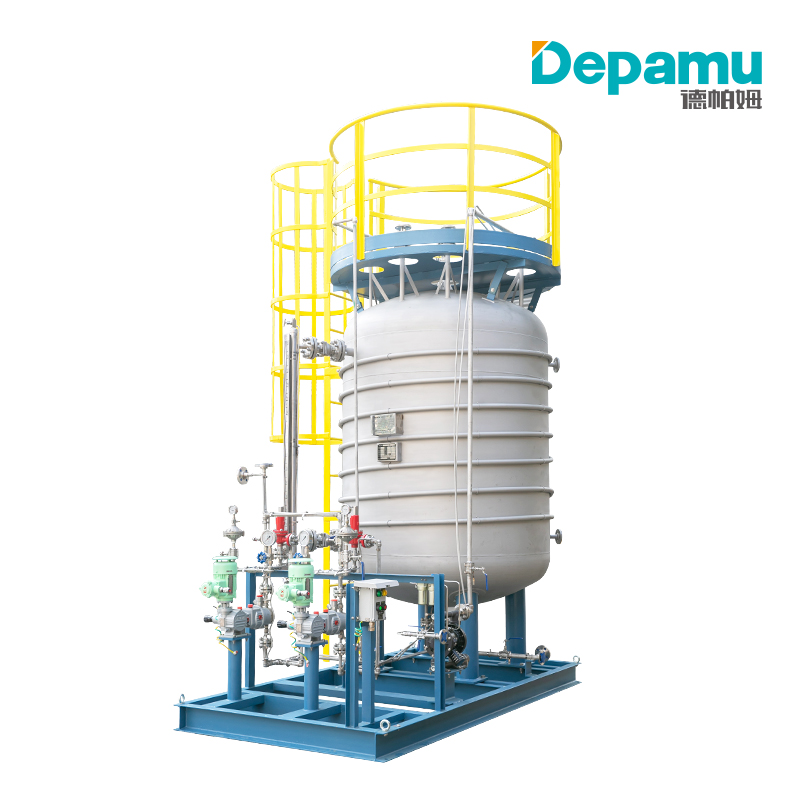
The Depamu injection package is built around a philosophy of modular integration. Unlike field-assembled systems that require separate procurement and assembly of tanks, pumps, and piping, the Depamu design mounts all critical components on a single structural steel base. This base is typically fabricated from heavy-gauge steel beams—I-beams or channel sections—engineered to withstand vibration, seismic loads, and the lifting stresses encountered during transport. Integrated forklift pockets and lifting lugs comply with international handling standards. A critical design feature is the inclusion of a full-perimeter drip tray or spill containment basin beneath the pump and tank areas. This secondary containment is essential for environmental compliance, preventing chemical leaks from reaching the plant floor.
2.2 Solution Tank and Material Selection
The solution tank forms the core of the injection package. For corrosion inhibitor applications, Depamu offers tank capacities ranging from 0.5 cubic meters to 20 cubic meters, depending on the specific application scenario—smaller units serving power plants and pilot facilities, while larger tanks are deployed in oil gathering and transportation pipelines.
Material selection is governed by the chemical compatibility requirements of the specific inhibitor formulation. Standard options include SS316L stainless steel and high-density polyethylene (HDPE). For particularly aggressive inhibitor formulations, such as high-acid scavengers, tanks may be fabricated from duplex steel (2205) or lined with PTFE. The tank assembly incorporates several essential features: a magnetic level gauge for local visual monitoring, level transmitters connected to the control system for low-level alarms and automatic refill initiation, and manways with electric agitators for powder-based or viscous inhibitors requiring homogenization. Optional heating or cooling jackets are available for formulations that require temperature control to maintain proper viscosity.
2.3 Metering Pump: The Precision Engine
The accuracy of any injection package depends on its metering pumps. Unlike standard centrifugal pumps, metering pumps—typically reciprocating diaphragm or plunger types—deliver precise volumetric displacement independent of discharge pressure fluctuations. Depamu equips its corrosion inhibitor packages with high-performance metering pumps offering flow rates from 10 liters per hour to 1,000 liters per hour and discharge pressures from 0.3 MPa to 4.0 MPa.
The flagship product line for these applications is the 3DP(M)ZA series Hydraulic Diaphragm Metering Pump. These pumps employ a hydraulic diaphragm design that eliminates leakage paths while providing the high injection pressures required for downhole and long-distance pipeline applications. The pump head can be configured as hydraulic diaphragm, packed plunger, or piston type depending on specific operating conditions. The hydraulic diaphragm mechanism isolates the process fluid from the hydraulic system, preventing contamination and ensuring zero-emission operation. For chemical industry applications requiring high-precision metering, Depamu packages incorporate advanced flow control instrumentation capable of achieving dosing accuracy of ±0.5% to 0.2%.
A hallmark of industrial-grade skid design is the main/standby pump configuration. This redundancy ensures continuous inhibitor injection even during pump maintenance. The control system automatically switches to the standby pump upon detection of a fault condition, maintaining uninterrupted corrosion protection.
2.4 Piping, Valves, and Ancillary Components
The piping network within the Depamu package is comprehensive and fully integrated. It includes safety valves for overpressure protection, pulsation dampers to smooth the flow fluctuations inherent in reciprocating pump operation, pressure gauges for visual monitoring, and a full complement of isolation and control valves. The pulsation damper is particularly important: the reciprocating action of the metering pump creates pressure pulsations that, if unchecked, can cause vibration, accelerated wear, and inaccurate injection rates. By smoothing these fluctuations, the pulsation damper ensures consistent chemical delivery and protects downstream instrumentation and piping.
3. Automation and Control Systems
Modern chemical plants demand injection systems that integrate seamlessly with plant-wide control architectures. The Depamu package's electrical control cabinet supports manual, semi-automatic, and fully automatic operation modes, with the ability to interface with distributed control systems (DCS) or host computer systems.
In automatic mode, the system receives signals for flow rate, pH value, and chemical-specific parameters (such as phosphate radical concentration in boiler water treatment) via PLC, host computer, or DCS. These signals are processed to automatically adjust the rotation speed and stroke length of the metering pump, enabling a flow adjustment range of 0 to 100% of rated capacity. The frequency converter control input signal is a standard 4–20 mA signal, matching industry-standard feedback protocols.
All metering pump and mixer status signals—including fault conditions—can be transmitted to the DCS or host computer, enabling remote start/stop and comprehensive system monitoring. This level of integration allows chemical plant operators to maintain complete visibility over their corrosion inhibitor program from the central control room, eliminating the need for dedicated operator rounds to check injection system status.
4. Compliance with International Standards
The Depamu injection package is designed to comply with relevant international standards governing chemical injection equipment. Of particular importance is API 675, the American Petroleum Institute standard for positive displacement pumps—controlled volume. API 675 specifies requirements for accuracy, reliability, and repeatability of metering pumps, with steady-state accuracy requirements typically set at ±1% of set point.
In a technical evaluation conducted by Oil and Gas Development Company Limited (OGDCL), a corrosion inhibitor package supplied by Depamu (Hangzhou) Pumps Technology Co. Ltd. was assessed against stringent technical specifications. The evaluation highlighted the importance of power take-off arrangements—the data sheet required that the corrosion inhibitor package take off power from the positive displacement pump, a specification that underscores the criticality of integrated power management in hazardous area installations. The evaluation also emphasized motor sizing requirements, with a minimum required power of 59 kW for the specific application, demonstrating that metering pump sizing must account for the full range of operating conditions including maximum discharge pressure and fluid viscosity.
Additional standards relevant to chemical injection packages include NACE standards for corrosion inhibitor evaluation and testing. NACE TM0172 provides the standard test method for determining the corrosion-inhibiting properties of materials, while NACE TR31215-2024 offers comprehensive guidance on laboratory evaluation of corrosion inhibitors, covering 18 inhibitor properties that should be assessed before field deployment. Depamu's injection packages are engineered to accommodate inhibitors formulated to meet these industry benchmarks.
5. Applications Across the Chemical Industry
5.1 Petrochemical Refining
In petrochemical refineries, corrosion inhibitors are injected at multiple points in the process—into crude unit overhead systems to combat HCl and H₂S corrosion, into catalytic cracking units to protect against naphthenic acid attack, and into product pipelines to prevent internal corrosion during transport. The Depamu package's high-pressure metering capability (up to 32 MPa in certain configurations) makes it suitable for injection into high-pressure process streams, while its precise metering ensures that expensive inhibitor formulations are consumed efficiently without waste.
5.2 Boiler Feedwater Treatment
Boiler feedwater treatment is a critical application where corrosion inhibitor injection directly impacts operational safety and equipment longevity. Impurities in feedwater—dissolved oxygen, hardness ions (calcium and magnesium), and pH imbalances—can precipitate scale, accelerate corrosion, and ultimately lead to catastrophic equipment failure. While mechanical deaeration removes the bulk of dissolved oxygen, chemical dosing serves as the critical final barrier against residual oxygen and pH imbalance. Depamu injection packages for boiler water treatment typically offer pump capacities of 20–70 L/H with discharge pressures up to 5–32 MPa for phosphate injection, and up to 2.5 MPa for ammonia and hydrazine injection.
5.3 Cooling Water Systems
Circulating cooling water systems in chemical plants present a unique corrosion environment. The combination of dissolved oxygen, elevated temperatures, and concentration effects from evaporation makes these systems particularly susceptible to corrosion and scale formation. Corrosion inhibitors—typically organic formulations based on amines, imidazolines, or their derivatives—are injected continuously to maintain protective films on heat exchanger surfaces and piping. The Depamu package's ability to deliver multiple chemicals from a single skid—through configurations accommodating two or four pump heads—enables simultaneous injection of corrosion inhibitors, scale inhibitors, and biocides from a compact footprint.
5.4 Wastewater Treatment and Environmental Compliance
Chemical plants must treat process wastewater before discharge to meet environmental regulations. Corrosion inhibitors in wastewater treatment applications protect concrete and steel structures in aeration basins, clarifiers, and sludge handling systems. The Depamu package's full-perimeter spill containment and secondary containment features are particularly valuable in this application, ensuring that chemical leaks do not contaminate treated water or surrounding soil.
6. Operational Advantages and Economic Benefits
The Depamu injection package offers several operational advantages that translate directly into economic benefits for chemical plant operators. The factory-assembled, pre-tested design reduces site installation time and eliminates the coordination challenges associated with procuring and assembling individual components. This "plug-and-play" approach accelerates project timelines and reduces the risk of installation errors that could compromise system performance.
The precise metering capability—with dosing accuracy as tight as ±0.2%—ensures that expensive corrosion inhibitor formulations are consumed at exactly the required rate. This precision eliminates the common practice of over-injection as a safety margin, which can waste 20–30% of chemical consumption in manually controlled systems. For a typical chemical plant spending $500,000 annually on corrosion inhibitors, this precision could translate to savings of $100,000 to $150,000 per year—delivering a return on investment that is often realized within the first year of operation.
The redundancy built into the main/standby pump configuration further enhances operational reliability. Continuous corrosion protection is maintained even during pump maintenance, preventing the corrosion damage that can occur during even brief interruptions in inhibitor supply. The integrated control system provides comprehensive monitoring and alarm capabilities, enabling operators to identify and address potential issues before they escalate into unplanned downtime.
7. Conclusion
The Depamu Corrosion Inhibitor Injection Package represents a mature, well-engineered solution to one of the chemical industry's most persistent operational challenges. By integrating storage, metering, control, and injection functions into a single factory-assembled skid, it delivers the precision, reliability, and compliance that modern chemical plants demand. Its compliance with API 675 and related international standards ensures that it meets the rigorous technical requirements of the industry, while its flexible configuration options—ranging from tank capacities of 0.5 to 20 cubic meters and pump flow rates of 10 to 1,000 L/H—allow it to be tailored to applications ranging from boiler feedwater treatment in a power plant to corrosion inhibitor injection in a high-pressure petrochemical process stream.
As the chemical industry continues to face pressure to reduce operating costs, extend equipment life, and comply with increasingly stringent environmental regulations, the role of precise, reliable chemical injection will only grow in importance. The Depamu injection package, with its combination of engineering precision, operational reliability, and standards compliance, is well-positioned to serve as a cornerstone of corrosion management programs across the chemical industry for years to come.