

Depamu Double Diaphragm Pumps: Engineered Fluid Handling for Wastewater Treatment, Chemical Manufacturing, and Food Processing
Abstract
The safe and efficient transfer of aggressive, viscous, and shear-sensitive fluids presents persistent engineering challenges across multiple industries. Depamu (Hangzhou) Pumps Technology Co., Ltd., a manufacturer established in 2003 and headquartered in Hangzhou, China, has developed a comprehensive portfolio of double diaphragm pumps—both pneumatic (AODD) and electric-operated (EODD)—that address these challenges through a combination of hermetic sealing, robust construction, and intelligent monitoring. This article examines the technical foundations of Depamu's double diaphragm pump technology and explores its specific applications in wastewater treatment, chemical manufacturing, and food processing.
1. Introduction
Industrial fluid transfer is a discipline defined by the tension between performance and containment. The fluids that must be moved—corrosive chemicals, abrasive slurries, viscous emulsions, and shear-sensitive biological products—demand pumping solutions that can deliver reliable flow without introducing contamination, leakage, or product degradation. Among the available pump technologies, the double diaphragm pump occupies a distinctive position, bridging the simplicity of centrifugal pumps and the high-pressure capabilities of positive displacement pumps.
Depamu has been active in this space since 2003, when it was founded in Hangzhou Qiantang Area with a strategic focus on introducing advanced German fluid-handling technologies. Over two decades, the company has accumulated more than 100 technical patents, including 38 invention patents, and has positioned itself as a drafter of pump industry standards. Its certifications include API, CE, ISO 9001, ISO 14001, and ISO 45001, reflecting adherence to international quality, environmental, and occupational health and safety benchmarks. The company's products are exported to over 50 countries and regions, and it maintains long-term partnerships with major enterprises including CNPC, SINOPEC, CNOOC, and CNNC.
The following sections examine the technical characteristics of Depamu's double diaphragm pumps before analyzing their application-specific value in three critical sectors.
2. Technical Foundations of Depamu Double Diaphragm Pumps
2.1 Operating Principle
Depamu's air-operated double diaphragm pumps (AODDP), represented primarily by the DPQ series, operate on a principle of balanced pneumatic reciprocation. The system comprises two symmetrical fluid chambers, each housing a flexible diaphragm connected by a common center block that contains an air distribution valve.
The operating cycle unfolds in four phases. During the power stroke, compressed air—typically at 2 to 7 kgf/cm²—is directed to the backside of one diaphragm, pushing it into its fluid chamber and displacing liquid through the discharge valve. Simultaneously, the connecting rod pulls the opposite diaphragm outward, creating a vacuum that draws fluid into the suction chamber. When the discharging diaphragm reaches the end of its stroke, a pilot valve detects the change in position and triggers the air distribution valve to shift, reversing the cycle. This reciprocating action continues as long as compressed air is supplied.
Depamu's DPQ series covers models ranging from the DPQ-10 with ½-inch ports to the DPQ-100 with 4-inch ports, offering flow rates from 0.8 m³/h to 30 m³/h (approximately 3.5 to 132 gallons per minute). A maximum suction lift of 7 meters and a discharge lift of up to 50 meters enable flexible installation in a wide range of process layouts.
2.2 Electric-Operated Variants
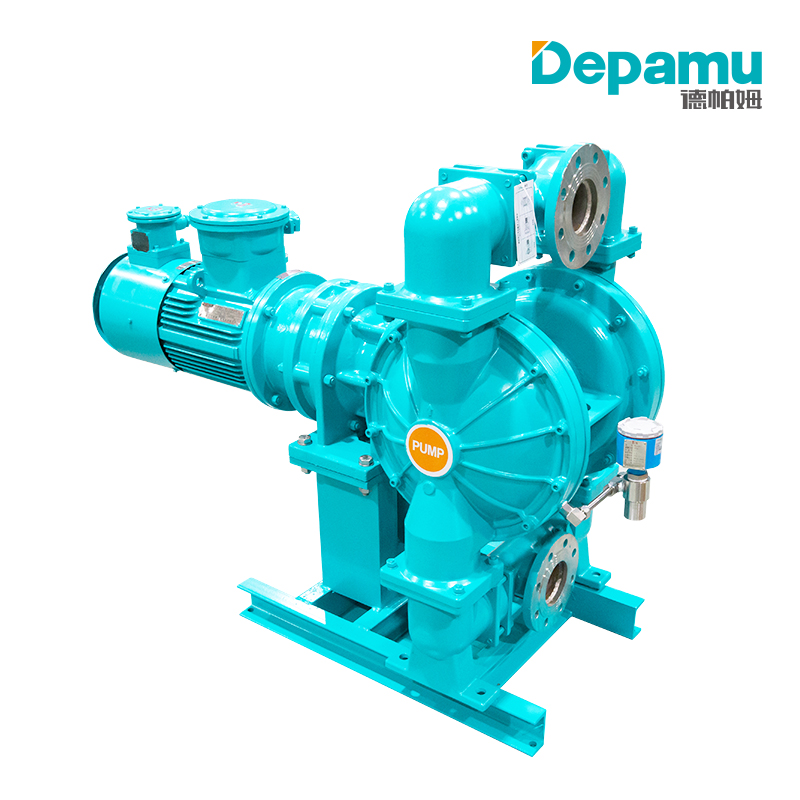
Depamu also manufactures electric-operated double diaphragm (EODD) pumps, which replace the pneumatic drive with a precision electric motor and crank mechanism. The motor drives a worm gear pair that converts rotary motion into reciprocating movement through an eccentric mechanism, which in turn drives the mechanical diaphragm to perform periodic deformation. These pumps offer advantages in controllability and energy efficiency, with flow rates that can be steplessly adjusted from 0 to 100% either statically or dynamically. Metering accuracy reaches ±0.5%, and the turndown ratio is 10:1.
2.3 Critical Design Feature: Double Diaphragm Containment
The defining characteristic of a double diaphragm pump—and the source of its name—is the use of two diaphragms operating in tandem. This configuration is not merely a redundancy measure; it constitutes a fundamental safety architecture. In Depamu's mechanical diaphragm Metering Pumps, the diaphragm status monitoring system can detect when one diaphragm ruptures and send a signal accordingly. The pump can continue operating until the diaphragm is replaced, or it can be stopped directly, all without any contamination of the pumped medium. This feature is particularly valuable in chemical and pharmaceutical applications where fluid purity and operator safety are paramount.
2.4 Materials of Construction
Depamu's double diaphragm pumps are available with wetted parts in 304, 316, and 316L stainless steel, as well as PVC, PVDF, PP, and PTFE, allowing material selection to be matched to the chemical compatibility requirements of each application. PTFE diaphragms are mechanically driven without a protection plate on the feeding side, enabling smooth material transfer and safe operation. Check valves employ a self-cleaning structure to reduce maintenance frequency.
3. Application in Wastewater Treatment
3.1 The Operational Challenge
Wastewater treatment plants contend with fluids that are chemically aggressive, biologically active, and often laden with suspended solids. The pumping requirements span the entire treatment process—from raw sewage transfer and chemical dosing for pH adjustment or coagulation, to the movement of thickened sludge and the precise injection of disinfectants. Reliability is non-negotiable: an unplanned pump failure can compromise treatment effectiveness and trigger regulatory violations.
3.2 Depamu Solutions for Wastewater Treatment
Depamu's Mechanical Diaphragm Metering Pumps are explicitly designed for treatment processes encompassing municipal water, industrial water and wastewater, and swimming pool water. The DP-Series DPMFWSA, for instance, offers maximum flow rates up to 150 L/h per head with discharge pressures reaching 1.2 MPa, and is constructed with a cast aluminum housing that provides good heat dissipation and resistance to acid-base fluids.
For larger-volume applications, the DP-Series 2DPMFXAA two-cylinder mechanical diaphragm metering pump delivers up to 3,200 L/h per head, with inlet and outlet manifolds that ensure smooth, stable flow with minimal pulsation. The two cylinders can be used to transport different fluids under separate flow adjustment, adding operational flexibility.
The pneumatic DPQ series is particularly well suited to sump and transfer duties in wastewater plants. The pump's ability to handle media with a viscosity of up to 2 million cP and a solid content of up to 60% means it can manage the thickest sludges and slurries without clogging. The maximum passable incompressible solid diameter of 80 mm accommodates the debris commonly encountered in raw sewage.
3.3 Chemical Dosing Precision
Beyond bulk transfer, wastewater treatment depends on accurate chemical dosing for disinfection, pH correction, and nutrient removal. Depamu's metering pumps achieve a steady-state accuracy of ±2%, with flow rates adjustable across a 10:1 turndown ratio. The company's PJYN chemical adding devices are specifically configured for sewage treatment, raw water pretreatment, and circular treatment systems, while complete Injection Packages address petroleum and oily wastewater treatment requirements.
4. Application in Chemical Manufacturing
4.1 The Handling Challenge
Chemical manufacturing environments present a confluence of hazards: corrosive reagents, toxic intermediates, flammable solvents, and reactive compounds that demand absolute containment. Sodium hypochlorite, a ubiquitous chemical used in water treatment, pulp and paper processing, and textile manufacturing, exemplifies the difficulties. It is a powerful oxidizing agent with high alkalinity (pH typically 11 to 13), corrosive to many metals and capable of degrading elastomers over time. Moreover, it tends to decompose and release oxygen gas, particularly under increased temperature or pressure, which can cause vapour lock, reduce pump efficiency, and potentially cause cavitation damage.
4.2 Containment and Monitoring
Depamu's double diaphragm architecture addresses these challenges through multiple layers of protection. The dual diaphragm design internally traps leaked fluid if a rupture occurs, providing an additional containment barrier that significantly reduces downtime and environmental exposure. The diaphragm status monitoring system operates continuously, capable of local display, signal output, and pump safety running monitoring.
For sodium hypochlorite transfer specifically, Depamu's EODD pumps offer distinct advantages over air-operated alternatives. The electric drive provides more consistent dosing accuracy and eliminates the risk of compressed air contamination, which is particularly important when the pumped chemical is sensitive to moisture or oxidation.
4.3 High-Pressure and High-Viscosity Capabilities
Chemical processes frequently involve high-pressure injection or the transfer of viscous polymer solutions. Depamu's high-pressure diaphragm Reciprocating Pumps incorporate patented hydraulic compensation technology and employ oil-immersed lubrication for the drive mechanism, ensuring longevity under continuous operation. Maintenance intervals range from 4,000 hours at pressures up to 1.0 MPa to 8,000 hours at pressures up to 0.7 MPa. The pumps' maximum discharge pressure capabilities extend to 95 MPa in certain configurations, with flow rates per pump head reaching 12,100 L/h.
5. Application in Food Processing
5.1 The Product Integrity Imperative
Food and beverage manufacturing imposes requirements that differ fundamentally from those of chemical processing. The pump must not only avoid contaminating the product but must also preserve its physical and sensory characteristics. Emulsions such as mayonnaise, salad dressings, and cream-based sauces are colloidal systems in which excessive shear stress during pumping can cause phase separation, altering texture and reducing shelf life. Concentrated fruit juices, fresh milk, and craft beer present similar challenges, demanding gentle handling that maintains product integrity from raw material intake through to packaging.
5.2 Low-Shear Pumping Action
Depamu's Electric Diaphragm Pumps are engineered specifically to address these demands. The positive displacement mechanism moves fluid through the reciprocating action of a diaphragm rather than through rotating impellers or high-speed gears, resulting in minimal shear forces on the product. This low-shear characteristic is critical for preserving droplet size distribution in emulsions and preventing coalescence. The seal-less design eliminates the risk of air entrainment through seal leakage, which could otherwise introduce oxygen and accelerate oxidative degradation.
The pump's performance is largely independent of fluid viscosity—the diaphragm displaces a fixed volume with each stroke, ensuring consistent flow regardless of product thickness. This makes the technology equally suitable for thin liquids like milk and for highly viscous products such as concentrated fruit purées.
5.3 Hygienic Construction
Compliance with food safety regulations requires that all product-contact surfaces be constructed from materials that resist corrosion, tolerate cleaning and sanitization chemicals, and present no crevices where bacteria could harbour. Depamu's hygienic pump designs incorporate wetted parts in AISI 316L stainless steel with surface roughness values below 0.8 micrometres (Ra), meeting the rigorous standards demanded by dairy, beverage, and pharmaceutical processing.
For applications requiring connection to existing sanitary piping systems, Depamu offers pumps equipped with standard hygienic fittings that facilitate quick breakdown and reassembly for cleaning. This design philosophy aligns with the clean-in-place (CIP) protocols that are standard practice in modern food manufacturing facilities.
6. Conclusion
The double diaphragm pump is a mature technology, but its effectiveness depends on the quality of its engineering and the appropriateness of its configuration for each application. Depamu's approach combines the inherent advantages of diaphragm pump architecture—hermetic sealing, dry-run capability, self-priming operation, and gentle fluid handling—with materials science, precision manufacturing, and intelligent monitoring systems that extend the technology's reach into demanding industrial environments.
In wastewater treatment, Depamu pumps deliver the solids-handling capacity and chemical dosing accuracy that treatment processes require. In chemical manufacturing, the double diaphragm containment architecture and continuous monitoring provide the safety and containment assurances essential for handling hazardous materials. In food processing, the low-shear pumping action and hygienic construction preserve product quality while meeting regulatory standards.
Depamu's manufacturing infrastructure—35,000 square metres of production space, five assembly lines, and annual capacity of 50,000 pump units—supports the company's ambition to serve as a global fluid equipment manufacturer. With products deployed across oil and gas, nuclear power, chemical, pharmaceutical, food, and environmental protection sectors in more than 50 countries, the company's double diaphragm pump portfolio represents a mature and field-proven solution for the fluid handling challenges that define modern industry.