

Depamu Chemical Injection Packages: Precision Dosing for Oil, Gas, and Industrial Applications
In the modern oil and gas industry, the uninterrupted movement of hydrocarbons from reservoir to refinery depends on a discipline known as flow assurance. Unrefined production streams carry water, hydrogen sulfide, carbon dioxide, paraffin, and dissolved salts; when these elements meet the pressure and temperature swings of extraction and transport, they create ideal conditions for corrosion, mineral scaling, gas hydrate formation, and emulsion blockages. Chemical injection is the primary defense against these threats, and the equipment responsible for delivering treatment chemicals at the correct rate, pressure, and moment is the Chemical Injection Package. Among the manufacturers serving this niche, Depamu (Hangzhou) Pumps Technology Co., Ltd. has established a distinctive position with its DPJY-series chemical injection skids, engineered for applications ranging from offshore liquefied natural gas treatment to enhanced oil recovery and industrial water treatment.
Company Foundations and Engineering Philosophy
Founded in 2003 and headquartered in a national-level economic and technological development zone in Hangzhou, Depamu has grown from a regional pump manufacturer into a technology-driven enterprise with a 35,000-square-meter facility, registered capital of 54 million yuan, and a workforce of more than 200 employees. The company invests no less than six percent of annual sales revenue in research and development, a commitment that has yielded 126 patents, including 38 invention patents, and recognition as a national-level “little giant” enterprise specializing in niche sectors. Its product portfolio spans Metering Pumps in plunger, mechanical diaphragm, and hydraulic diaphragm configurations; high-pressure Reciprocating Pumps; screw, rotor, and centrifugal pumps; and complete chemical injection packages and water treatment systems.
Depamu’s engineering philosophy reflects a synthesis of international standards and modular manufacturing efficiency. The company’s design practices incorporate philosophies from the United States, Germany, and Japan, adapted for rigorous operating conditions and international export markets. The result is a range of skid-mounted systems that balance high-pressure performance with operational simplicity—a critical combination in an industry where downtime can cost millions of dollars per day.
The DPJY Series: Modular Architecture and Systematic Integration
The fundamental advantage of the Depamu chemical injection package over traditional stick-built systems lies in its skid-mounted, modular design. Traditional injection setups often suffer from compatibility issues when pumps, tanks, and controls are sourced separately, leading to bottlenecks and inefficiencies in the field. Depamu addresses this through systematic integration: the hydraulic characteristics of the metering pump are matched to the viscosity of the chemical and the suction and discharge piping dynamics before the unit leaves the factory.
The modular architecture of the DPJY series is particularly valuable for oil fields undergoing phased development. An operator can begin with a single tank and dual pump configuration and, as production increases, add pump heads or tanks without redesigning the entire skid. This scalability reduces capital expenditure risks associated with future production uncertainty and allows the same skid footprint to accommodate evolving chemical treatment programs.
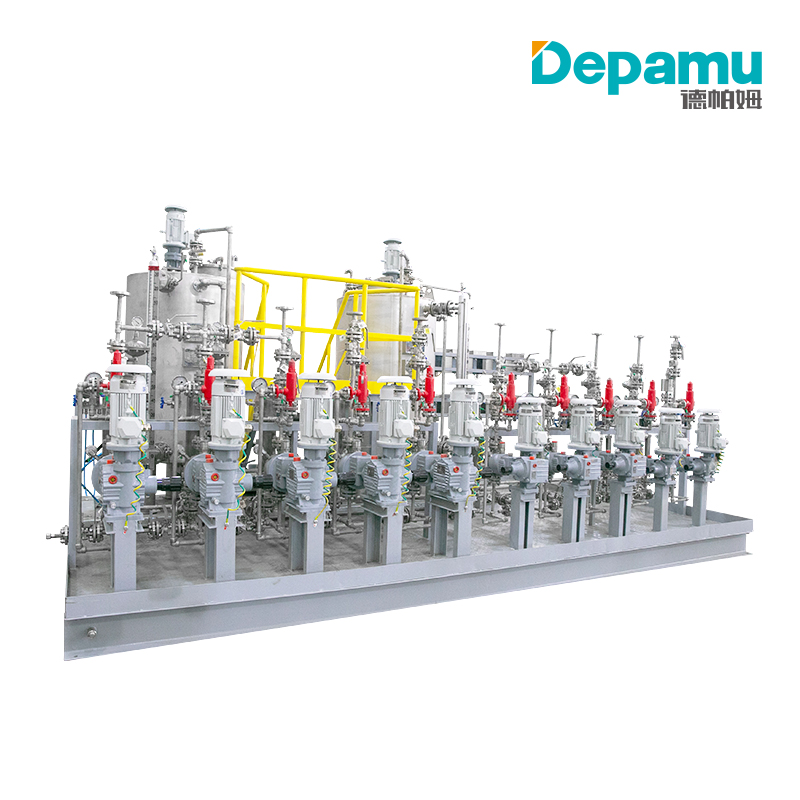
A standard Depamu injection package integrates a solution tank, a mixer, a metering pump, a level gauge, a safety valve, a pressure gauge, a pulsation damper, a comprehensive valve and piping network, a support base, a stairway with handrail, and an electrical control cabinet, all mounted on a single profile-steel base. Solution tanks range from 0.5 to 20 cubic meters, with material options that include 304 and 316 stainless steel, carbon steel, carbon steel with rubber or plastic lining, fiberglass-reinforced plastic, and polyethylene, selected according to the corrosiveness of the chemical being handled. This material flexibility is essential because oil and gas chemicals span the pH spectrum, from high-pH caustic fluids to low-pH acids and volatile solvents such as methanol.
Precision Dosing: The Heart of the Package
At the center of every Depamu injection package is the metering pump, the component that defines the unit’s performance envelope. Depamu packages cover a capacity range from 10 liters per hour for precise corrosion inhibitor injection up to 1,500 liters per hour for scale inhibitors in water treatment, with discharge pressures reaching as high as 32 megapascals—approximately 4,600 pounds per square inch—for deep-well injection where wellhead pressures are substantial. Advanced flow control instrumentation integrated into Depamu packages achieves dosing accuracies in the range of ±0.5 percent to ±0.2 percent for applications requiring high-precision chemical metering.
The Hydraulic Diaphragm Metering Pump represents a particularly important technology for hostile-service applications. In the 2DP(M)DA series, a piston compresses hydraulic fluid, which in turn flexes a diaphragm to displace the process chemical. This design delivers three critical advantages: zero leakage to the atmosphere, which is essential when handling toxic chemicals such as mercaptans or carcinogenic substances like benzene; internal safety valves and automatic air-release mechanisms that prevent damage from over-pressure events; and a patented integrated sleeve adjustable eccentric transmission mechanism that permits stepless flow adjustment from zero to 100 percent of rated capacity while maintaining metering accuracy of ±0.5 percent. Depamu has extended this technology to a high-pressure reciprocating Diaphragm Pump capable of reaching 470 bar, approximately 6,800 psi, a milestone that broke the long-standing foreign monopoly on such equipment for offshore applications.
Automation and Control Logic
Modern oil fields demand “smart” skids that can operate with minimal human intervention, and Depamu units support multiple control modes to meet this requirement. The systems can be controlled locally and manually or automatically, with automatic control regulating the injection pump’s output flow based on the injection volume indicated by a flowmeter at the injection port. All signals related to pump and mixer status and faults can be transmitted to a distributed control system or host computer, enabling remote start, stop, and comprehensive system monitoring.
The DPJY series features a programmable logic controller-based architecture that monitors pressure, flow, and temperature in real time, automatically adjusting the pump stroke or motor speed to maintain the exact set point. In the CNOOC floating production, storage, and offloading project in the South China Sea, the system achieved a fault prediction accuracy rate of no less than 99 percent, a level of predictive maintenance that is vital for offshore platforms where a pump failure can lead to lost production costing millions of dollars per day. The control system communicates using standard 4–20 milliampere analog signals for both setpoint input and feedback, and users can select from manual, semi-automatic, or fully automatic control modes according to operational requirements.
Applications Across the Oil and Gas Value Chain
Depamu categorizes its injection packages specifically for the petroleum, natural gas exploitation, gathering and transportation, and oily sewage treatment sectors. The chemical-specific configurations include demulsifier injection packages, corrosion inhibitor injection packages, deoxidant injection packages, germicide injection packages, reverse demulsifier injection packages, and methanol or ethylene glycol injection packages. Each addresses a distinct flow assurance or asset integrity challenge.
In primary recovery, methanol and monoethylene glycol injection is essential for hydrate prevention in production tubing and flowlines, particularly in deepwater and cold-climate operations. These packages are engineered to inject inhibitors directly into the wellhead or pipeline at pressures capable of overcoming line pressure, often exceeding 2,500 psi, with frequency converters adjusting dosage based on real-time differential pressure and temperature readings to prevent waste of expensive chemicals. Corrosion inhibitor injection protects production tubing and flowlines from the corrosive effects of produced fluids, while scale inhibitor dosing prevents mineral deposition in downhole and topside equipment. Demulsifier injection aids in the separation of oil-water emulsions, and hydrogen sulfide scavenger injection is required in sour service environments.
In secondary and tertiary recovery, water injection and polymer injection become the primary mechanisms for maintaining reservoir pressure and mobilizing additional oil. Depamu’s High-Pressure Reciprocating Pumps are explicitly designed for these applications, serving as oilfield Water Injection Pumps and polymer injection pumps. The company signed the world’s largest Indian oilfield polymer high-pressure reciprocating pump project in 2018, a contract that broke the monopoly previously held by European and American manufacturers in this high-end equipment segment.
Industrial and Boiler Feedwater Treatment
Beyond oil and gas, Depamu chemical injection packages serve critical industrial applications, most notably boiler feedwater treatment in thermal power plants and industrial boiler systems. The quality of boiler feedwater fundamentally determines the reliability and efficiency of steam-generating systems. Impurities—particularly dissolved oxygen, hardness ions such as calcium and magnesium, and pH imbalances—can precipitate scale formation, accelerate corrosion, and ultimately lead to catastrophic equipment failure.
Depamu offers dedicated injection packages for phosphate, hydrazine, and ammonia treatment. The phosphate injection package controls scale formation through a precipitation reaction in which trisodium phosphate reacts with calcium ions to form basic calcium phosphate, a loose, non-adherent sludge that can be removed through routine boiler blowdown rather than hard scale that would compromise heat transfer. The hydrazine injection package scavenges residual dissolved oxygen, reacting to form nitrogen and water, while the ammonia injection package raises boiler water pH to the optimal range, reducing the solubility of corrosion products and maintaining protective magnetite films on metal surfaces. Automatic control is achieved through continuous monitoring of feedwater flow rate, pH, conductivity, dissolved oxygen, and phosphate concentration, with the control system adjusting pump speed and stroke to maintain optimal chemical levels.
Case Studies: From the South China Sea to the Arctic
The validity of any engineering philosophy is proven through operational history, and Depamu’s project references span some of the most geologically and logistically challenging environments in the world. For CNOOC’s floating production, storage, and offloading vessel in the South China Sea, Depamu delivered a super-large flow, ultra-high-pressure water injection pump system driven by an 800-kilowatt motor. The system achieves a maximum working pressure of 30 megapascals and a single-unit daily water injection capacity of 2,000 cubic meters, meeting the secondary oil recovery requirements of offshore oilfields. The equipment has been certified to API 674 and DNV-GL standards, with a salt-spray corrosion-resistant design ensuring stable operation in the high-temperature, high-humidity marine environment.
For offshore platform chemical injection skids deployed in the South China Sea and Bohai Sea, Depamu’s engineering team faced severe space constraints. The solution was an innovative three-tier skid structure that arranges ton tanks, storage tanks, and pump groups in a vertical configuration, reducing the footprint by 40 to 50 percent compared to traditional designs. This space-saving arrangement also leverages height differences to reduce pump cavitation risk and extend equipment service life. To withstand the highly corrosive marine atmosphere, the team optimized welding processes, applied full-penetration welds to critical steel structure components, and upgraded to corrosion-resistant materials including duplex stainless steel and titanium.
The Arctic LNG 2 project in Russia, operated on the Utrenneye field on the Gydan Peninsula, presented a different set of challenges. The field holds proven reserves of nearly 1.4 trillion cubic meters of natural gas and 90 million tons of liquid hydrocarbons, and the project is located in an extreme cold zone that imposes exceptionally high requirements on media transportation. Depamu supplied high-pressure process diaphragm pumps and hydraulic diaphragm metering pumps designed specifically for the project’s extreme cold conditions, satisfying performance criteria for flow rate, pump efficiency, stability, and temperature. Notably, the previous Arctic LNG 1 project had sourced its fluid equipment from an American supplier; Depamu’s selection for Arctic LNG 2 signaled that Chinese pump technology had reached a level competitive with established Western manufacturers.
The delivery of 29 chemical injection skids to the Kingfisher oil field in Uganda further illustrates the modular approach in practice. The project required equipment that could handle the complex crude composition of the Albertine Graben while meeting stringent local content requirements. Depamu’s solution utilized an integrated combination of two or four pump heads per skid, allowing for the simultaneous injection of different chemicals—such as demulsifiers and corrosion inhibitors—from a single compact footprint.
Compliance, Safety, and Operational Advantages
For oil and gas engineers, safety is the primary metric by which any injection package is judged. Depamu’s status as an audited supplier with certifications from SGS and BV indicates adherence to international manufacturing standards. The DPJY-series packages are designed to comply with explosion-proof requirements for Zone 2 classification, utilizing flameproof motors and enclosures necessary for operating in volatile hydrocarbon atmospheres. The company’s products carry DNV, ISO 9001, and CE certifications, and its high-pressure reciprocating pumps are designed in accordance with API 674.
Operationally, the skid-mounted design offers distinct advantages. Because the unit is fully assembled, wired, and tested at the factory, field hook-up time is significantly reduced—a major cost saving on offshore platforms where space and weight are premium commodities. The modular design permits “hot swapping” of pump heads: if a diaphragm fails, the maintenance crew can isolate the single pump head without shutting down the entire chemical treatment train. By integrating the tank, pump, and controls on a single skid with drip trays and, where specified, double-walled piping, the risk of chemical spillage during transfer is minimized.
Future Outlook: Digitalization and Sustainability
As the oil and gas industry moves toward digitalization and decarbonization, the role of the chemical injection package is evolving from a simple pump-and-tank assembly into a data hub. Future iterations of systems like the Depamu DPJY series are likely to emphasize predictive maintenance through vibration sensors on pump motors that can predict diaphragm failure before it occurs; chemical optimization through real-time analysis of produced fluid downstream to close the loop and adjust dosage to the exact parts-per-million required, potentially reducing chemical waste by up to 30 percent; and low-power solutions integrating solar or hybrid power systems for remote well pads. In the Middle East, major operators are already requiring solar-powered chemical injection packages to support net-zero targets, utilizing battery autonomy to run pumps for two days without sunlight. Depamu’s modular design philosophy and its ability to offer manual mode for simple remote wells and fully automatic mode for complex, high-value production lines position the DPJY series well for these trends.
Conclusion
The Depamu chemical injection package represents a robust and versatile solution for the precise dosing demands of oil, gas, and industrial applications. By combining systematic engineering, modular skid-mounted architecture, hydraulic diaphragm and plunger metering technologies capable of achieving ±0.5 percent accuracy, and a broad range of application-specific configurations—from corrosion inhibition and hydrate suppression to phosphate, hydrazine, and ammonia treatment in boiler systems—Depamu provides operators with the tools necessary to ensure flow assurance, asset integrity, and operational efficiency. In an industry where the consequences of under-dosing or over-dosing can range from blocked pipelines to catastrophic equipment failure, the reliability of a pre-engineered, factory-tested injection package is invaluable. Depamu’s trajectory—from a regional Chinese manufacturer to a supplier serving CNOOC, Sinopec, and international projects in Uganda and the Russian Arctic—demonstrates that high-precision chemical injection is no longer a technological bottleneck but an accessible enabler of modern energy production and industrial reliability.