

Depamu Chemical Injection Pumps for Oil Circulation and Feeding: Precision Metering as the Circulatory and Nutritional Core of Hydrocarbon Systems
Abstract
A hydrocarbon production system without chemical injection is a system running toward failure on a timer. Corrosion consumes wall thickness from the inside; scale narrows flow paths until throughput collapses; gas hydrates can occlude a subsea flowline in a matter of hours; and oil–water emulsions that are never chemically broken overload surface separation trains. The chemical injection pump is the organ that maintains the chemical “blood chemistry” of this circulatory system, delivering inhibitors, demulsifiers, hydrate suppressants, and flow improvers at rates measured in liters per hour against process pressures that may exceed 200 bar. This article examines how Depamu (Hangzhou) Pumps Technology Co., Ltd., a Chinese manufacturer that absorbed German hydraulic diaphragm metering technology and scaled it into a portfolio of more than 4,000 metering-pump varieties, engineers chemical injection pumps and skid-mounted packages for oil circulation and feeding duties across the upstream, midstream, and downstream value chain. The analysis covers the hydraulic diaphragm and plunger architectures that underpin Depamu’s oilfield offering, the skid-level integration philosophy that transforms individual pumps into flow-assurance systems, and field deployments ranging from the South China Sea to the Albert Basin in Uganda that demonstrate how precision metering performs under divergent operating constraints.
1. Introduction: The Circulatory Logic of Chemical Injection
The phrase “oil circulation” in production engineering refers not to a single loop but to a set of coupled fluid circuits: the reservoir-to-wellbore-to-flowline path along which produced fluids travel; the water-injection circuit that maintains reservoir pressure; the chemical distribution network that carries treatment agents to injection points; and, on the downstream side, the feed circuits that introduce additives into crude oil before refining or custody transfer. Each circuit has its own pressure regime, its own fluid chemistry, and its own failure modes. What unites them is a single requirement: the chemical delivered into the circuit must arrive at the correct rate, at the correct pressure, and without interruption.
This is the domain of the controlled-volume reciprocating pump. In oilfield service, the chemical injection pump is routinely described as the “heart” of the processing facility, and the metaphor is technically apt. A heart that beats irregularly—over-dosing or under-dosing—produces consequences that range from wasted chemical spend to catastrophic asset failure. An under-dosed corrosion inhibitor leaves fresh metal exposed to CO₂ and H₂S attack; an under-dosed hydrate inhibitor can allow a flowline to plug; an over-dosed demulsifier can destabilize separation chemistry downstream. Depamu’s engineering position in this field rests on a recognition that the pump cannot be specified as an isolated component. Its hydraulic behavior, its materials of construction, and its control logic must be matched to the chemical’s viscosity and corrosivity and to the pressure profile of the circuit it feeds.
2. Pump Architectures for Oilfield Duty: Hydraulic Diaphragm and Plunger
Depamu’s product range for oil circulation and feeding duties spans Metering Pumps in plunger, mechanical diaphragm, and hydraulic diaphragm configurations, alongside high-pressure process Reciprocating Pumps designed to API 674. The choice among these architectures is not a matter of brand preference; it is a determination driven by the pressure, leakage tolerance, and chemical compatibility profile of the duty.
2.1 The Hydraulic Diaphragm Advantage for Zero-Leakage Circuits
The Hydraulic Diaphragm Metering Pump is the architecture most closely associated with Depamu’s oilfield identity, and for defensible engineering reasons. In this design, a motor-driven eccentric mechanism displaces hydraulic fluid, which in turn flexes a diaphragm against the process side. The process chemical never contacts the pump’s mechanical components or the atmosphere across a dynamic seal. Depamu’s 2DP(M)DA and 3DP(M)ZA hydraulic diaphragm series embody this principle, with the 3DP(M)ZA spanning flow rates from 15 L/H to 5,400 L/H and discharge pressures from 0.4 MPa to 72 MPa at a metering accuracy of ±0.5%, with stepless stroke adjustment across the full 0% to 100% range.
The operational consequences of this architecture are threefold. First, zero leakage to atmosphere is not a convenience feature but a safety requirement when the injected medium is methanol, benzene-containing produced streams, or sour-service chemicals. Second, the hydraulic system incorporates internal safety valves and compensation valves that perform automatic air discharge and oil replenishment, allowing the pump to sustain continuous duty without manual venting after a process upset. Third, the sealed diaphragm barrier eliminates the packed-plunger leakage pathway that limits conventional plunger pumps in abrasive or corrosive service. For offshore platforms, where a chemical leak in a confined module carries both safety and environmental exposure, this architecture is often the only acceptable specification.
2.2 Plunger Metering Pumps for Extreme Pressure and High Capacity
Where the duty demands the highest pressures and largest single-pump capacities, Depamu’s plunger metering pumps—the DP(M)ZA series—define the upper bound of the portfolio. These pumps reach a single-head flow capacity of up to 12,100 L/H and pressure ratings as high as 228 MPa (approximately 33,000 psi), figures that place them in the territory of deep-well chemical injection and high-pressure pipeline service. The working principle is mechanically direct: a worm gear pair converts rotary motor motion into reciprocating plunger travel through an eccentric mechanism, and high-precision inlet and outlet check valves close the metering loop with each stroke.
The plunger architecture is not a universal substitute for the diaphragm design, nor is the reverse true. Plunger pumps offer robust high-pressure performance but expose the process fluid to a dynamic seal; hydraulic Diaphragm Pumps offer zero-leakage containment but are bounded by diaphragm fatigue limits under extreme pressure cycling. Depamu’s portfolio strategy is to let the chemical and the circuit pressure determine the choice, rather than forcing every duty onto a single platform. The company’s achievement of a hydraulic diaphragm pump rated to 470 bar (approximately 6,800 psi) is notable precisely because it extended the zero-leakage option into a pressure domain previously served only by plunger designs, addressing a bottleneck that had historically required imported equipment.
2.3 Mechanical Diaphragm Pumps for Low-Pressure Feed and Viscous Media
Not every oil circulation and feeding duty sits at the high-pressure frontier. Demulsifier injection at a surface separation train, low-pressure chemical feed into a slop system, and the dosing of viscous fuel-oil additives operate in a different regime. Depamu’s Mechanical Diaphragm Metering Pumps cover this lower-pressure territory, with maximum discharge pressures up to 0.6 MPa in the standard range and flow rates reaching 3,200 L/H, using PTFE diaphragm construction for chemical compatibility. The DPMFXWA series extends this capability to heavy fuel oil dosing at low flows and low pressures, with a maximum flow of 450 L/h per head and a maximum discharge pressure of 1.2 MPa, a configuration explicitly engineered for the viscosity and low-pressure niche of heavy-oil feeding. This segmentation matters because a pump specified for 200 bar hydrate-inhibitor service is economically and hydraulically mismatched to a 2 bar demulsifier feed duty. Depamu’s ability to populate both ends of the pressure spectrum allows a single skid supplier to serve the full chemical taxonomy of a production facility.
3. From Pumps to Packages: The Skid as a Flow-Assurance System
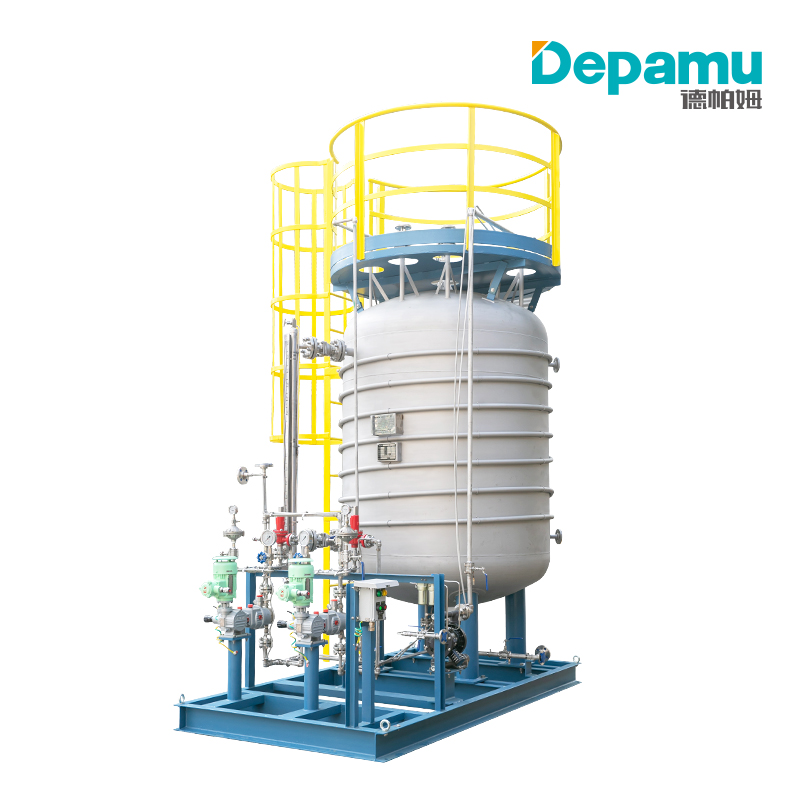
A chemical injection pump installed as a standalone unit is only half a system. The pump needs a solution tank sized to the chemical consumption rate; suction strainers to protect the liquid end; a pulsation dampener to convert reciprocating flow into the steady injection profile that the process expects; a relief valve to protect the discharge line against blockage; calibration columns for verification; and a control layer that ties injection rate to process flow. Depamu’s DPJY-series Injection Packages integrate these elements into a pre-piped, pre-wired, factory-tested skid, collapsing the interface risk and commissioning time that accompany field-erected assemblies.
The component architecture of a DPJY skid reflects continuous oilfield duty. Solution tanks range from 0.5 m³ to 20 m³ and are available in 304/316L stainless steel, carbon steel with rubber or plastic lining, fiber-reinforced plastic, and polyethylene, so that material selection follows the corrosivity of the chemical rather than forcing the chemical to accommodate a single metallurgy. For aggressive inhibitor formulations—high-acidity scavengers, for example—tanks may be constructed from duplex stainless steel 2205 or lined with PTFE. The skid frame incorporates a full-perimeter drip tray or spill containment basin beneath the pump and tank areas, a secondary containment feature that is essential for environmental compliance and for offshore installations where a chemical release cannot be permitted to reach the sea.
Redundancy is treated as a design philosophy rather than an optional extra. The standard corrosion-inhibitor configuration is “one tank plus two pumps”: a duty unit and a standby unit kept in ready-to-run condition, with pressure switches or transmitters monitoring the duty pump’s discharge. If the duty pump fails to maintain pressure or the motor trips, the control system starts the standby unit automatically, converting a potential uninhibited event into a controlled maintenance activity. This logic matters because corrosion inhibitor films are not permanent; they require continuous replenishment to repair breaches, and a pump outage measured in hours can translate directly into accelerated metal loss across the protected circuit.
4. Oil Circulation Duties: Flow Assurance at the Wellhead, Flowline, and Pipeline
The upstream segment is where the consequences of imprecise chemical injection become visible most quickly. Hydrate inhibition is the most technically demanding circulation duty. In subsea flowlines and cold-climate gathering systems, low temperatures and high pressures cause water and methane to crystallize into ice-like solids that can occlude a line entirely. Depamu skids configured for methanol or monoethylene glycol injection operate at the upper end of the pressure spectrum, and the pump’s precision is critical in both directions: under-injection risks hydrate plugs, while over-injection wastes an expensive solvent and loads the downstream separation system with excess methanol.
Corrosion inhibitor injection protects production tubing and flowlines from the combined attack of CO₂, H₂S, and produced water. Scale inhibitor dosing prevents mineral deposition in downhole and topside equipment. Demulsifier packages break oil–water emulsions that would otherwise raise viscosity and burden surface separation; H₂S scavenger injection is required in sour service; and biocide packages control the bacterial growth that drives microbiologically influenced corrosion. Depamu’s package catalogue maps onto this chemical taxonomy with dedicated demulsifier, corrosion inhibitor, deoxidant, reverse demulsifier, germicide, methanol, and ethylene glycol configurations, each built around the specific handling requirements of the chemical rather than offered as a generic dosing platform.
The midstream circuit presents a different injection problem. Gathering systems, trunklines, and pipeline networks offer limited access for maintenance, and the cost of a corrosion-related failure is measured in lost throughput and environmental exposure as well as repair. Skids on midstream pipelines dose corrosion inhibitors to protect long, often inaccessible pipeline interiors, drag-reducing agents to improve flow efficiency, and scale inhibitors to prevent deposits that throttle flow. The same skid architecture used upstream adapts to these duties, with the chemical package selected according to the pipeline’s specific threat profile.
5. Oil Feeding Duties: Additive Metering and Enhanced Recovery Circuits
“Feeding” in the oil circuit extends beyond treatment chemicals to the fluids that modify the reservoir’s own behavior. In secondary and tertiary recovery, polymer injection increases the viscosity of injected water to improve sweep efficiency, mobilizing oil that water flooding alone would leave behind. Depamu’s High-Pressure Reciprocating Pumps, designed to API 674, serve as polymer and Water Injection Pumps, with the HD series covering 3.37 to 78.99 m³/h and pressures from 3.0 to 83.5 MPa. Advanced enhanced-oil-recovery and polymer configurations can exceed 120 MPa, extending the feeding circuit into pressure regimes that demand the same fatigue-resistant diaphragm and eccentric transmission engineering that defines the high-end metering portfolio.
At the downstream end of the feeding chain, the metering pump becomes an additive dosing instrument for custody-transfer and product-quality circuits. Drag-reducing agents, corrosion inhibitors, and product markers must be injected into flowing fuel at precisely controlled dosing rates to ensure uniform blending; the same accuracy requirement that governs a 10 L/H corrosion-inhibitor duty at a wellhead applies to a low-flow additive injection point on a product pipeline. Depamu’s skid control philosophy accommodates this range: skids can run in local manual mode for simple remote wells, semi-automatic mode, or fully automatic closed-loop control in which injection rate tracks real-time process parameters from online instrumentation, with status and fault signals transmitted to a DCS for remote monitoring.
6. Field Validation: From the South China Sea to the Albert Basin
Engineering claims acquire credibility through deployment, and Depamu’s project record illustrates how the skid architecture performs under constraints that differ sharply from one another.
For China National Offshore Oil Corporation, Depamu delivered multiple sets of offshore platform chemical injection skids and high-pressure reciprocating pumps for service in the South China Sea and Bohai Sea, environments characterized by high temperature, extreme humidity, and corrosive salt spray. The defining constraint offshore is space. Depamu abandoned single-layer layouts and adopted a three-tier skid design that vertically integrates IBC totes, storage tanks, and pump assemblies, reducing equipment footprint by 40 to 50 percent compared with conventional designs while using height differentials to minimize pump cavitation risk. Welding processes were optimized, full-penetration welds specified on critical steel structures, and materials upgraded to duplex stainless steel and titanium to resist marine corrosion. The associated high-pressure water-injection unit for a CNOOC FPSO—an 800 kW machine producing 30 MPa while injecting 2,000 cubic meters of water per day—met DNV-GL classification rules, and the chemical injection skids that regulate the injected water chemistry were engineered to the same marine-duty standard.
The Uganda Kingfisher project tested a different capability: adaptation to a frontier operating environment. Depamu designed, manufactured, and delivered 29 custom chemical injection skids for Uganda’s first commercial oil field in the Albert Basin, a project representing the largest Chinese-invested development in the country. Uganda’s crude production processes are exceptionally complex, and local content requirements demanded equipment that could be supported and maintained with limited industrial infrastructure. The skids were built around a modular, integrated design with a high degree of automation and flexible operation, and all 29 units completed factory testing and shipment on schedule. The Kingfisher skids used an integrated combination of two or four pump heads per skid, allowing simultaneous injection of different chemicals—demulsifiers and corrosion inhibitors, for example—from a single compact footprint.
These deployments share a common thread that is more instructive than the individual specifications: the skid’s physical envelope and its configuration flexibility are often as decisive as its dosing accuracy. Deliveries to the Nigerian LNG fields at Soku and Gbaran required bespoke frames to match existing concrete plinths, containerized transport for difficult road networks, and remote monitoring capability. In the Middle East, demand is emerging for solar-powered injection packages with battery autonomy for two days without sunlight—a requirement that Depamu’s modular design philosophy is positioned to accommodate through configuration rather than redesign. The injection skid that cannot adapt to its site is a skid that will be adapted around at the operator’s expense.
7. Conclusion: Precision Metering as Infrastructure
The chemical injection pump occupies an unusual position in the oil and gas asset hierarchy. It is small relative to the compressors, turbines, and separators that dominate capital budgets, yet its failure or drift places every one of those larger assets at risk. Depamu’s contribution to this landscape is not a single breakthrough component but an integrated system: German-origin diaphragm metering precision, a vertically integrated manufacturing base, and field experience spanning offshore China, East African frontier basins, and West African LNG complexes. The 470-bar hydraulic diaphragm milestone, the three-tier offshore skid, and the 29-unit Kingfisher delivery are different expressions of the same engineering logic—that the pump must be matched to its chemical, its circuit, and its site before it is matched to a catalogue number.
In an industry where a blocked flowline or a corroded riser carries costs measured in production days and environmental consequence, the quiet, continuous work of a chemical injection pump is easily overlooked. It should not be. The circulatory and feeding circuits of a hydrocarbon system depend on the metering pump’s stroke, cycle after cycle, to maintain the chemical conditions under which every other asset can operate. Depamu’s portfolio—from 15 L/H hydraulic diaphragm units to 12,100 L/H plunger machines and from single-pump skids to multi-head offshore packages—is best understood not as a product range but as infrastructure for that dependence.