

Engineering Precision and Reliability: The Advantages of Depamu Mechanical Chemical Metering Pumps for Fluid Dosing
In the intricate landscape of industrial fluid handling, the precise, reliable, and safe dosing of chemicals is not a peripheral concern but an operational imperative. From the synthesis of petrochemicals to the treatment of municipal wastewater, the accuracy of a metering pump directly influences product quality, regulatory compliance, operational safety, and economic efficiency. Within this demanding environment, the Mechanical Diaphragm Metering Pump has established itself as a workhorse technology, and among the manufacturers serving this niche, Depamu has engineered a compelling suite of advantages. This article provides a comprehensive examination of the benefits that Depamu mechanical chemical metering pumps offer for dosing fluids, analyzing their design philosophy, performance characteristics, safety architecture, material versatility, and operational economy.
A Foundation of Precision and Repeatable Performance
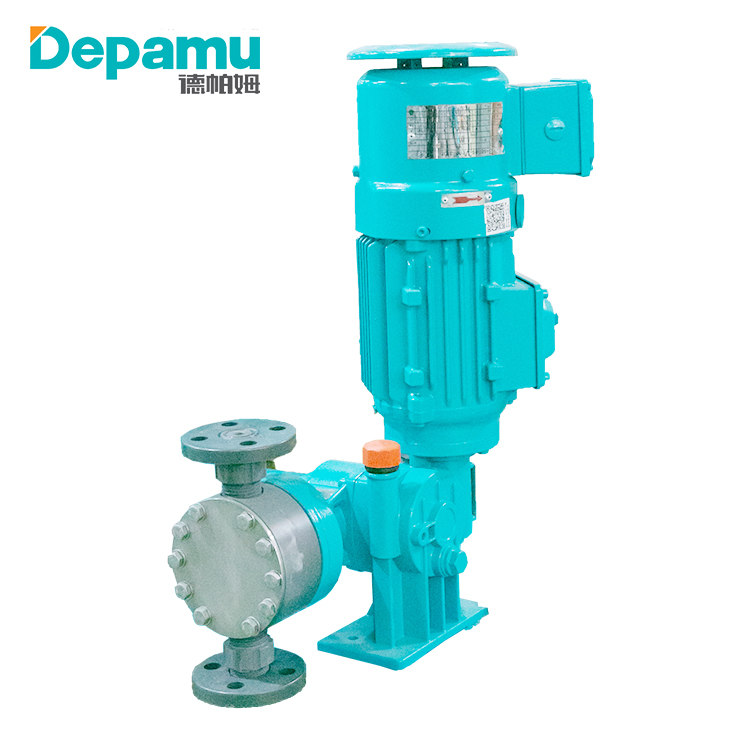
The primary advantage of any metering pump lies in its ability to deliver a consistent, repeatable volume of fluid. Depamu’s mechanical Diaphragm Pumps are built upon a fundamentally sound electromechanical principle designed to achieve this with high fidelity. The pump operates through a motor that drives a worm gear pair, converting rotary motion into reciprocating movement via an eccentric mechanism. This reciprocating action, in turn, drives a slide rod that causes the mechanical diaphragm to undergo periodic deformation, enabling precise fluid suction and discharge.
This direct mechanical actuation yields metering accuracy that is highly competitive within its class. Depamu’s mechanical diaphragm pumps achieve a steady-state accuracy of ±2%, with a 10:1 turndown ratio for standard configurations. This level of precision ensures that chemical dosing remains consistent even as process conditions fluctuate, a critical factor in maintaining stoichiometric ratios for chemical reactions or ensuring uniform treatment in water purification. For applications demanding even tighter control, Depamu’s plunger and hydraulic diaphragm variants push accuracy to ±0.5% within a 10–100% stroke length adjustment range, demonstrating the company’s broader engineering capabilities in precision fluidics. The result is a pump that delivers not just volume, but verifiable volume, providing operators with the confidence that the intended dose is the delivered dose, cycle after cycle.
Inherent Safety Through Leak-Free Design
Perhaps the most significant advantage of a diaphragm-based metering pump, and one that Depamu has optimized, is its inherent safety when handling hazardous, toxic, or volatile chemicals. Unlike plunger pumps that rely on dynamic seals (such as packing or mechanical seals) to contain the fluid, a diaphragm pump completely isolates the pumped medium from the drive mechanism and the atmosphere. The static seal of the fluid-end diaphragm replaces the dynamic seal of the plunger, creating a completely sealed liquid end with no leak paths. This design feature is not merely a convenience; it is a fundamental safety barrier. It eliminates the risk of fugitive emissions—the unintended and often dangerous release of chemicals into the workplace or environment—which is essential for environmental compliance and operator protection.
Depamu enhances this baseline safety with additional engineering features. The company offers double PTFE diaphragm configurations that provide a redundant layer of protection. In these designs, a laminated diaphragm structure ensures even stress distribution, enhancing durability, while the double PTFE material offers excellent anti-corrosion and anti-permeability performance. Most critically, these pumps can be equipped with a diaphragm status monitoring system. This intelligent system detects the rupture of the primary diaphragm and can either send an alarm signal while the pump continues operating on the backup diaphragm or initiate an immediate shutdown. This capability prevents contamination of the process fluid and avoids the hazardous release of chemicals, transforming a potential failure point into a managed, alerted event.
Extensive Material Versatility for Aggressive Media
The corrosiveness of the fluids being dosed is a constant challenge in chemical processing. Depamu addresses this by offering an extensive range of wetted materials, making its pumps adaptable to a vast spectrum of aggressive media. The pump heads and wetted flow paths can be specified in 304, 316, and 316L stainless steels, as well as PVC, PVDF, PP (polypropylene), and PTFE (polytetrafluoroethylene). This material versatility is a decisive advantage. For handling strong acids and bases, PTFE and PVDF offer superior chemical resistance, while stainless steel options provide the necessary durability for high-temperature or high-purity applications.
The PTFE diaphragm itself is a key enabler of this chemical compatibility. It is chemically inert and capable of handling a wide range of corrosive fluids, including strong acids, bases, and solvents. Furthermore, for applications requiring elevated temperatures, PTFE-rated components can handle fluid temperatures up to 80°C, while PVC variants are suitable for lower-temperature services up to 40°C. This range of material options ensures that a Depamu pump can be configured not just to meter a fluid accurately, but to survive in that chemical environment for an extended service life, protecting the process purity and the capital investment.
Structural Simplicity and Low Maintenance
A compelling operational advantage of Depamu mechanical diaphragm pumps is their structural simplicity relative to hydraulically actuated alternatives. The mechanical actuation—where a slide rod directly drives the diaphragm—eliminates the need for a hydraulic fluid system, which is a standard feature of hydraulic diaphragm pumps. This has cascading benefits for maintenance and reliability. The hydraulic system introduces additional components—hydraulic fluid, valves, a replenishment system, and a relief valve—that are potential points of failure, leak, and contamination. By removing this subsystem, the mechanical design reduces complexity, minimizes potential leak points, and simplifies maintenance procedures.
This simplicity translates directly into reduced downtime and lower lifecycle costs. The direct drive mechanism is easier to troubleshoot and service, and the absence of hydraulic fluid eliminates the cost and hassle of fluid monitoring and replacement. Depamu complements this with design features that extend service intervals. The power end features bath lubrication to ensure a long service life for drive components, and the check valves are designed with a self-cleaning structure to prevent clogging when handling fluids that may precipitate, crystallize, or contain particulates. The maintenance intervals are demonstrably long: extending to 4,000 hours at pressures up to 1.0 MPa, and up to 8,000 hours at pressures below 0.7 MPa. For continuous chemical production or 24/7 water treatment operations, these extended intervals are a significant contributor to overall equipment effectiveness.
Operational Flexibility and Control
A metering pump must not only be accurate and safe but also adaptable to changing process demands. Depamu mechanical pumps offer multiple modalities for flow rate adjustment. The flow rate can be steplessly adjusted across the full 0–100% range while the pump is either running or stopped, allowing for fine-tuning without process interruption. This adjustment can be performed manually via a fine adjustment knob, or through electric, pneumatic, or variable frequency drive (VFD) actuators, enabling seamless integration with modern plant automation and control systems.
The mechanical design also contributes to smooth, stable flow. The patented integrated sleeve adjustable eccentric transmission mechanism is engineered to ensure smooth, stable flow with minimal pulsation. For higher flow applications, Depamu offers two-cylinder mechanical diaphragm pumps that provide even smoother, more stable flow with reduced pulsation through a manifolded inlet and outlet. This operational flexibility ensures that a single pump model can be adapted to varying dosing requirements, optimizing chemical consumption and process control without the need for replacement equipment.
Certified Quality and Broad Application Versatility
The advantages of Depamu pumps are underpinned by a robust commitment to international quality and safety standards. The company holds a comprehensive suite of certifications, including CE, API, ISO 9001, ISO 14001, and ISO 45001. The CE marking confirms compliance with rigorous European health, safety, and environmental protection standards, facilitating procurement for international projects. Adherence to API 674 and API 675 standards further demonstrates the pumps' suitability for the demanding requirements of the petroleum and petrochemical industries.
This certified reliability enables deployment across a remarkably broad range of applications. In water and wastewater treatment, these pumps are essential for precise dosing of coagulants, disinfectants (such as sodium hypochlorite), and pH adjustment chemicals. In chemical processing and petrochemicals, they handle the accurate injection of catalysts, additives, and reactants under challenging conditions. In the pulp and paper industry, they reliably dose bleaching chemicals, retention aids, and sizing agents, with the mechanical design capable of handling fluids with viscosities exceeding 5000 cps. The ability to multiplex multiple pump heads from a single drive also allows for a compact footprint when dosing multiple chemicals at one location.
Conclusion
The advantages of a Depamu mechanical chemical metering pump for dosing fluids are cumulative and mutually reinforcing. They begin with a precision engineering core that delivers repeatable accuracy for critical processes. They are protected by an inherently safe, leak-free design that isolates hazardous media and incorporates redundant safety monitoring. They are made durable through extensive material versatility that matches the pump to the chemical challenge. They are made practical by a structurally simple, low-maintenance architecture that reduces downtime and lifecycle costs. Finally, they are made adaptable through flexible control options and certified reliability that enable deployment across nearly every process industry. For facilities seeking the optimal balance of accuracy, safety, durability, and operational economy, the Depamu mechanical diaphragm metering pump represents a thoroughly engineered and comprehensively advantageous solution for the precise dosing of fluids.