

Depamu Single Screw Pump for Feeding Applications: Engineering Reliable Flow for the World’s Most Difficult Media
In virtually every process industry, the point at which raw materials, intermediates, or finished products enter a system—the feeding stage—is where operational reliability is most severely tested. Feeding applications rarely involve clean, water-like fluids. They involve syrups that resist flow, slurries that settle and abrade, pastes that shear-degrade, and broths that must be transferred without destroying the biological activity within them. Centrifugal pumps, the default choice for simple liquid transfer, lose efficiency precipitously as viscosity rises and shear becomes destructive. Positive displacement pumps offer an alternative, but among them, the single screw pump—also known as the progressive cavity pump—occupies a distinctive position for feeding duties. Depamu, a Hangzhou-based pump manufacturer founded in 2003, has built a substantial portfolio around this technology, leveraging German engineering principles and modular design to address feeding challenges across food, wastewater, chemical, and energy sectors. This article examines why the Depamu single screw pump is particularly well-suited to feeding applications, how its operating principle translates into practical feeding advantages, and where it has demonstrated measurable value in real industrial contexts.
The Feeding Problem: Why Conventional Pumps Fall Short
The fundamental difficulty of feeding is that the material to be moved often does not behave as a simple liquid. A high-fructose corn syrup at 67.5% solids may exhibit viscosity hundreds of times that of water at ambient temperature, and its rheology can shift from pseudoplastic to thixotropic depending on thermal history and shear exposure. Toothpaste, a non-Newtonian fluid with viscosity in the 30,000–150,000 cP range, contains 20–50% abrasive particles and relies on a stable yield stress to maintain its structure; excessive shear during pumping can permanently degrade that structure, causing the product to “slump” in its final packaging. Sewage sludge, meanwhile, combines abrasiveness, variable solids content, and a tendency to clog narrow passages. Fermentation broths carry living cells or fragile mycelia whose productivity collapses if the pump imparts high shear.
Centrifugal pumps address these media poorly. Their flow output falls as system pressure rises, and their high-speed impeller action introduces shear that is unacceptable for shear-sensitive products. The result, in feeding service, is often a pump that is oversized to compensate for viscosity-induced derating, yet still unable to deliver a consistent, metered feed without damaging the product. The Depamu single screw pump addresses this gap not by incremental improvement but by a fundamentally different geometry of fluid displacement.
Progressive Cavity Geometry: The Basis of Feeding Reliability
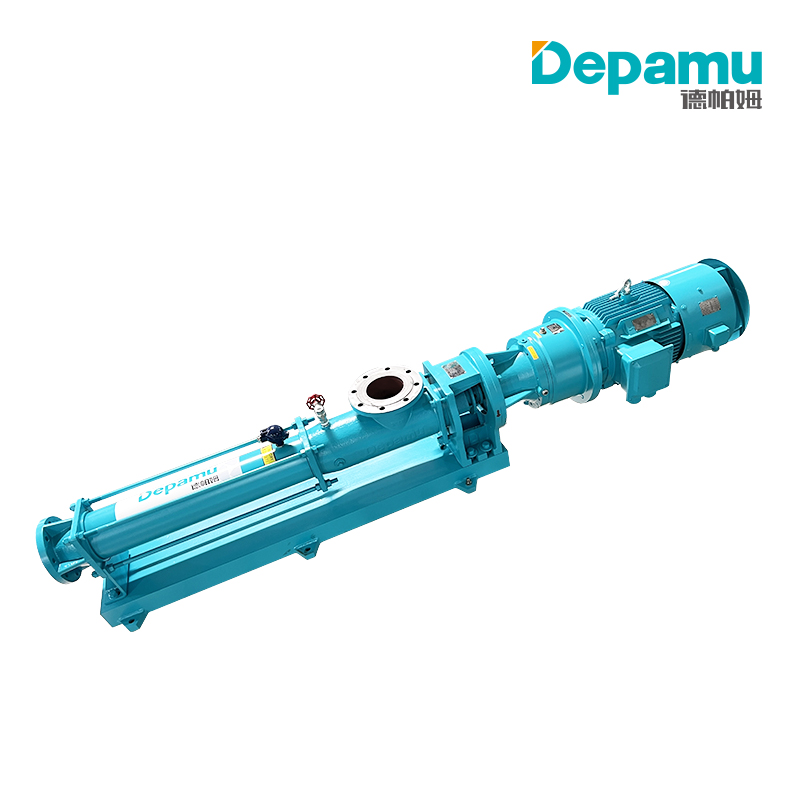
The Depamu single screw pump operates on the progressive cavity principle: a single helical metallic rotor turns eccentrically within a double-helical elastomer stator. This configuration creates a series of sealed, constant-volume cavities that progress axially from suction to discharge as the rotor rotates. The fluid within each cavity is displaced, not accelerated. There is no impeller, no high-velocity shear zone, and no valve that the medium must force open against a spring. The result is a flow that is virtually pulsation-free and directly proportional to rotational speed.
For feeding applications, this geometry yields three properties that matter more than any single performance number. First, the flow is metering-capable by nature: because each rotation of the rotor displaces a fixed cavity volume, speed regulation alone provides accurate feed-rate control, a critical requirement for blending operations, fermenter inoculation, and chemical dosing. Second, the pump is low-shear: the fluid moves within enclosed cavities without the turbulent mixing or mechanical working that degrades shear-sensitive thickeners, polymers, and biological cells. Third, the pump is self-priming with high suction capability: Depamu specifications cite suction lifts of up to 8 meters of water column, and some configurations reach 9 meters, enabling the pump to draw viscous or poorly flowing media directly from vessels, tanks, or hoppers without auxiliary feeding equipment.
The performance envelope that Depamu publishes for its single screw platform reflects the breadth of feeding duties it is intended to cover. Viscosity handling extends from 1 mPa·s to 1,000,000 mPa·s in standard specifications, with some sources citing capability up to 2,000,000 cP or even 3,000,000 mPa·s for specialized configurations. Solids content can reach 60%, and particle sizes up to 30 mm are tolerated in standard models, with larger passages available in sludge-duty variants. Flow rates span from 0.02 m³/h in laboratory or dosing-scale units to 300 m³/h in production-scale configurations, with maximum discharge pressures typically reaching 1.5 MPa in single-stage form and up to 3.0 MPa or higher in multistage arrangements. Temperature capability extends from −12°C to +150°C, accommodating both chilled and hot feeding streams. These are not merely catalogue figures; they define the operating space within which the pump can replace more complex or less reliable feeding solutions.
Feeding Applications in Practice
Food and Bioprocessing. The feeding of syrups, jams, and fermentation broths illustrates the single screw pump’s core strengths. In syrup handling, the pump must cope with viscosity that changes with temperature and composition while delivering a consistent feed to blending or crystallization stages. Depamu’s progressive cavity design maintains flow output independent of pressure within its design range, and its high suction lift allows it to draw directly from storage vessels where gravity feed is unreliable. For jams and fruit preparations, the low-shear action preserves suspended fruit pieces and texture, a quality parameter that directly affects market value. In fermentation feeding, the absence of high-shear zones protects microbial cells and mycelia, preserving yield, while the metering characteristic supports precise nutrient or inoculum delivery.
Toothpaste delivery represents a more abrasive and rheologically demanding feeding duty. Depamu has documented the application of its single screw pumps in transferring finished toothpaste from mixing vessels to filling lines, where consistent tube fill weights and preservation of yield stress are essential. The pump’s ability to handle 20–50% abrasive particle loads without excessive wear, combined with its gentle handling of shear-sensitive thickeners, has made it a recognized solution in oral care manufacturing. In these hygienic applications, Depamu offers sanitary configurations with appropriate elastomer and material selections, and modular construction that allows the wetted components to be adapted to cleaning and sterilization requirements.
Wastewater and Sludge Feeding. In municipal and industrial wastewater treatment, the reliable feeding of sludge from primary and secondary clarifiers to digesters, thickeners, and dewatering equipment is a persistent operational challenge. Sludge is abrasive, variable in consistency, and prone to clogging conventional pumps. The Depamu single screw pump’s positive displacement action handles solids up to 60% and accommodates non-compressible materials that would stall a centrifugal impeller. The ability to reduce pump speed to minimize wear on abrasive slurries is a practical maintenance advantage: lower rotational speed reduces the velocity of particles across the rotor and stator surfaces, extending component life in a duty where abrasion is continuous. The pump’s self-priming capability also simplifies suction-side piping design in sumps and wet wells, reducing installation complexity in retrofit projects.
Chemical and Polymer Feeding. The feeding of polymer flocculants and chemical additives demands both metering accuracy and low shear, because many water-soluble polymers lose effectiveness if their molecular chains are mechanically degraded during transfer. Depamu’s progressive cavity design delivers a smooth, essentially pulsation-free flow in which the polymer solution is displaced rather than violently mixed or accelerated. The linear relationship between flow rate and rotational speed provides a simple, reliable basis for dosing control, whether the pump is controlled manually or integrated into an automated chemical feed system. This combination—gentle handling plus predictable output—explains the pump’s adoption in polymer make-down and dosing packages as well as in sludge conditioning trains.
Oil, Petrochemical, and Heavy Industrial Feeding. Depamu’s single screw pumps are also deployed in crude oil and heavy oil transfer, where high viscosity and the presence of solids or sand challenge conventional transfer equipment. In surface transfer and refining contexts, the pump’s ability to handle viscous hydrocarbons without emulsification or shear-induced viscosity loss is valuable. The same platform appears in pulp and paper applications, where fibrous slurries with consistencies from 3% to 18% must be fed to screening, cleaning, and papermaking processes; the pump’s ability to convey fibrous, abrasive media without clogging is central to its suitability there. In mining and metallurgy, the pump handles drilling muds, thickener underflow, and reagent feeds where abrasion and solids settling would defeat less robust designs.
Configurations for Feeding: Matching the Pump to the Duty
Depamu’s single screw platform is not a single product but a modular family, and this modularity is particularly relevant to feeding applications where the condition of the feed material at the suction point varies widely. The standard close-coupled or bearing-housing configurations suit clean, free-flowing viscous liquids drawn from tanks with reliable suction conditions. For media that will not flow under gravity—thick pastes, settled slurries, or materials with very high viscosity—a loading hopper configuration is available, in which an auger or feed screw draws the product from a rectangular hopper into the pump’s suction chamber. This arrangement is specified for “very viscous products or products with low flowability” and allows the pump to maintain a steady feed even when the upstream supply is uneven.
Material and elastomer selection further tailors the pump to the feed medium. Stators are available in natural rubber, nitrile (NBR), EPDM, and fluorocarbon (FKM) compounds, chosen according to the chemical aggressiveness, temperature, and abrasiveness of the product. Rotors are typically chrome-plated steel or stainless steel, and hygienic or sanitary variants are offered for food, pharmaceutical, and oral care applications. The pumps can be configured for reversible operation, a useful feature for clearing lines or recovering product from transfer piping during changeovers. Modularity also extends to the drive end: a single bearing housing and shaft design can accept different rotor/stator geometries, allowing a change in feed capacity or pressure requirement to be met by changing the hydraulic components rather than replacing the entire pump.
The Feeding Advantage in Comparative Terms
The case for the Depamu single screw pump in feeding service becomes clearest when it is set against the alternatives. Against centrifugal pumps, the difference is categorical: centrifugal machines lose efficiency as viscosity rises, impart high shear, and produce a flow that falls as discharge pressure increases. Against progressive cavity pumps from other manufacturers, Depamu’s differentiation lies in its engineering heritage, modular range, and the breadth of its published performance envelope—particularly the extension to high solids content and high viscosity while retaining a compact, self-priming package. Against lobe or gear pumps, the single screw geometry offers a simpler sealing path and better tolerance of solids, because the cavities are formed by the rotor–stator interference rather than by close-running metal-to-metal clearances that can be damaged by abrasive particles.
For the process engineer designing a feeding system, the practical implication is that the Depamu single screw pump can often replace a more complex feeding arrangement—a centrifugal pump with a separate metering valve, a progressive cavity pump with an upstream pre-conditioning step, or a pneumatic transfer system with its associated air handling and filtration—with a single positive displacement machine that meters, primes, and conveys without damaging the product. The reduction in ancillary equipment and control complexity is itself a feeding reliability gain.
Conclusion
Feeding applications are defined by the difficulty of the medium and the consequences of inconsistent or damaging transfer. The Depamu single screw pump addresses both dimensions through a progressive cavity geometry that displaces fluid gently, meters it predictably, and primes itself from vessels that would starve other pump types. Its performance envelope—viscosity to the millions of centipoise, solids to 60%, flows from dosing scale to hundreds of cubic meters per hour, and temperatures from chilled to 150°C—covers a remarkable range of industrial feeding duties. The modular availability of hopper-fed configurations, hygienic constructions, and material options matched to aggressive or abrasive media means the same core technology can be adapted across food, wastewater, chemical, petroleum, and heavy industrial applications. In an operational environment where feeding failures cascade downstream and product damage cannot be recovered, the Depamu single screw pump offers a combination of robustness, gentleness, and controllability that is difficult to match with any other single machine.