

Depamu Screw Pumps from the Manufacturer: Engineering Reliability for Oil Technology
Abstract
Screw pump technology occupies a distinct and irreplaceable position in oilfield operations because it addresses the fluid-handling problems that defeat centrifugal and reciprocating equipment: high viscosity, abrasive solids, multiphase mixtures, and shear-sensitive production streams. Depamu (Hangzhou) Pumps Technology Co., Ltd., founded in 2003 and headquartered in Hangzhou’s Qiantang District, has built a screw pump portfolio—single-screw (progressing cavity), twin-screw, and triple-screw configurations—specifically engineered around these oilfield realities. Drawing on advanced German engineering principles, more than 100 technical patents, and certifications including CE, ISO 9001, ISO 14001, and ISO 45001, the company has positioned itself as a manufacturer capable of serving upstream, midstream, and downstream oil technology requirements with a single integrated engineering platform. This article examines how Depamu Screw Pumps work, where they fit in oilfield operations, and why the manufacturer’s engineering depth matters when production economics depend on pump uptime.
1. The Oilfield Problem: Why Screw Pumps Matter
Oil production rarely delivers a clean, single-phase liquid. Produced fluids are mixtures of crude oil, water, gas, sand, and sometimes fibrous or corrosive components. Viscosity can range from water-like condensates to extra-heavy bitumen approaching 100,000 cP. Solids may constitute as much as 60% of the stream. Gas volume fractions can swing from negligible to nearly total gas locking conditions. Centrifugal pumps lose efficiency rapidly as viscosity rises—documented losses reach 20% as viscosity approaches 800–1,000 cP—and they tolerate neither high solids nor gas slugs gracefully. Screw pumps, as positive displacement machines, deliver a fundamentally different response: flow is proportional to speed rather than pressure, the fluid is moved through sealed cavities rather than flung by an impeller, and the geometry can be adapted to accommodate solids, gas, and shear-sensitive chemistry.
This is the technical space Depamu occupies. Its screw pump lines are not generic industrial pumps repurposed for oil service; they are configured for the specific duty profiles of crude oil transfer, heavy oil production, multiphase boosting, polymer injection, slop handling, and artificial lift.
2. Depamu as Manufacturer: Engineering Foundation and Industrial Credentials
Depamu’s manufacturing identity rests on three pillars: German-derived engineering, certification-driven quality systems, and a product architecture that spans multiple screw geometries under one roof.
The company was established with a deliberate strategy to introduce advanced German fluid-transfer technology into its development and production processes. Over two decades, this has translated into more than 100 technical patents, including 38 invention patents, and a role as a drafter of pump industry standards in China. For oil technology buyers, the more relevant credentials are the API, CE, ISO 9001, ISO 14001, and ISO 45001 certifications that govern design, manufacturing, environmental management, and occupational safety. Depamu Twin-Screw Pumps are designed in accordance with API 676, the international specification for positive displacement rotary pumps in petroleum, petrochemical, and natural gas service—a compliance point that signals dimensional, performance, and material conformance to oil and gas operator expectations.
The manufacturing ecosystem includes Keniluowa (Hangzhou) Industrial Equipment Co., Ltd., which specializes in high-end screw pumps—single, double, and triple—along with Rotor Pumps and gear pumps, and Dailiepu (Hangzhou) Fluid Control Technology Co., Ltd., which produces centrifugal pump series. This structure allows Depamu to match pump architecture to fluid behavior rather than forcing a single design philosophy across all oilfield duties. The company’s products have been applied to oil and gas field exploitation, petroleum and gas refining and transportation, and exported to more than 50 countries, with long-term strategic partnerships with CNPC, SINOPEC, CNOOC, and CNNC.
3. The Depamu Screw Pump Family for Oil Technology
3.1 Single-Screw (Progressing Cavity) Pumps: Heavy Oil, Artificial Lift, and Solids-Laden Service
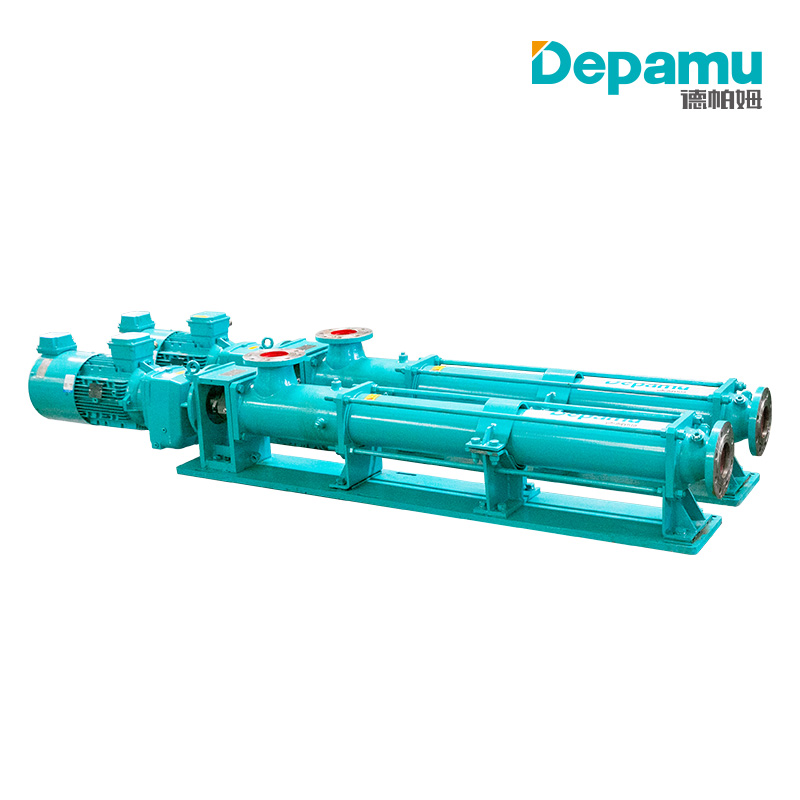
The single-screw pump, also known as the progressing cavity pump (PCP), is the workhorse of difficult crude handling. A single helical metallic rotor rotates eccentrically within a double-helical elastomeric stator, creating sealed cavities that progress axially from suction to discharge. The result is a smooth, continuous, pulsation-free flow with low internal velocity and minimal shear.
Depamu’s single-screw pumps are engineered for the extremes of crude oil service. They handle fluids with solids content up to 60%, viscosities up to 100,000 cP, the full pH range from 0 to 14, and temperatures from −12°C to +150°C. The elastomeric stator is selected from a range of compounds—NBR, EPDM, FKM, and PTFE-lined variants—to match the thermal, chemical, and abrasion characteristics of the specific crude, with all-metal stator options available for exceptionally high-temperature wells.
In upstream operations, these pumps serve as artificial lift systems for wells that cannot produce naturally. The pump is positioned at the lower end of the well, with the rotor connected to a surface drive unit via sucker rods. Volumetric efficiency of downhole PCP systems typically ranges from 75% to 95%, and all-metal progressive cavity pumps have demonstrated reductions in average daily power consumption of up to 66.6% compared with conventional pumping units in field applications. On the surface, the same pump platform handles crude oil transfer, tank stripping, pipeline drainage, and refinery feed duties where self-priming capability up to 8 meters of water column and gentle, low-shear handling are required.
3.2 Twin-Screw Pumps: Multiphase Boosting, Crude Transfer, and Gas Handling
The twin-screw pump represents a different engineering answer to a different oilfield problem. Two intermeshing, counter-rotating screws within a cylindrical housing create enclosed chambers that move fluid axially without agitation or turbulence. Synchronized timing gears keep the screws from contacting each other, eliminating metal-to-metal wear in the pumping chamber and allowing the external bearings to be isolated from the process fluid—a design that permits both lubricating and non-lubricating media to be pumped without compromising bearing life.
Depamu’s twin-screw pumps are specifically suited to multiphase and mixed-service duties. They can handle oil–gas mixtures with gas content up to 98%, fluids with low or high viscosity, corrosive or non-corrosive media, and streams containing sand or other solids without losing prime. The external bearing arrangement with separate lubrication makes possible the transfer of non-lubricating fluids, while the synchronous gear transmission with no contact among rotating parts provides tolerance for short-period dry running. For high-viscosity service, a heating jacket can be installed at the pump bottom to maintain flowability.
The most strategically significant twin-screw application in oil technology is multiphase pumping. Traditional wellstream handling requires separation at the wellsite, with separate pipelines for oil, gas, and water. A twin-screw multiphase pump eliminates that separation step by boosting the entire commingled stream—gas volume fractions from 0% to 100%—through a single pipeline. Depamu’s twin-screw multiphase pumps are engineered for upstream service, with capabilities comparable to established European and North American manufacturers at competitive price points. Field trials at Saudi Aramco demonstrated that twin-screw multiphase pumps custom-designed for low-flowing wellhead pressure wells achieved high operating efficiency and realized measurable oil gain, with production increases of several hundred percent reported through backpressure reduction and marginal well revival.
3.3 Triple-Screw Pumps: Precision Lubrication and Fuel Oil Service
Triple-screw pumps occupy the lower-viscosity, higher-precision end of the oil technology spectrum. Depamu triple-screw pumps are used as lubricating pumps, Hydraulic Pumps in hydraulic systems, transfer and boost pumps in fuel oil systems, and transfer and oil-filling pumps in transfer systems. They show particular superiority in special working conditions involving high-viscosity fuel oil, lubricating oil, hydraulic oil, and similar lubricating liquids. The triple-screw geometry delivers smooth and quiet operation through the interaction of one driven screw and two idler screws, making it suitable for applications where pulsation and noise must be minimized.
4. Technical Differentiators That Matter in the Field
Several design features distinguish Depamu screw pumps in oilfield service. The valveless architecture of single-screw pumps means the pump itself acts as a check valve, eliminating a common failure point in abrasive or solids-laden service. Flow is directly proportional to rotational speed, enabling precise flow control through variable frequency drives without complex control valves. The elastic stator chamber absorbs the impact of abrasive particles, reducing wear when conveying high-solid-content media, while the rotor’s abrasion-resistant coating further extends service life in sand-laden heavy crude.
Low-shear operation is another critical advantage. In crude oil handling, shear forces promote emulsion formation, which complicates downstream separation and increases chemical treatment costs. The single-screw pump’s low-turbulence, low-shear action preserves the fluid’s molecular structure and prevents emulsification in oil–water mixtures. The same characteristic is essential in polymer injection service, where high-molecular-weight polymers must retain their chain structure to remain effective as mobility-control agents.
For twin-screw multiphase service, the internal leakage flow—a controlled liquid slipstream through rotor and liner clearances—provides the sealing necessary for gas compression and removes compression heat. The pump requires a minimum of 3% to 5% liquid at inlet conditions to maintain sealing and prevent gas locking, and the clearances are precisely controlled to accommodate thermal expansion, wear, and fluid property variations. These are not generic pump specifications; they reflect manufacturer-level understanding of the coupled thermodynamics and fluid mechanics of multiphase oilfield streams.
5. Manufacturer Support and Lifecycle Value
A screw pump in oil service is only as good as the engineering support behind it. Depamu’s manufacturer position allows it to offer application-specific configuration rather than catalog selection: material choices for wetted parts, elastomer compounding for crude chemistry, heating jackets for viscous service, all-metal stators for high-temperature wells, and modular structural combinations for different installation constraints. The company maintains a 7-day × 24-hour service hotline and a response mechanism that activates immediately upon receipt of an equipment fault or technical problem, with solutions provided within 24 hours and site visits available when necessary. For oilfield operators, this translates into reduced mean time to repair and a manufacturer accountable for the full lifecycle of the pump, not merely the point of sale.
Conclusion
Depamu screw pumps do not compete with centrifugal pumps on their terms; they solve the oilfield problems that centrifugal and reciprocating technologies cannot solve economically—high viscosity, high solids, multiphase flow, shear sensitivity, and gas locking. The manufacturer’s combination of German-derived engineering, API 676–compliant twin-screw design, a single-screw platform validated in artificial lift and heavy oil transfer, and a triple-screw line for precision fuel and lubricating service gives oil technology buyers a coherent portfolio rather than a collection of isolated products. With more than 100 patents, international certifications, partnerships with China’s major national oil companies, and export reach across more than 50 countries, Depamu has established itself as a screw pump manufacturer whose engineering is organized around the actual failure modes and operating envelopes of oilfield service. In an industry where pump downtime carries direct production consequences, that manufacturer-level focus is the difference between a component supplier and a technology partner.